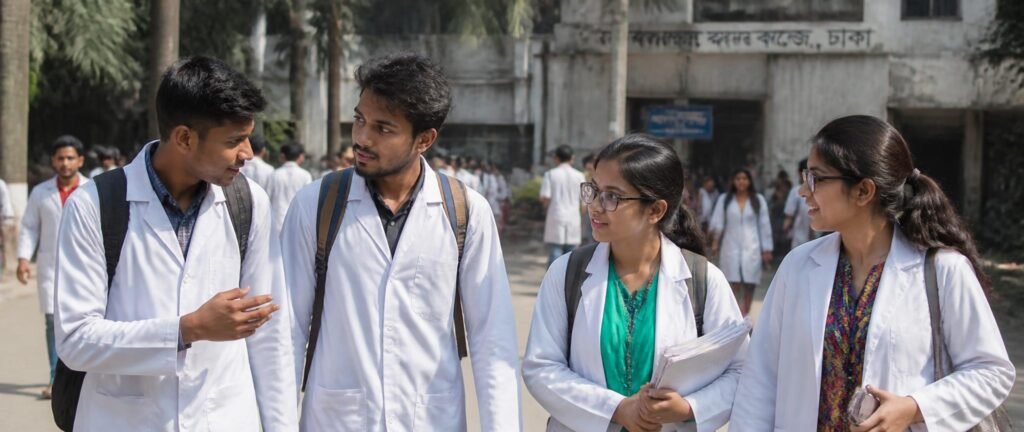
Bangladesh offers Indian students something rare: MBBS on nearly free tuition through a government scheme built for the region. MBBS in Bangladesh 2026 pairs an India-identical curriculum with the SAARC quota — but that quota is fiercely competitive, and missing its narrow application window catches most students out.
This guide covers the cost, the SAARC scheme, the approved colleges, and the eligibility rules. If you are still comparing destinations, our low-score options guide maps the full field, while the FMGE and NExT route explains the exam you must clear to practise in India.
Table of Contents
Why MBBS in Bangladesh 2026 Appeals to Indian Students
Bangladesh’s pull is a mix of familiarity, quality, and cost:
- A curriculum almost identical to India’s — the syllabus, disease profile, and clinical training closely mirror the Indian MBBS, which builds strong screening-test readiness.
- Cultural comfort — food, language, and lifestyle are close to home, and Indian festivals are widely celebrated on campus.
- English-medium teaching — all courses are taught in English, with busy teaching hospitals for early clinical exposure.
- Affordable, with a unique subsidy — private colleges are reasonably priced, and the SAARC scheme makes government seats extraordinarily cheap.
Like the Nepal route, Bangladesh wins on proximity and FMGE alignment, but its government-college subsidy is something Nepal cannot match.
The SAARC Quota: Free Tuition in Government Colleges
This is Bangladesh’s defining advantage. Under the SAARC quota, the Government of Bangladesh reserves subsidised seats in its government medical colleges for students from South Asian countries, including India — and tuition on these seats is effectively free, leaving you to cover only living costs.
There is a catch, though: these seats are merit-based and intensely competitive, with very limited numbers. Indian students apply through the DGME as soon as their NEET result is out, running it in parallel with domestic counselling rather than waiting for it to finish. Miss that window and the quota closes. Because government seats are so scarce, always keep a private college as a backup route rather than betting everything on the government quota.
MBBS Bangladesh Eligibility for Indian Students
The eligibility rules combine NMC’s guidelines with Bangladesh’s own requirements. You must:
- Qualify NEET UG — a valid NEET qualification is mandatory, with 50th percentile for general and 40th for reserved categories.
- Meet the academic bar — Class 12 with Physics, Chemistry, Biology, and English, scoring at least 50% (40% for reserved categories).
- Be at least 17 years old by 31 December of the admission year.
- Choose a BMDC-recognised, NMC-approved college — the choice that decides whether your degree counts at home.
Note that Bangladesh, unlike Nepal, requires a student visa, processed at the Bangladesh High Commission over roughly four to six weeks, so factor that time into your plan.
MBBS in Bangladesh Fees: SAARC vs Private
Cost depends entirely on which route you take for MBBS in Bangladesh 2026. Under the SAARC quota, government-college tuition is effectively free and you pay only living expenses; on the private route, the MBBS Bangladesh fees run to a full package that still sits below the private college fees in India and close to the Kazakhstan route, with an education loan for MBBS available against NMC-approved programmes.
| Route | Approximate Cost |
|---|---|
| SAARC scheme (government college) | Free tuition; living ~₹3,000–5,500/month |
| Private college (full package) | ₹27 – 45 lakh total |
| Living expenses (private route) | ₹3,000 – 5,500/month |
Even the private package saves substantially against Indian private-college costs, which can cross ₹1 crore.
Top NMC Approved Colleges in Bangladesh
Bangladesh has around a hundred medical colleges, with a share of seats reserved for international students, but outcomes differ, so stick to well-regarded NMC approved colleges. Established names Indian students choose include:
- Dhaka National Medical College
- Bangladesh Medical College
- Community Based Medical College
- Khwaja Yunus Ali Medical College
- Sylhet Women’s Medical College
Always confirm a college’s live NMC status on nmc.org.in, its BMDC recognition, and its WDOMS listing before paying, and take the full fee structure and offer letter in writing.
FMGE and the Licensing Route
Bangladesh graduates have historically cleared the FMGE above the national average, helped by a curriculum and disease pattern that match India’s closely — but the FMGE pass rate swings widely by college, so choose on verified results rather than reputation alone.
The licensing rule is the standard one: to practise in India you must clear the FMGE, with the National Exit Test set to replace it for foreign graduates only once NMC confirms a date. After graduating and clearing the exam, you complete a one-year internship in India before registration.
Things to Check Before You Apply
A little diligence here prevents an expensive mistake:
- Apply to DGME early for the SAARC seats, in parallel with domestic counselling, not after it.
- Confirm NMC and BMDC recognition in writing before any payment.
- Keep a private college as backup, since SAARC government seats are scarce and competitive.
- Check the FMGE record of your specific college, not just the country average.
Final Word
MBBS in Bangladesh 2026 is a genuinely strong option for a NEET-qualified student who wants an India-like education close to home — and for the fortunate few who secure a SAARC government seat, it is one of the cheapest legitimate routes to a medical degree anywhere. Even the private route stays affordable against Indian private fees.
Apply early for the quota, keep a private backup, confirm recognition in writing, and treat FMGE preparation as part of the plan from day one. Play both routes wisely, and Bangladesh can turn a missed Indian seat into a familiar, affordable path to becoming a doctor.
❓ FAQ Section
Q: Is NEET mandatory for MBBS in Bangladesh 2026? A: Yes. A valid NEET UG qualification is mandatory for any Indian student who wants to study MBBS in Bangladesh and practise in India later, whether through the SAARC quota or the private route. Without it, the degree cannot be used for Indian licensing.
Q: What is the SAARC quota for MBBS in Bangladesh? A: The SAARC quota is a special scheme under which the Government of Bangladesh reserves subsidised government-college seats for students from South Asian countries, including India. Tuition on these seats is effectively free, but they are merit-based and highly competitive.
Q: How much does MBBS in Bangladesh cost? A: Under the SAARC quota, government-college tuition is effectively free and you pay only living costs of around ₹3,000–5,500 per month. On the private route, the total package typically runs from ₹27 lakh to ₹45 lakh depending on the college.
Q: How do I apply for the SAARC quota? A: Indian students apply through the DGME as soon as their NEET result is out, running it in parallel with domestic counselling. The application window is narrow, so waiting until domestic counselling ends often means missing the quota entirely.
Q: Is a Bangladesh MBBS degree valid in India? A: Yes, provided the college is BMDC-recognised, NMC-approved, and listed in the World Directory of Medical Schools. You must also have qualified NEET and clear the FMGE or NExT exam, then complete a one-year internship in India.
Q: Do I need a visa to study MBBS in Bangladesh? A: Yes. Unlike Nepal, Bangladesh requires a student visa, processed at the Bangladesh High Commission over roughly four to six weeks. Factor this processing time into your admission and travel plan.
[…] MBBS in Bangladesh 2026 — Affordable MBBS with no entrance exam hassles and NMC-approved colleges close to home. […]