
Quick answer: A ray optics NEET PYQ analysis shows that Ray Optics and Optical Instruments gives about two to three questions a year, with nearly 90 past questions in total. NTA keeps returning to five areas: lenses (lens maker’s formula, combinations, power), the prism and angle of minimum deviation, total internal reflection, refraction at plane surfaces (apparent depth), and optical instruments (compound microscope and astronomical telescope). The 2026 papers alone asked five questions from these areas.
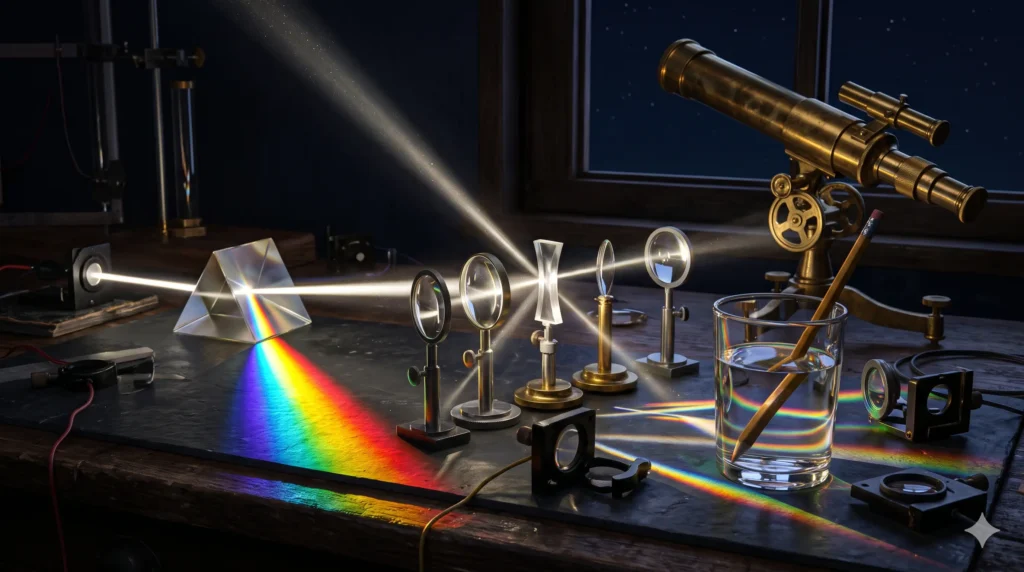
This guide breaks down what NTA repeats, the formulas you must know and solved PYQ-pattern numericals. Before you start, get the bigger picture from our complete NEET Physics strategy, and follow official exam news on our NEET 2027 latest updates page.
Want to test yourself first? Solve the Ray Optics PYQs for free, then use this guide to fix the gaps.
Table of Contents
Why Ray Optics Deserves Extra Time
Ray optics questions are mostly one-step numericals with a handful of formulas, and many are rated easy. Get the sign convention right and the chapter becomes reliable marks. For chapter notes, use our Ray Optics class 12 notes, and for a quick warm-up, try these five quick optics questions.
Light as a wave belongs to our Electromagnetic Waves PYQ analysis. If you are planning your year, our guide to the NEET 2027 registration date explains when the form is expected.
Ray Optics NEET PYQ Analysis: What NTA Repeats
When you sort the past NEET physics PYQs from this chapter, five question types cover nearly everything.
| Question type | Frequency | What it tests |
|---|---|---|
| Lenses | Most frequent | Lens formula, lens maker’s formula, combination of lenses, power, lens in a liquid |
| Prism | Very frequent | Angle of minimum deviation, thin prism, dispersion |
| Total internal reflection | Very frequent | Critical angle, conditions, applications |
| Refraction at plane surfaces | Regular | Apparent depth, normal shift |
| Optical instruments | Regular | Simple and compound microscope, astronomical telescope |
Reflection: Spherical Mirrors
- Mirror formula: 1/v + 1/u = 1/f, with f = R/2.
- Magnification: m = −v/u. A negative m means an inverted, real image.
- Use the New Cartesian sign convention: distances measured against the incident light are negative.
Refraction and Apparent Depth
- Refractive index: n = c/v.
- Snell’s law: n₁ sin i = n₂ sin r.
- Apparent depth = real depth/n, so an object under water looks raised.
- Normal shift = d(1 − 1/n).
Total Internal Reflection
Total internal reflection happens when light goes from a denser to a rarer medium at an angle greater than the critical angle C, where:
sin C = 1/n
- Red light has a slightly larger critical angle than violet light, because n is smaller for longer wavelengths.
- Applications: optical fibres, the sparkle of diamonds, mirages and totally reflecting prisms.
TIR was asked in 2022 and twice in 2023.
Refraction at a Spherical Surface and the Lens Maker’s Formula
- Single spherical surface: n₂/v − n₁/u = (n₂ − n₁)/R
- Lens maker’s formula: 1/f = (n − 1)(1/R₁ − 1/R₂)
- Lens in a liquid of refractive index nₗ: 1/f’ = (n/nₗ − 1)(1/R₁ − 1/R₂). If nₗ = n, the lens seems to disappear; if nₗ > n, a convex lens behaves like a diverging lens.
Thin Lenses and Their Combinations
| Relation | Formula |
|---|---|
| Lens formula | 1/v − 1/u = 1/f |
| Magnification | m = v/u |
| Power | P = 1/f (f in metres), measured in dioptres (D) |
| Lenses in contact | 1/F = 1/f₁ + 1/f₂, or P = P₁ + P₂ |
A convex lens forms a real image of the same size when the object is at 2F (u = −2f), so the image is also at 2F.
The combination of lenses was asked in 2023, 2025 and the 2026 Re-NEET, almost always using P = P₁ + P₂.
The Prism
| Relation | Formula |
|---|---|
| Angle of the prism | r₁ + r₂ = A |
| Deviation | δ = i + e − A |
| At minimum deviation | i = e, r₁ = r₂ = A/2 |
| Refractive index | n = sin[(A + δm)/2] / sin(A/2) |
| Thin prism | δ = (n − 1)A |
In dispersion, violet light deviates the most and red the least, because n is largest for violet.
The angle of minimum deviation was asked in 2024 and 2026.
Optical Instruments
| Instrument | Magnifying power | Notes |
|---|---|---|
| Simple microscope | m = 1 + D/f (image at the near point, D = 25 cm) | A single convex lens |
| Compound microscope | m ≈ (L/fo)(D/fe) in normal adjustment | Objective and eyepiece both have short focal lengths |
| Astronomical telescope | m = fo/fe in normal adjustment; tube length L = fo + fe | Objective has a long focal length and large aperture; eyepiece has a short focal length |
The astronomical telescope was asked in 2022 and 2024, and the compound microscope in 2025.
Worked PYQ-Pattern Questions
Q1. The refractive index of a medium is √2. Its critical angle is: (a) 30° (b) 45° (c) 60° (d) 90°
Answer: (b) 45°, since sin C = 1/√2.
Q2. A convex lens of focal length 10 cm is placed in contact with a concave lens of focal length 20 cm. Find the power and focal length of the combination.
P = 1/0.10 − 1/0.20 = 10 − 5 = 5 D, so F = 1/5 m.
Answer: 5 D, focal length 20 cm (converging).
Q3. A biconvex lens has n = 1.5 and radii of curvature 20 cm each. Find its focal length.
1/f = (1.5 − 1)(1/20 + 1/20) = 0.5 × 0.1 = 0.05.
Answer: 20 cm.
Q4. A prism of angle 60° gives a minimum deviation of 30°. Find its refractive index.
n = sin(45°)/sin(30°) = (1/√2)/(1/2).
Answer: √2, about 1.41.
Q5. An astronomical telescope has fo = 100 cm and fe = 5 cm. Find its magnifying power and length in normal adjustment.
m = fo/fe = 100/5, and L = fo + fe.
Answer: Magnifying power 20; length 105 cm.
Q6. A coin lies at the bottom of a tank of water 12 cm deep (n = 4/3). How deep does it appear?
Apparent depth = 12/(4/3).
Answer: 9 cm.
Common Traps in This Chapter
- Using the mirror formula (1/v + 1/u) for lenses (lenses use 1/v − 1/u)
- Adding focal lengths instead of powers for lenses in contact
- Forgetting to convert focal length to metres when finding power
- Saying red light deviates most in a prism (violet deviates most)
- Writing L = fo − fe for a telescope in normal adjustment (it is fo + fe)
- Saying TIR can happen when light goes from a rarer to a denser medium
Practise Every Ray Optics PYQ
This ray optics NEET PYQ analysis shows you where the marks are. Solving real past questions makes the sign convention and formulas automatic. Every Ray Optics and Optical Instruments previous year question is available chapter-wise, free:
👉 Solve all Ray Optics NEET PYQs
Keep the lens, prism and instrument tables beside you for the first round, then solve the second round without them.
Conclusion
Ray Optics rewards careful use of a few formulas and the sign convention. Use this ray optics NEET PYQ analysis to master lenses and their combinations, the prism, total internal reflection, apparent depth and optical instruments. Then solve the past numericals until each one takes under a minute.
FAQ
Q: How many questions come from Ray Optics in NEET? A: Usually two to three questions a year from Ray Optics and Optical Instruments.
Q: What is the most important topic in Ray Optics for NEET? A: Lenses, especially the lens maker’s formula and combinations of lenses, followed by the prism and total internal reflection.
Q: What is the formula for the critical angle? A: sin C = 1/n, where n is the refractive index of the denser medium with respect to the rarer one.
Q: How do you find the power of lenses in contact? A: Add their powers: P = P₁ + P₂. Power in dioptres is 1/f with f in metres.
Q: What is the magnifying power of an astronomical telescope? A: In normal adjustment, m = fo/fe, and the tube length is fo + fe.
Q: Where can I practise Ray Optics NEET PYQs for free? A: You can solve every Ray Optics previous year question chapter-wise for free using the practice links in this article.
Related posts:
 Alternating Current NEET PYQ Analysis: LCR Circuits, Resonance and Transformers
 Electromagnetic Waves NEET PYQ Analysis: Spectrum, Displacement Current and Wave Properties
 Current Electricity NEET PYQ Analysis: Wheatstone Bridge, Cells and Resistance
 Magnetism NEET PYQ Analysis: Moving Charges and Magnetic Field