
Quick answer: A sexual reproduction in flowering plants NEET PYQ analysis shows that this is one of the highest-scoring Botany chapters, with about three to four questions a year. NTA keeps returning to five areas: pollination (types, agents and adaptations), the anther wall and pollen grain (tapetum, sporopollenin), the ovule and embryo sac (megasporogenesis, synergids, filiform apparatus), double fertilisation with endosperm ploidy, and seeds and fruits (albuminous vs non-albuminous seeds, perisperm, apomixis). The 2026 papers alone asked eight questions from these areas.
This guide breaks down what NTA repeats, the tables to memorise and PYQ-pattern questions with answers. For the full Botany plan, see our complete NEET Botany guide.
Want to test yourself first? Solve the Sexual Reproduction in Flowering Plants PYQs for free, then use this guide to fix the gaps.
Table of Contents
Why This Chapter Deserves Extra Time
With more than 120 past questions, this chapter has one of the largest PYQ banks in NEET Biology, and its questions come straight from NCERT examples: Vallisneria, Ophrys, coconut water, black pepper. To see where it sits among other chapters, check the NEET 2027 chapter weightage.
Flower structure comes from our Morphology PYQ analysis, and the animal side of the unit is in our Human Reproduction PYQ analysis. Many questions use diagrams of the anther, ovule and embryo sac, so our NCERT biology diagrams guide is useful too.
Sexual Reproduction in Flowering Plants NEET PYQ Analysis: What NTA Repeats
When you sort the past NEET biology PYQs from this chapter, five question types cover nearly everything.
| Question type | Frequency | What it tests |
|---|---|---|
| Pollination | Most frequent | Autogamy, geitonogamy, xenogamy; wind, water and insect pollination; outbreeding devices |
| Anther and pollen | Very frequent | Microsporangium wall, tapetum, microsporogenesis, exine and intine, pollen viability |
| Ovule and embryo sac | Very frequent | Parts of the ovule, megasporogenesis, 7-celled embryo sac, synergids |
| Double fertilisation | Very frequent | Syngamy, triple fusion, ploidy of endosperm and zygote |
| Seeds, fruits and apomixis | Regular | Albuminous seeds, perisperm, scutellum, false fruits, polyembryony |
The Anther and Pollen Grain
| Structure | Key facts |
|---|---|
| Anther | Bilobed, dithecous, with four microsporangia (tetrasporangiate) |
| Microsporangium wall | Four layers: epidermis, endothecium, middle layers, tapetum |
| Tapetum | Innermost layer; nourishes the developing pollen; cells have dense cytoplasm and often more than one nucleus |
| Microsporogenesis | Microspore mother cells divide by meiosis to form microspore tetrads |
| Exine | Made of sporopollenin, the most resistant organic material known; withstands high temperature, strong acids and alkalis; no enzyme can degrade it |
| Germ pores | Gaps in the exine where sporopollenin is absent |
| Intine | Thin inner wall of cellulose and pectin |
| Mature pollen | A large vegetative cell and a small, spindle-shaped generative cell; in over 60% of angiosperms, pollen is shed at this 2-celled stage |
Pollen viability: rice and wheat pollen lose viability within about 30 minutes, while some members of Rosaceae, Leguminosae and Solanaceae stay viable for months. Pollen can be stored for years in liquid nitrogen at −196 °C. Pollen of Parthenium (carrot grass) causes allergies.
The Ovule and Embryo Sac
Parts of the ovule: funicle (stalk), hilum (junction with the funicle), integuments, micropyle, chalaza and nucellus.
Megasporogenesis: a megaspore mother cell (MMC) in the micropylar region of the nucellus divides by meiosis to form four megaspores. In most flowering plants, one megaspore is functional and three degenerate; this is monosporic development.
The functional megaspore nucleus divides mitotically three times, forming an 8-nucleate, 7-celled embryo sac:
| Position | Cells |
|---|---|
| Micropylar end (egg apparatus) | Two synergids and one egg cell |
| Chalazal end | Three antipodal cells |
| Centre | One large central cell with two polar nuclei |
The synergids carry the filiform apparatus, special cellular thickenings at the micropylar tip that guide the pollen tube into the synergid. The embryo sac structure was asked in 2025 and in the 2026 Re-NEET.
Pollination: Types and Agents
| Type | Pollen comes from | Genetic effect |
|---|---|---|
| Autogamy | The same flower | Self-pollination |
| Geitonogamy | Another flower on the same plant | Functionally cross-pollination, but genetically like autogamy |
| Xenogamy | A flower on a different plant | Brings genetically different pollen |
- Chasmogamous flowers have exposed anthers and stigma. Cleistogamous flowers never open, so they are invariably autogamous and give assured seed set. Viola (common pansy), Oxalis and Commelina produce both kinds.
| Agent | Adaptations and NCERT examples |
|---|---|
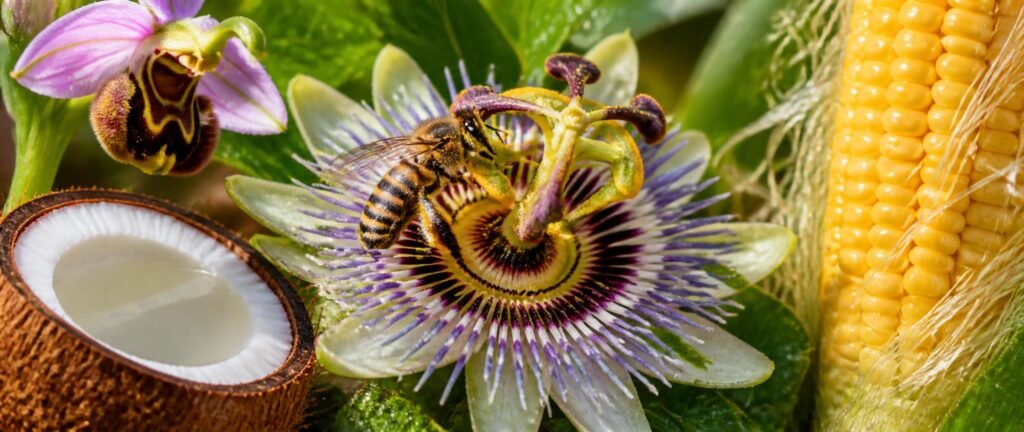
| Wind (anemophily) | Light, non-sticky pollen; well-exposed stamens; large, often feathery stigma; usually one ovule per ovary; many flowers in an inflorescence. Example: corn cob, where the tassels are the stigma and style |
| Water (hydrophily) | Only about 30 genera, mostly monocots. Vallisneria releases pollen onto the water surface; in Zostera (sea grass), long ribbon-like pollen is carried inside the water; pollen of water-pollinated plants has a mucilaginous covering. Water hyacinth and water lily, though aquatic, are pollinated by insects or wind |
| Insects (entomophily) | Large, colourful, fragrant, nectar-rich flowers; bees are the main pollinators. Amorphophallus has a flower about 6 feet tall. In Yucca, a moth and the plant depend on each other, because the moth lays eggs in the ovary’s locule |
Pollination by deceit: a petal of the orchid Ophrys looks like a female bee. Male bees try to mate with it (pseudocopulation) and carry pollen to the next flower. This was asked in 2026.
Outbreeding Devices
| Device | How it prevents self-pollination |
|---|---|
| Timing | Pollen is released before or after the stigma is receptive |
| Position | Anther and stigma are placed apart |
| Self-incompatibility | A genetic mechanism stops self-pollen from germinating or growing |
| Unisexual flowers, monoecious (castor, maize) | Prevents autogamy, but not geitonogamy |
| Unisexual flowers, dioecious (papaya) | Prevents both autogamy and geitonogamy |
In artificial hybridisation, breeders remove the anthers from a bisexual flower bud before they dehisce (emasculation) and cover it with a butter-paper bag (bagging) to keep out unwanted pollen.
Double Fertilisation
The pollen tube enters the ovule through the micropyle and one synergid through the filiform apparatus, then releases two male gametes.
| Event | Fusion | Product | Ploidy |
|---|---|---|---|
| Syngamy | One male gamete + egg | Zygote | 2n |
| Triple fusion | Other male gamete + two polar nuclei | Primary endosperm nucleus (PEN) | 3n |
Because both fusions happen in the same embryo sac, this is called double fertilisation, and it is unique to flowering plants. Ploidy questions are common:
| Structure | Ploidy |
|---|---|
| Microspore, pollen, megaspore, egg, synergids, antipodals | n |
| Zygote, nucellus, integuments, perisperm | 2n |
| Endosperm (PEN) | 3n |
Endosperm, Embryo and Seed
- Endosperm develops before the embryo. The commonest type is free-nuclear endosperm: in a coconut, the water is free-nuclear endosperm with thousands of nuclei, and the white kernel is cellular endosperm.
- Non-albuminous (exalbuminous) seeds have no endosperm left when mature, because the embryo uses it all: pea, groundnut and beans.
- Albuminous seeds keep part of the endosperm: wheat, maize, barley, castor and coconut.
- Perisperm, a persistent remnant of the nucellus, is found in black pepper and beet.
- A monocot embryo has one cotyledon called the scutellum. Its radicle and root cap are covered by the coleorhiza, and its plumule by the coleoptile.
- The seed coat has an outer testa and inner tegmen; the micropyle remains as a small pore.
Fruits, Seed Viability and Apomixis
- The ovary becomes the fruit, the ovules become seeds, and the ovary wall becomes the pericarp.
- False fruits develop partly from the thalamus: apple, strawberry and cashew. Parthenocarpic fruits, such as banana, develop without fertilisation.
- Seeds of Lupinus arcticus about 10,000 years old germinated, and a date palm seed (Phoenix dactylifera) about 2000 years old was germinated from King Herod’s palace near the Dead Sea.
- Apomixis is the formation of seeds without fertilisation, seen in Asteraceae and grasses. If hybrids could be made apomictic, farmers could keep using hybrid seed year after year.
- Polyembryony (more than one embryo in a seed) is seen in Citrus and mango, where nucellar cells develop into embryos.
Worked PYQ-Pattern Questions
Q1. The innermost wall layer of the microsporangium, which nourishes the developing pollen, is the: (a) Endothecium (b) Middle layer (c) Tapetum (d) Epidermis
Answer: (c) Tapetum.
Q2. A typical angiosperm embryo sac at maturity is:
Answer: 8-nucleate and 7-celled: three antipodals, two synergids, one egg and one central cell with two polar nuclei.
Q3. The filiform apparatus is found in the: (a) Egg cell (b) Antipodals (c) Synergids (d) Central cell
Answer: (c) Synergids. It guides the pollen tube.
Q4. The ploidy of the primary endosperm nucleus is:
Answer: 3n, from the fusion of one male gamete with two polar nuclei.
Q5. Geitonogamy is:
Answer: Transfer of pollen to another flower on the same plant. It is functionally cross-pollination but genetically similar to autogamy.
Q6. Perisperm is found in: (a) Wheat (b) Black pepper and beet (c) Pea (d) Groundnut
Answer: (b) Black pepper and beet.
Common Traps in This Chapter
- Calling geitonogamy genetically the same as xenogamy
- Saying monoecious plants prevent geitonogamy (only dioecious plants do)
- Writing 8-celled instead of 7-celled for the embryo sac
- Writing 2n for endosperm (it is 3n)
- Calling groundnut or pea albuminous (they are non-albuminous)
- Saying all aquatic plants are water-pollinated (water hyacinth and water lily are not)
Practise Every Sexual Reproduction in Flowering Plants PYQ
This sexual reproduction in flowering plants NEET PYQ analysis shows you where the marks are. Solving real past questions makes the examples automatic. Every previous year question from this chapter is available chapter-wise, free:
👉 Solve all Sexual Reproduction in Flowering Plants NEET PYQs
Keep the pollination, embryo sac and ploidy tables beside you for the first round, then solve the second round without them.
Conclusion
Sexual Reproduction in Flowering Plants is one of the most rewarding Botany chapters in NEET. Use this sexual reproduction in flowering plants NEET PYQ analysis to master pollination, the anther and pollen, the embryo sac, double fertilisation and seeds. Then practise the past questions until each example comes without thinking.
❓ FAQ
Q: How many questions come from Sexual Reproduction in Flowering Plants in NEET? A: Usually three to four questions a year, making it one of the highest-scoring Botany chapters.
Q: What is the most important topic in this chapter for NEET? A: Pollination is the most tested, followed by the embryo sac, double fertilisation and the anther wall.
Q: What is double fertilisation? A: One male gamete fuses with the egg to form the 2n zygote (syngamy), and the other fuses with the two polar nuclei to form the 3n primary endosperm nucleus (triple fusion).
Q: What is sporopollenin? A: The material of the pollen exine. It is the most resistant organic material known and is not broken down by any enzyme.
Q: Which seeds are non-albuminous? A: Pea, groundnut and beans, where the embryo uses up all the endosperm before the seed matures.
Q: Where can I practise Sexual Reproduction in Flowering Plants NEET PYQs for free? A: You can solve every previous year question from this chapter chapter-wise for free using the practice links in this article.
Related posts:
 Human Reproduction NEET PYQ Analysis: Gametogenesis, Menstrual Cycle and Pregnancy
 Evolution NEET PYQ Analysis: Human Evolution, Hardy-Weinberg and Evidences
 Animal Kingdom NEET PYQ Analysis: Examples NTA Asks Again and Again
 Breathing and Exchange of Gases NEET PYQ Analysis: Volumes, Transport and Regulation