
Quick answer: An anatomy of flowering plants NEET PYQ analysis shows that NTA asks about two questions a year from this chapter, and most come from four areas: secondary growth (vascular cambium, annual rings, heartwood, periderm and lenticels), simple and complex tissues (sclerenchyma, xylem and phloem), the anatomy of dicot and monocot roots, stems and leaves (including bulliform cells), and vascular bundles (endarch vs exarch, open vs closed). Recent papers from 2021 to 2026 asked almost every one of these.
This guide breaks down what NTA repeats, the comparison tables you must know and PYQ-pattern questions with answers. For the full Botany plan, see our complete NEET Botany guide.
Want to test yourself first? Solve the Anatomy of Flowering Plants PYQs for free, then use this guide to fix the gaps.
Table of Contents
Why This Chapter Is Worth Mastering
Anatomy questions are almost all comparisons: dicot vs monocot, root vs stem, spring wood vs autumn wood, heartwood vs sapwood. Once those comparisons are in tables, the chapter becomes predictable. For chapter notes, use our Anatomy of Flowering Plants notes, and to see where it sits among other chapters, check the NEET 2027 chapter weightage.
It pairs naturally with our Morphology PYQ analysis, and our list of overlooked NCERT Botany lines covers small facts such as bulliform cells and phloem fibres.
Anatomy of Flowering Plants NEET PYQ Analysis: What NTA Repeats
When you sort the past NEET biology PYQs from this chapter, four question types cover nearly everything.
| Question type | Frequency | What it tests |
|---|---|---|
| Growth in thickness | Most frequent | Vascular cambium, annual rings, heartwood and sapwood, periderm, bark, lenticels |
| Tissues | Very frequent | Meristems, sclerenchyma and sclereids, xylem and phloem elements |
| Dicot and monocot anatomy | Very frequent | Root, stem and leaf sections; bulliform cells; stomata |
| Vascular bundles | Regular | Radial vs conjoint, open vs closed, endarch vs exarch |
Meristems
| Meristem | Position | Role |
|---|---|---|
| Apical | Tips of root and shoot | Primary growth in length |
| Intercalary | Between mature tissues, as in grasses | Regenerates parts removed by grazing herbivores |
| Lateral | Sides (vascular cambium, cork cambium) | Growth in thickness |
Apical and intercalary meristems are primary meristems; lateral meristems are secondary meristems.
Simple and Complex Tissues
| Tissue | Key facts |
|---|---|
| Parenchyma | Thin-walled living cells; photosynthesis, storage and secretion |
| Collenchyma | Living; walls thickened at the corners with cellulose, hemicellulose and pectin; in layers below the epidermis in dicots |
| Sclerenchyma: fibres | Long, narrow, thick-walled, usually dead; mechanical support |
| Sclerenchyma: sclereids | Spherical or oval, very narrow lumen; in nut shells, the pulp of guava, pear and sapota, legume seed coats and tea leaves |
| Xylem | Tracheids, vessels, xylem fibres and xylem parenchyma; vessels are characteristic of angiosperms, and gymnosperms lack them |
| Phloem | Sieve tube elements, companion cells, phloem parenchyma and phloem fibres; gymnosperms have albuminous cells and sieve cells instead of sieve tubes and companion cells |
More lines NTA likes: phloem fibres (bast fibres) are used commercially in jute, flax and hemp; phloem parenchyma is absent in most monocots; the first-formed xylem is protoxylem and the later one metaxylem.
Vascular Bundles: Endarch, Exarch, Open and Closed
| Term | Meaning | Found in |
|---|---|---|
| Radial | Xylem and phloem on different radii, alternating | Roots |
| Conjoint | Xylem and phloem on the same radius | Stems and leaves |
| Open | Cambium present between xylem and phloem | Dicot stems |
| Closed | No cambium | Monocot stems and leaves |
| Endarch | Protoxylem towards the centre (pith) | Stems |
| Exarch | Protoxylem towards the periphery | Roots |
Dicot and Monocot Anatomy
| Feature | Dicot root | Monocot root | Dicot stem | Monocot stem |
|---|---|---|---|---|
| Xylem bundles | 2 to 4 (diarch to tetrarch) | More than six (polyarch) | In a ring, conjoint, open, endarch | Scattered, conjoint, closed |
| Pith | Small or absent | Large, well developed | Present | Not distinct |
| Hypodermis | — | — | Collenchymatous | Sclerenchymatous |
| Cambium activity | Yes | No | Yes | No |
| Special features | Pericycle gives rise to lateral roots and vascular cambium | — | Endodermis rich in starch (starch sheath); medullary rays | Bundle sheath of sclerenchyma; water-containing cavities in bundles; no phloem parenchyma |
The endodermis of roots has Casparian strips of water-impermeable, waxy suberin on its tangential and radial walls.
Leaves and Bulliform Cells
| Feature | Dorsiventral (dicot) leaf | Isobilateral (monocot) leaf |
|---|---|---|
| Stomata | More on the lower (abaxial) surface | On both surfaces |
| Mesophyll | Differentiated into palisade (upper) and spongy (lower) | Not differentiated |
| Venation | Reticulate | Parallel |
In grasses, some adaxial epidermal cells along the veins become large, empty and colourless. These are bulliform cells. When they are turgid, the leaf stays open; when they lose water, the leaf curls inward to reduce water loss. Bulliform cells were asked in both 2024 and 2026.
Guard cells are bean-shaped in dicots and dumb-bell shaped in grasses.
Secondary Growth: The Most Tested Part
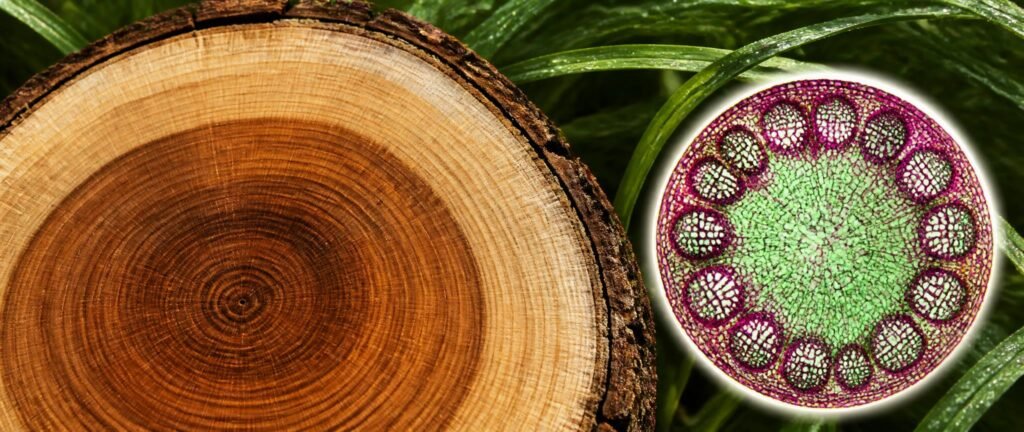
In a dicot stem, it starts when the intrafascicular cambium and the interfascicular cambium join to form a complete ring of vascular cambium. It produces more secondary xylem towards the inside than secondary phloem towards the outside.
| Comparison | First | Second |
|---|---|---|
| Spring wood vs autumn wood | Spring (early) wood: lighter colour, lower density, wider vessels | Autumn (late) wood: darker, higher density, narrower vessels |
| Heartwood vs sapwood | Heartwood (duramen): dark, dead, filled with tannins, resins, oils and gums; does not conduct water; gives mechanical support | Sapwood (alburnum): lighter, peripheral; conducts water and minerals |
- One spring wood and one autumn wood ring together make an annual ring, used to estimate the age of a tree.
- Cork cambium (phellogen) forms cork (phellem) on the outside and secondary cortex (phelloderm) on the inside. Together they make the periderm.
- Cork is impervious to water because of suberin in its walls.
- Bark is every tissue outside the vascular cambium, including the secondary phloem. Bark formed early in the season is early or soft bark; bark formed late is late or hard bark.
- Lenticels are lens-shaped openings in the periderm for gas exchange, found in most woody trees.
- In dicot roots, the vascular cambium is completely secondary in origin: it comes from the tissue just below the phloem bundles and from part of the pericycle opposite the protoxylem.
Worked PYQ-Pattern Questions
Q1. Bulliform cells are found in: (a) Dicot roots (b) Grass leaves (c) Dicot stems (d) Monocot roots
Answer: (b) Grass leaves. They help the leaf curl inward when water is short.
Q2. Casparian strips in the root endodermis are made of:
Answer: Suberin, a waxy, water-impermeable material.
Q3. In a stem, the protoxylem lies towards the pith. This arrangement is: (a) Exarch (b) Endarch (c) Radial (d) Closed
Answer: (b) Endarch. Roots are exarch.
Q4. Which statement about heartwood is correct? (a) It conducts water (b) It is the peripheral, lighter wood (c) It is filled with tannins, resins and gums and gives mechanical support (d) It is formed by cork cambium
Answer: (c). Heartwood is dead, dark and does not conduct water.
Q5. Periderm is made up of:
Answer: Phellogen, phellem and phelloderm.
Q6. Commercial fibres such as jute, flax and hemp come from:
Answer: Phloem fibres (bast fibres).
Common Traps in This Chapter
- Calling roots endarch (they are exarch; stems are endarch)
- Saying monocot stems have open vascular bundles (they are closed)
- Mixing up spring wood (lighter, wider vessels) and autumn wood (darker, narrower vessels)
- Saying heartwood conducts water
- Leaving secondary phloem out of the bark
- Putting vessels in gymnosperms or companion cells in gymnosperm phloem
Practise Every Anatomy of Flowering Plants PYQ
This anatomy of flowering plants NEET PYQ analysis shows you where the marks are. Solving real past questions makes the comparisons automatic. Every previous year question from this chapter is available chapter-wise, free:
👉 Solve all Anatomy of Flowering Plants NEET PYQs
Keep the dicot vs monocot and wood tables beside you for the first round, then solve the second round without them.
Conclusion
Anatomy of Flowering Plants is a chapter of comparisons, and NTA keeps asking the same ones. Use this anatomy of flowering plants NEET PYQ analysis to master tissues, vascular bundles, dicot and monocot sections, bulliform cells and secondary growth. Then practise the past questions until each comparison comes without thinking.
❓ FAQ
Q: How many questions come from Anatomy of Flowering Plants in NEET? A: Usually about two questions a year, mostly on wood and bark, tissues and dicot vs monocot anatomy.
Q: What is the most important topic in this chapter for NEET? A: Secondary growth is the most tested, especially annual rings, heartwood and sapwood, periderm and lenticels.
Q: What is the difference between endarch and exarch xylem? A: In endarch xylem, found in stems, the protoxylem faces the centre. In exarch xylem, found in roots, the protoxylem faces the periphery.
Q: What are bulliform cells? A: Large, empty, colourless cells in the upper epidermis of grass leaves. When they lose water, the leaf curls inward to reduce water loss.
Q: What does bark include? A: All tissues outside the vascular cambium, including the secondary phloem and the periderm.
Q: Where can I practise Anatomy of Flowering Plants NEET PYQs for free? A: You can solve every previous year question from this chapter chapter-wise for free using the practice links in this article.