
Knowing NEET 2027 will be computer-based is one thing; knowing how to attempt NEET 2027 CBT well is another. It is a genuinely different skill from solving problems on paper — the screen changes how you read, navigate, and manage your 200 minutes. Pair this guide with regular CBT mock test practice so the strategy below becomes automatic rather than something you recall under pressure.
Students who only prepare subject knowledge and ignore this skill often lose 15 to 20 marks purely to unfamiliarity on exam day.
Table of Contents
How to Attempt NEET 2027 CBT: Understand the Screen First
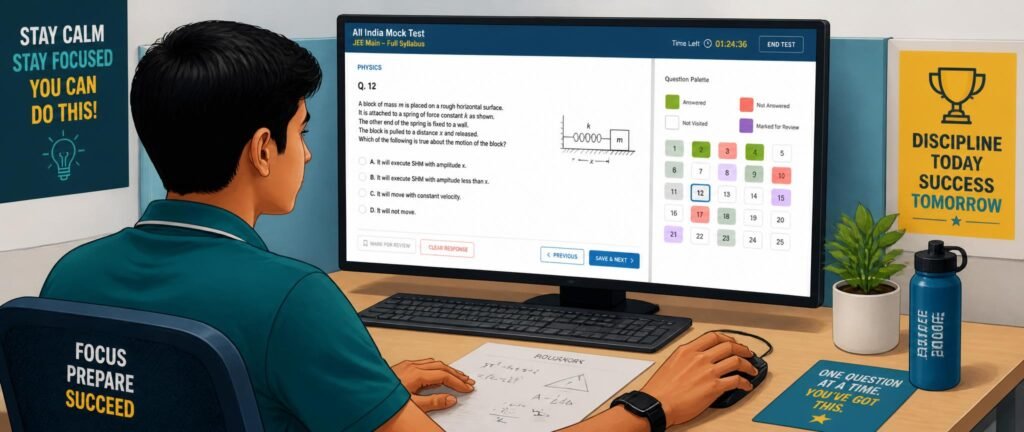
Before strategy, you need to know exactly what the interface looks like. The question palette NEET 2027 uses is colour-coded to track your progress at a glance:
- White — questions you have not yet visited.
- Red — questions you have visited but left unanswered.
- Green — questions you have answered.
- Violet — questions marked for review.
Below the question, you will find Save & Next, Save & Mark for Review, and Clear Response buttons, along with instant subject-switching between Physics, Chemistry, Botany, and Zoology. Crucially, you can change or clear any answer as many times as you like before final submission — there is no OMR-style permanence to a selected answer.
Screen Reading Strategy: Scan, Don’t Read Linearly
The biggest adjustment in learning how to attempt NEET 2027 CBT is how you read. On paper, most students read a question start to finish before deciding on an approach. On screen, this is slower and increases eye strain over a 200-minute exam.
Instead, scan for keywords and numerical values first, form a rough idea of what is being asked, then go back and read the full question only once you know what you are looking for — this is the core of good on-screen navigation. This single habit shift, practised early, saves meaningful time across 180 questions and reduces the fatigue that builds up from staring at a screen for over three hours.
Using the Question Palette Strategically
The palette is your single biggest advantage over the old OMR system, but only if you use it actively rather than passively — pair this habit with a proper mock review routine so palette patterns actually improve your next attempt. Glance at your palette roughly every 30 minutes to check your colour balance — too much red late into the exam is a clear signal to stop chasing new questions and start clearing marked ones instead.
Use Mark for Review aggressively rather than getting stuck. If a question feels uncertain within the first 15 to 20 seconds, mark it, move on, and return in a second pass with a clearer head. Because negative marking still applies, a marked-but-unattempted question costs you nothing, while a rushed guess can cost four marks for one careless click.
Time Management NEET 2027 CBT: The 200-Minute Plan
With all 180 questions compulsory across 720 marks, time management NEET 2027 CBT needs a clear structure rather than an improvised pace, best rehearsed through full-length CBT mock tests until it feels automatic. A workable framework:
- First pass (roughly 140 minutes) — attempt every question you are confident about immediately, using Save & Next. Mark anything uncertain for review rather than pausing to deliberate.
- Second pass (roughly 40 minutes) — return to every question marked for review. With calmer focus and no new questions competing for attention, several of these become answerable.
- Final review (roughly 20 minutes) — check the palette for any remaining white or red markers, attempt informed guesses only where elimination genuinely favours you, and confirm your subject-wise balance before submitting.
Adjust the split slightly by subject strength — if biology is your strongest section, front-load it early in your first pass to bank marks before fatigue sets in later.
Practical Screen Habits for How to Attempt NEET 2027 CBT
A few habits, practised well before exam day, make the difference between comfort and panic:
- Adjust font size in the first two minutes of any mock test, and settle on whatever is most comfortable for you — most CBT interfaces allow this.
- Use the on-screen scribble pad or provided rough sheets deliberately for calculations, since there is no margin to scribble in as with a paper booklet.
- Practice instant subject-switching so moving between Physics, Chemistry, Botany, and Zoology becomes automatic rather than a distraction mid-attempt.
- Stay calm through technical delays — if the screen freezes or lags, raise your hand for the invigilator rather than losing composure, since time lost to genuine technical issues is typically compensated.
Building This Skill Before Exam Day
None of this replaces subject preparation — the move to CBT changes how you take the exam, not what you study. But screen fluency has to be built the same way subject knowledge is: through repetition. Take full-length mock tests of 3 hours 20 minutes in one sitting on a computer, not in short bursts, so your stamina and pacing match the real exam.
Gradually increase your screen time from short sessions to the full duration over the months before your exam, so that by the time NEET 2027 arrives, the interface itself is the least stressful part of your day.
Final Word
Learning how to attempt NEET 2027 CBT ultimately comes down to three things: reading differently, using the colour-coded palette as an active tool rather than a passing glance, and following a disciplined three-pass time structure instead of a single unstructured attempt. None of this is difficult, but all of it needs practice before it becomes instinctive under exam pressure.
Build these habits early, rehearse them in full-length mock tests, and treat the screen itself as a skill worth mastering — not an afterthought behind your subject revision. Students who do this consistently walk into NEET 2027 with one less thing to worry about on the day that matters most.
❓ FAQ Section
Q: How do I attempt NEET 2027 CBT effectively? A: Use a three-pass strategy — attempt confident questions first while marking uncertain ones for review, return to marked questions in a focused second pass, and use a final review to check the colour-coded palette before submitting. Scan questions for keywords first rather than reading linearly.
Q: What does the colour-coded question palette mean in NEET 2027 CBT? A: White means not visited, red means visited but unanswered, green means answered, and violet means marked for review. Checking this palette every 30 minutes helps you track progress and decide whether to keep attempting new questions or clear marked ones.
Q: Can I change my answer after selecting it in NEET 2027 CBT? A: Yes. Unlike an OMR sheet, you can change or clear any answer as many times as you want before final submission, using the Clear Response and Save & Next buttons, giving you far more flexibility than the old paper format.
Q: How should I manage time during the 200-minute NEET 2027 CBT exam? A: A workable split is roughly 140 minutes for a first confident pass, 40 minutes to revisit questions marked for review, and 20 minutes for a final check of your palette and subject-wise balance before submitting.
Q: Does the move to CBT mean I need to study differently for NEET 2027? A: No. The syllabus, subjects, and marking scheme remain based on NCERT and are not changing. What changes is how you take the exam, so your subject preparation stays the same while your screen strategy and time management need separate practice.