
There is no unit in Biology with a better return per hour than this one. Biotechnology for NEET 2027 is two chapters, almost entirely factual, drawn so directly from NCERT that most questions are traceable to a single line — and yet students routinely leave it until the final month.
Students skip biotechnology for NEET 2027 for positional reasons, not intellectual ones. It sits late in Class 12, gets taught during board season, and looks intimidating because of the terminology. Strip the jargon away and it’s a list of names, enzymes, organisms and numbers.
Anchor it against subject-wise chapter weightage and make sure your genetics and evolution base is solid first, since this unit assumes it.
Table of Contents
Why This Unit Is Efficient
Compare it to plant physiology or human physiology. Those units demand sequence — you must know what happens in what order, in what compartment, producing what. Get one step wrong and the chain breaks.
Biotechnology doesn’t work that way. Questions ask which enzyme, which organism, which gene, which company, which year. There is very little to reason through and a great deal to simply know.
That makes it the ideal unit for revision-heavy study, and a genuinely good place to start if you’re rebuilding Biology from a weak base — single-fact content is exactly what spaced revision that sticks handles best. Making effective condensed notes pays off faster here than anywhere else in the syllabus.
Biotechnology for NEET 2027: What’s Actually Tested
| Chapter | Typical Questions | Nature |
|---|---|---|
| Biotechnology: Principles and Processes | 2–3 | Tools, techniques, definitions |
| Biotechnology and Its Applications | 2–3 | Case studies, names, numbers |
Biotechnology for NEET 2027 usually carries 3–5 questions across the unit. Not the largest share of the paper — but measured against the ten or twelve hours it takes to learn properly, nothing else in Biology comes close on biotechnology chapter weightage per hour invested.
Biotechnology: Principles and Processes
The tools chapter. Biotechnology principles and processes questions cluster around a predictable set of items.
Almost every recombinant DNA technology NEET question lives in this chapter, and solving previous year papers filtered here shows how narrowly it is asked.
Restriction enzymes. Learn the EcoRI naming convention properly — genus, species, strain, order of isolation. Know what palindromic sequences are and why staggered cuts produce sticky ends.
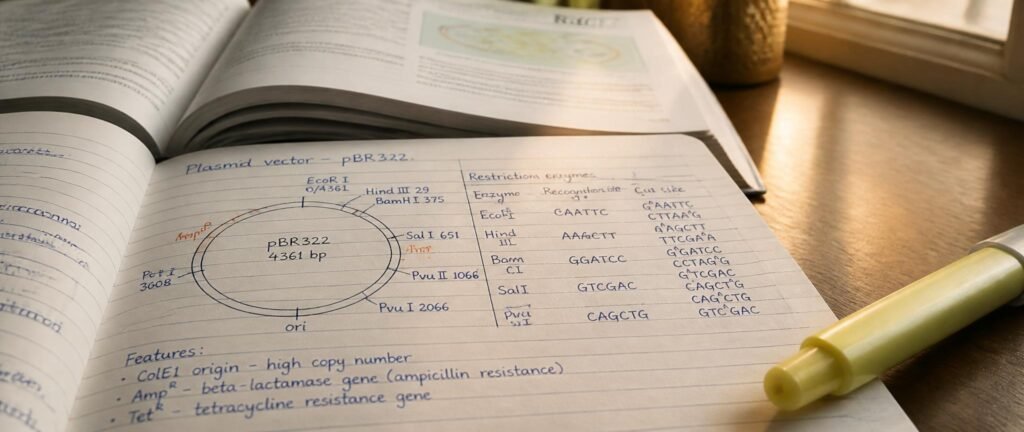
Cloning vectors. pBR322 is the standard example: origin of replication, selectable markers, cloning sites. Understand insertional inactivation, because it’s asked as a reasoning question rather than a recall one.
Vectors for plants and animals. The Ti plasmid of Agrobacterium tumefaciens, and retroviruses for animal cells. Know that the versions used are disarmed.
Getting DNA into the host. Calcium chloride treatment with heat shock, micro-injection, and the gene gun. Know which method suits which cell type.
Mechanism questions lean on your cell biology base, so shore that up if it’s shaky.
Processes. Gel electrophoresis — DNA is negatively charged, so it migrates toward the anode, and bands are visualised with ethidium bromide under UV. PCR — denaturation, annealing, extension, using Taq polymerase from Thermus aquaticus. Then bioreactors and downstream processing.
Diagram work matters here too. Memorising NCERT biology diagrams covers pBR322 and the bioreactor schematic, both of which appear as labelled questions.
Biotechnology and Its Applications
The case-study chapter, and pure recall. Biotechnology and its applications NEET questions almost always name a specific example.
Bt cotton. Bacillus thuringiensis, cry genes, and which gene targets which pest. The protoxin is inactive until the alkaline gut of the insect activates it — that mechanism is a favourite.
RNA interference. Used against the nematode Meloidogyne incognita in tobacco.
Insulin. Humulin, Eli Lilly, 1983. The A and B chains are produced separately in E. coli and joined by disulphide bonds. Know how this differs from natural proinsulin processing.
Gene therapy. ADA deficiency and SCID. Note that the lymphocyte infusion approach is not a permanent cure and must be repeated — students consistently get this wrong.
Molecular diagnosis. PCR and ELISA, and what each detects.
Transgenic animals and the ethical framework — GEAC, biopiracy, and the basmati, turmeric and neem patent cases.
The mechanism questions lean on cell structure, so a shaky base there shows up quickly.
The Traps
- EcoRI nomenclature reversed. E from genus, co from species, R from strain, I for order of isolation.
- Electrophoresis direction. DNA is negative and moves toward the positive electrode.
- Cry gene mismatches. Learn which gene targets which pest, not just that cry genes exist.
- Assuming Bt toxin is active in the bacterium. It’s a protoxin; alkaline pH activates it.
- Calling ADA gene therapy a cure. It isn’t, in the lymphocyte approach.
- PCR step order, and forgetting that Taq polymerase’s value is thermostability.
- Confusing recombinant insulin assembly with natural proinsulin cleavage.
Most of these are single-fact errors, which means repetition fixes them permanently in a way it can’t for process-heavy units.
How to Study It
- Read both NCERT chapters line by line. Highlight every name, organism, enzyme, year and number — those are the questions.
- Build one table per chapter. Tools and their functions for the first; applications and their organisms for the second.
- Draw pBR322 and the bioreactor once from memory.
- Practise past questions, then revise the table weekly.
Ten to twelve hours for a first pass. Then it’s maintenance.
Final Word
Biotechnology for NEET 2027 is where organised students quietly bank three to five marks that disorganised students leave on the table.
Biotechnology for NEET 2027 asks nothing conceptually difficult of you. It asks only that you learn a defined list of facts and keep them warm. Do that in July and you never think about it again — which is exactly the position you want to be in when April arrives and everything else is competing for your attention.
❓ FAQ Section
Q: How many questions come from biotechnology in NEET? A: Typically 3–5 across both chapters — Principles and Processes, and Applications. The exact count varies by year, so check recent papers for the current pattern.
Q: Is biotechnology hard for NEET? A: No, relative to its weightage. It’s factual rather than conceptual — names, enzymes, organisms and numbers — which makes it far more tractable than sequence-heavy units like plant physiology or human physiology.
Q: Is NCERT enough for biotechnology? A: Yes, more so than almost any other unit. Questions are usually traceable to specific NCERT lines. Add previous year papers for exposure, but don’t substitute reference books here.
Q: How long does biotechnology take to prepare? A: Roughly ten to twelve hours for a thorough first pass across both chapters, plus periodic revision. It’s one of the fastest units in the syllabus to cover properly.
Q: Which chapter is more important? A: Both carry similar weight. Principles and Processes leans toward tools and techniques; Applications leans toward case studies and specific examples. Neither should be skipped.
Q: Do I need genetics before starting biotechnology? A: A working knowledge of Molecular Basis of Inheritance helps considerably, particularly around DNA structure and replication. You can study biotechnology without it, but the mechanisms make more sense afterwards.
[…] concept building, pair this with our biotechnology preparation strategy guide, and see where the unit fits in the plan to score 360 in Biology. This article focuses on what past […]