
Understanding the syllabus is the first real step in serious preparation. Most students start studying without clarity and later feel overwhelmed, not because the syllabus is too vast, but because it was never broken down properly. If you want a strong NEET 2027 syllabus approach, you need to convert the entire syllabus into a structured, manageable system. At the beginning of your journey, following a complete NEET preparation roadmap with clear syllabus mapping helps you remove confusion and focus only on what actually matters for the exam.
Why Understanding the NEET 2027 Syllabus Is Critical
The NEET exam is not about random knowledge—it is about NCERT-based concepts applied in a predictable pattern. Students who deeply understand the syllabus know exactly what to prioritize and what to ignore. Without this clarity, preparation becomes scattered and inefficient.
A clear syllabus breakdown also reduces stress. Instead of looking at NEET as one huge challenge, you start seeing it as smaller, achievable parts. This shift in perspective makes your preparation more focused and controlled.
Complete NEET 2027 Syllabus Breakdown
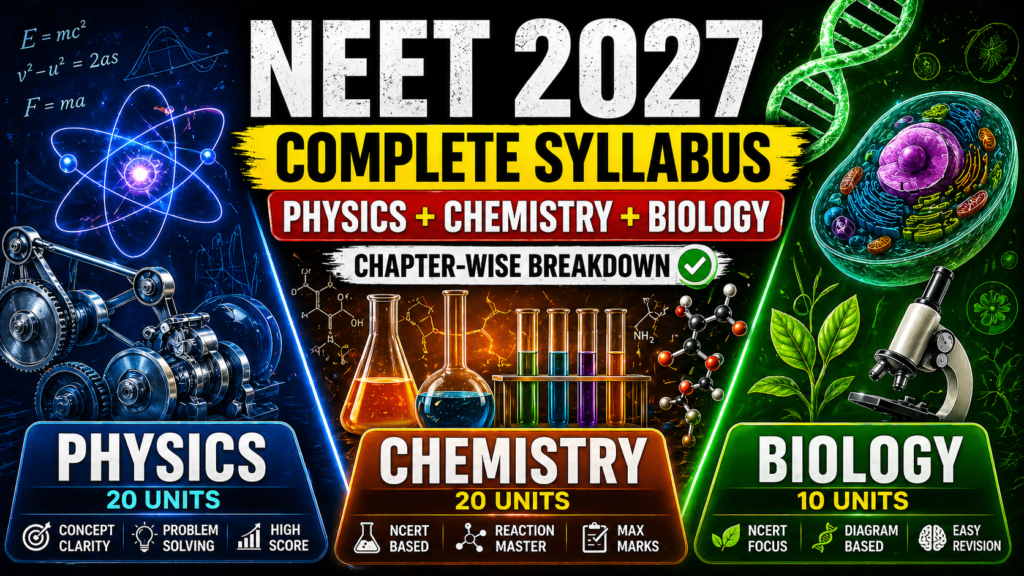
Based on the latest available official NEET UG syllabus pattern,” because NEET 2027 final syllabus is not released yet. NTA/NMC’s official NEET UG syllabus lists 20 Physics units, 20 Chemistry units, and 10 Biology units across Class 11 and 12 topics.
| Subject | Chapter / Unit Name |
|---|---|
| Physics | Physics and Measurement |
| Physics | Kinematics |
| Physics | Laws of Motion |
| Physics | Work, Energy and Power |
| Physics | Rotational Motion |
| Physics | Gravitation |
| Physics | Properties of Solids and Liquids |
| Physics | Thermodynamics |
| Physics | Kinetic Theory of Gases |
| Physics | Oscillations and Waves |
| Physics | Electrostatics |
| Physics | Current Electricity |
| Physics | Magnetic Effects of Current and Magnetism |
| Physics | Electromagnetic Induction and Alternating Currents |
| Physics | Electromagnetic Waves |
| Physics | Optics |
| Physics | Dual Nature of Matter and Radiation |
| Physics | Atoms and Nuclei |
| Physics | Electronic Devices |
| Physics | Experimental Skills |
| Chemistry | Some Basic Concepts in Chemistry |
| Chemistry | Atomic Structure |
| Chemistry | Chemical Bonding and Molecular Structure |
| Chemistry | Chemical Thermodynamics |
| Chemistry | Solutions |
| Chemistry | Equilibrium |
| Chemistry | Redox Reactions and Electrochemistry |
| Chemistry | Chemical Kinetics |
| Chemistry | Classification of Elements and Periodicity in Properties |
| Chemistry | P-Block Elements |
| Chemistry | d- and f-Block Elements |
| Chemistry | Coordination Compounds |
| Chemistry | Purification and Characterisation of Organic Compounds |
| Chemistry | Some Basic Principles of Organic Chemistry |
| Chemistry | Hydrocarbons |
| Chemistry | Organic Compounds Containing Halogens |
| Chemistry | Organic Compounds Containing Oxygen |
| Chemistry | Organic Compounds Containing Nitrogen |
| Chemistry | Biomolecules |
| Chemistry | Principles Related to Practical Chemistry |
| Biology | Diversity in Living World |
| Biology | Structural Organisation in Animals and Plants |
| Biology | Cell Structure and Function |
| Biology | Plant Physiology |
| Biology | Human Physiology |
| Biology | Reproduction |
| Biology | Genetics and Evolution |
| Biology | Biology and Human Welfare |
| Biology | Biotechnology and Its Applications |
| Biology | Ecology and Environment |
The final NEET 2027 syllabus will be confirmed by NTA/NMC closer to the exam, but aspirants can begin preparation using the latest official syllabus structure given below.
How to Prioritize Topics Smartly
Not all topics carry equal weight. Some chapters are consistently more important than others. Instead of giving equal time to everything, focus more on high-weightage topics while ensuring you cover the entire syllabus.
Start with fundamental chapters that form the base for advanced topics. For example, Mechanics in Physics and basic Organic Chemistry concepts should be covered early. This makes later topics easier to understand.
At the same time, don’t ignore smaller chapters. NEET often includes straightforward questions from them, which can boost your score.
Smart Study Strategy for NEET 2027
A smart strategy is not about studying more—it’s about studying efficiently. Your preparation should revolve around three core activities: learning, practicing, and revising.
Begin with concept clarity. Use NCERT and one reliable source for each subject. Avoid switching between multiple materials. Once you understand a topic, immediately move to question practice. This strengthens your understanding and improves application skills.
Revision should be continuous. Without revision, your preparation weakens over time. Integrate it into your daily routine instead of postponing it.
Following this structured approach ensures that your NEET 2027 syllabus coverage is both complete and effective.
How to Divide the Syllabus Over Time
Instead of trying to complete everything quickly, divide the syllabus into phases. The first phase should focus on learning and understanding concepts. The second phase should emphasize practice and strengthening weak areas. The final phase should be dedicated to revision and full-length mock tests.
Set monthly and weekly targets based on your timeline. This makes the syllabus manageable and prevents last-minute stress.
Consistency is more important than speed. Completing topics steadily ensures better retention and understanding.
Balancing All Three Subjects
Balancing Physics, Chemistry, and Biology is essential for a high score. Many students focus too much on one subject and neglect others.
Biology should be studied daily due to its weightage. Chemistry can be divided into smaller sections, making it easier to manage. Physics requires regular practice to build confidence and speed.
A balanced approach ensures that your overall score improves, not just one subject.
Importance of Practice and Testing
Covering the syllabus is only half the job. The real improvement comes from practice and testing. After completing a topic, solve questions to check your understanding.
Start with chapter-wise tests and gradually move to full-length mock exams. Testing helps you identify weak areas and improve time management.
Analyzing your tests is equally important. Understanding your mistakes helps you avoid repeating them and improves your accuracy.
Common Mistakes While Covering the Syllabus
Many students make mistakes that slow down their progress. Using too many resources creates confusion. Skipping revision leads to forgetting. Ignoring weak topics creates gaps in preparation.
Another common mistake is focusing only on theory without enough practice. NEET requires application, so solving questions is essential.
Avoiding these mistakes will make your NEET 2027 syllabus coverage more effective.
Can You Complete the NEET 2027 Syllabus Effectively?
Yes, with the right approach. The syllabus is large, but it is manageable when broken down into smaller parts and studied consistently. A clear plan, regular practice, and continuous revision can help you cover everything without stress.
The key is to stay consistent and follow your plan. Over time, your understanding and confidence will improve, bringing you closer to your goal.
FAQ
What is included in the NEET 2027 syllabus?
The syllabus includes Physics, Chemistry, and Biology topics based on NCERT concepts from Classes 11 and 12.
Is NCERT enough for NEET preparation?
NCERT is essential, especially for Biology and Inorganic Chemistry, but additional practice is needed for Physics.
How long does it take to complete the syllabus?
With a structured plan, most students can complete it in 6–8 months while maintaining revision.
How should I revise the syllabus effectively?
Use a spaced revision system—revise topics the next day, after one week, and again after one month.