If you’re preparing seriously, then your NEET Chemistry Strategy 2026 will decide whether you stay average or push into the 650+ zone.
Chemistry is not the hardest subject in NEET—but it is the most misunderstood. Students either over-study it with too many books or underperform because they don’t follow a structured approach.
The truth is simple. A well-executed NEET Chemistry Strategy 2026 based on NCERT and PYQs is enough to take you to 160+ marks. Not luck. Not talent. Just correct execution.
Why NEET Chemistry Strategy 2026 Must Be NCERT + PYQ Focused
NEET Chemistry is one of the most predictable sections in the exam. Unlike Physics, where problem variations can surprise you, Chemistry follows patterns.
In Inorganic, questions often come directly from NCERT lines. In Organic, reaction patterns repeat. In Physical Chemistry, formulas and concepts are reused with minor changes.
That’s why a proper NEET Chemistry Strategy 2026 should not revolve around multiple reference books. It should revolve around two core resources—NCERT and PYQs.
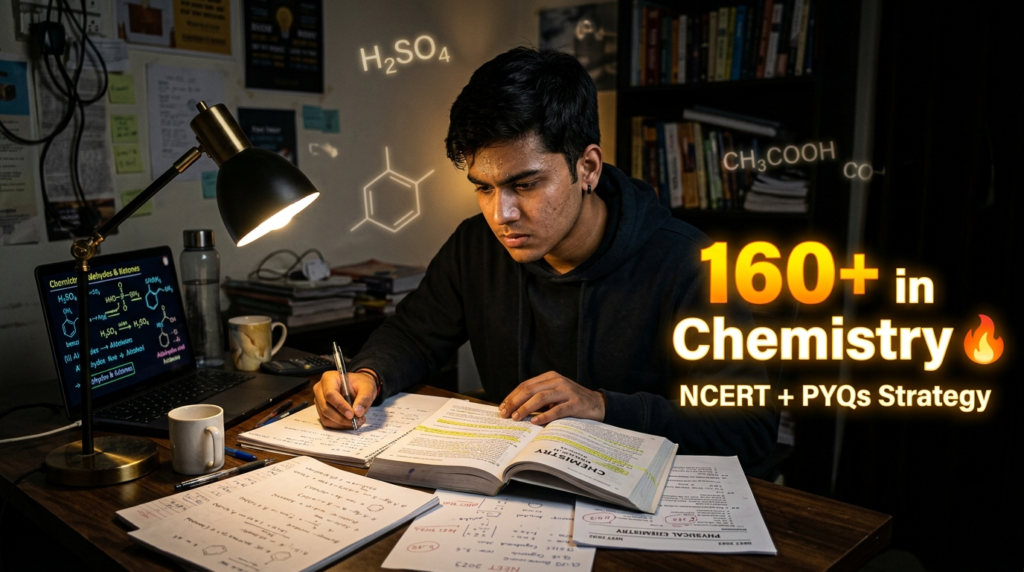
Understanding the Structure Before Applying NEET Chemistry Strategy 2026
Chemistry in NEET is divided into three parts, and each requires a different approach.
Physical Chemistry is numerical and concept-driven. It requires clarity and practice. Organic Chemistry is logical and pattern-based, where understanding reactions matters more than memorization. Inorganic Chemistry is memory-heavy and almost entirely dependent on NCERT.
Most students fail because they use the same study method for all three. A strong NEET Chemistry Strategy 2026 respects these differences and adapts accordingly.
NEET Chemistry Strategy 2026 for Physical Chemistry
Physical Chemistry is where many students lose confidence, not because it is difficult, but because they approach it passively.
This section demands active problem-solving. Simply reading theory or formulas is not enough. You need to apply them repeatedly.
The right way to handle Physical Chemistry within your NEET Chemistry Strategy 2026 is to focus on clarity first and then build speed. Every chapter should follow a cycle: understand the concept, solve basic questions, then move to PYQs.
Repetition is key here. The same formulas appear again and again in different forms. The more you practice, the more familiar the patterns become. Over time, questions start feeling predictable.
NEET Chemistry Strategy 2026 for Organic Chemistry
Organic Chemistry is often feared, but the fear comes from misunderstanding how to study it.
It is not about memorizing reactions blindly. It is about understanding why reactions happen. Once you understand mechanisms, you can solve even unfamiliar questions.
A good NEET Chemistry Strategy 2026 for Organic Chemistry focuses on reaction flow, not isolated facts. You need to connect reagents, intermediates, and products into a logical chain.
PYQs play a crucial role here. They show you how reactions are asked in exams and help you identify important mechanisms.
With consistent practice, Organic Chemistry shifts from confusion to one of the most scoring sections.
NEET Chemistry Strategy 2026 for Inorganic Chemistry
If there is one section that can guarantee marks, it is Inorganic Chemistry.
But only if you respect NCERT.
A major mistake students make is ignoring NCERT lines and relying on notes or shortcuts. NEET questions often pick exact phrases, exceptions, and trends directly from the textbook.
A disciplined NEET Chemistry Strategy 2026 treats NCERT as the primary source. Every line matters. Tables, examples, and exceptions are all potential questions.
Revision is the only way to master this section. One reading is never enough. Multiple revisions are what turn memory into accuracy.
How to Use NCERT Effectively in NEET Chemistry Strategy 2026
Reading NCERT casually does not work. You need an active approach.
Every chapter should be read with attention to detail. Important lines should be highlighted. Reactions and trends should be noted. Confusing parts should be revisited.
The strength of NCERT lies in its simplicity. But that simplicity is deceptive. Questions are often framed in a way that tests how deeply you understood the text.
That’s why your NEET Chemistry Strategy 2026 should include repeated NCERT revisions, not just one-time reading.
How to Use PYQs in NEET Chemistry Strategy 2026
PYQs are not just practice—they are insight.
They show you what examiners prioritize. They reveal patterns that no theory book can explain.
The correct way to use PYQs in your NEET Chemistry Strategy 2026 is to solve them chapter-wise immediately after completing theory. This creates a direct link between concept and application.
While solving, the focus should not be on speed. It should be on understanding. Every question should answer three things: what concept is being tested, why the correct option works, and why the others fail.
This level of analysis is what separates average preparation from rank-level preparation.
Common Mistakes That Break NEET Chemistry Strategy 2026
Most students don’t fail because they lack effort. They fail because their approach is flawed.
One common mistake is collecting too many resources. More books create more confusion. Another mistake is solving PYQs without analyzing them, which reduces their value to simple practice.
Lack of revision is another major issue. Students keep moving forward without reinforcing what they already studied. Over time, this leads to weak retention.
A strong NEET Chemistry Strategy 2026 avoids these traps by staying focused, consistent, and structured.
Revision Strategy in NEET Chemistry Strategy 2026
Revision is where real performance is built.
Without revision, even the best preparation fades. Chemistry, especially Inorganic and Organic, demands repeated exposure.
A simple revision cycle works well. After studying a chapter, revise it within a week. Then revisit it again after a few weeks. Each revision strengthens recall and reduces mistakes.
Your NEET Chemistry Strategy 2026 should treat revision as a priority, not an afterthought.
How to Reach 160+ with NEET Chemistry Strategy 2026
Scoring 160+ in Chemistry is not unrealistic. It is achievable with the right balance.
Inorganic Chemistry should be your strongest area because it offers direct and predictable questions. Organic Chemistry should be your second focus, where understanding leads to accuracy. Physical Chemistry should be practiced regularly to maintain consistency.
When these three are balanced, your overall score naturally moves into the 150–170 range.
This is not about perfection. It is about minimizing mistakes and maximizing accuracy.
Why Structured Practice Strengthens NEET Chemistry Strategy 2026
Self-study works, but lack of structure often leads to inconsistency.
Students start strong but lose direction over time. They skip revision, ignore weak areas, and lose track of progress.
A structured system solves this problem. It organizes practice, ensures coverage of important topics, and keeps preparation consistent.
👉 Check structured practice:
Grip-NCERT-chemistry
This is where preparation becomes more efficient and less stressful.
Final Thoughts on NEET Chemistry Strategy 2026
Chemistry is not the subject that limits your score. It is the subject that can boost it.
A focused NEET Chemistry Strategy 2026 built on NCERT, PYQs, and consistent revision is enough to reach 160+.
No shortcuts. No unnecessary complexity.
Just clarity, practice, and discipline.
That’s the difference between preparation and results.
The best NEET Chemistry Strategy 2026 focuses on NCERT, PYQs, and regular revision. Study NCERT line-by-line, solve chapter-wise PYQs, and analyze mistakes consistently to build accuracy and confidence.
Yes, NCERT is the most important resource, especially for Inorganic and Organic Chemistry. Most NEET questions are directly or indirectly based on NCERT, so multiple revisions are essential.
You should solve at least 15 years of PYQs, but 20+ years is ideal. This helps you understand question patterns and improves your problem-solving ability.
Focus more on Inorganic for easy marks, build strong concepts in Organic, and practice Physical Chemistry daily. A balanced approach ensures better overall performance.
Yes, with a proper NEET Chemistry Strategy 2026, you can achieve 160+ through self-study. Consistency, correct resources, and regular revision are more important than coaching.