

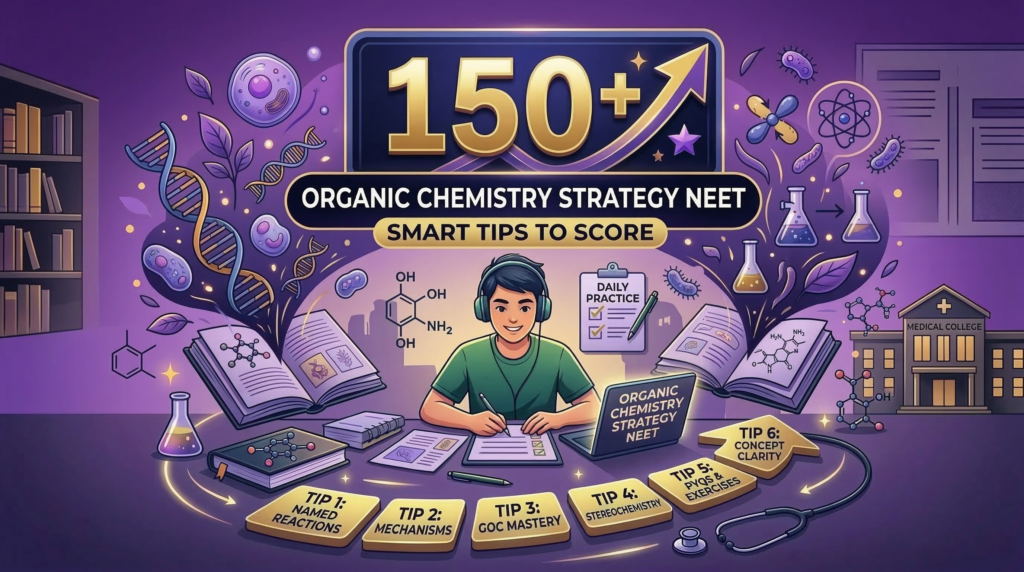
Preparing for NEET chemistry can feel overwhelming, especially when it comes to organic reactions. With the right organic chemistry strategy NEET aspirants can simplify complex reactions, understand mechanisms clearly, and solve questions faster in the exam.
Unlike physical chemistry, which involves calculations, organic chemistry relies more on conceptual clarity, reaction mechanisms, and consistent practice.
Every year, around 14–18 questions in NEET Chemistry come from organic chemistry. That means mastering it can significantly boost your overall score.
In this guide, we’ll break down the best organic chemistry strategy for NEET so you can build strong concepts, remember reactions easily, and solve questions faster in the exam.
Why Organic Chemistry Is Important for NEET
Before discussing preparation techniques, it’s important to understand why organic chemistry plays such a major role in NEET.
1. High Weightage
A large portion of NEET chemistry questions are based on organic chemistry topics.
2. Concept-Based Questions
Most questions test concepts and reaction mechanisms, not just memorization.
3. Direct NCERT Questions
Many NEET organic chemistry questions are directly based on NCERT examples and reactions.
Because of this, students who follow a structured preparation method can gain a strong advantage.
Important Organic Chemistry Topics for NEET
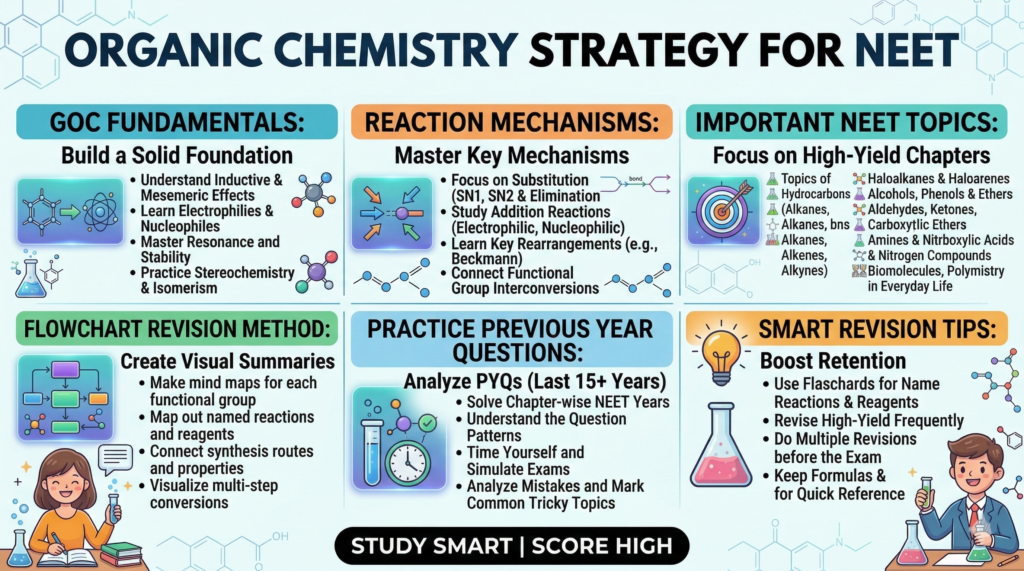
These topics are frequently asked in the exam and should be prioritized.
Basic Organic Chemistry
- General Organic Chemistry (GOC)
- Electronic effects
- Acidity and basicity
- Resonance and hyperconjugation
Hydrocarbons
- Alkanes
- Alkenes
- Alkynes
- Aromatic hydrocarbons
Functional Groups
- Alcohols, Phenols, and Ethers
- Aldehydes and Ketones
- Carboxylic Acids
Biomolecules & Polymers
- Biomolecules
- Polymers
- Chemistry in Everyday Life
Mastering these topics builds a solid foundation for solving reaction-based questions quickly.
Step-by-Step Organic Chemistry Strategy for NEET
Now let’s talk about the actual preparation method.
1. Start With General Organic Chemistry (GOC)
This is the foundation of organic chemistry.
Without understanding GOC, reactions will feel random and impossible to remember.
Focus on:
- Inductive effect
- Mesomeric effect
- Electrophiles and nucleophiles
- Carbocation stability
If these concepts are clear, most reactions automatically start making sense.
2. Understand Reaction Mechanisms Instead of Memorizing
One of the biggest mistakes students make is memorizing reactions without understanding the mechanism.
Instead, ask questions like:
- Why does this reaction happen?
- What is the attacking species?
- Which intermediate forms?
When you understand mechanisms, even unfamiliar reactions become solvable.
3. Make a Reaction Flow Chart
Organic chemistry becomes much easier if you visualize reactions.
Create flow charts like:
Alcohol → Aldehyde → Carboxylic Acid
Alkene → Alcohol → Ketone
This helps you remember reaction sequences, which are commonly asked in NEET.
4. Practice NCERT Reactions Thoroughly
For NEET preparation, NCERT is the most important resource.
Many exam questions are directly based on NCERT reactions and examples.
You should:
- Highlight important reactions
- Memorize named reactions
- Practice all NCERT exercises
You can also review official exam updates and syllabus information from the National Testing Agency website:
https://neet.nta.nic.in/
5. Solve Previous Year Questions
Past NEET questions reveal the pattern of organic chemistry questions.
By practicing them, you learn:
- Which reactions are frequently asked
- How mechanisms are tested
- How to eliminate incorrect options
Aim to solve at least the last 15 years of NEET questions.
6. Use Mnemonics to Remember Reactions
Organic chemistry involves many reagents and reactions.
Mnemonics help remember them quickly.
For example:
Lucas Test: distinguishes alcohol types
Tollen’s Test: aldehydes detection
Memory tricks make revision faster during the final weeks before NEET.
7. Revise Regularly
Organic chemistry is not something you study once.
Regular revision is essential.
A good revision cycle could look like:
- Weekly reaction revision
- Monthly full organic chemistry revision
- Final quick revision using short notes
Consistent revision prevents confusion between similar reactions.
Best Books to Support Your Organic Chemistry Strategy NEET Preparation
Choosing the right books is essential for mastering organic chemistry concepts. While many students rely on multiple resources, NCERT remains the most important book for NEET preparation.
Here are some recommended resources:
NCERT Chemistry (Class 11 & 12)
NCERT forms the backbone of NEET preparation. Most organic chemistry questions in NEET are directly based on NCERT reactions, examples, and mechanisms.
Students should focus on:
- Reaction mechanisms explained in NCERT
- Important named reactions
- Examples and back exercises
MS Chauhan – Organic Chemistry
This book is excellent for practicing advanced reaction-based questions. It helps students strengthen their conceptual understanding and improve problem-solving speed.
Previous Year NEET Question Papers
Solving past questions helps students identify the most frequently asked organic chemistry reactions and understand the exam pattern.
A combination of NCERT study and consistent question practice is one of the most effective approaches for improving organic chemistry performance.
30-Day Organic Chemistry Study Plan for NEET Aspirants
A structured study plan helps students stay consistent and avoid confusion between multiple reactions.
Here is a simple 30-day preparation strategy.
Week 1: Foundation Building
Focus on General Organic Chemistry concepts.
Topics to cover:
- Electronic effects
- Resonance
- Inductive effect
- Carbocation stability
These concepts form the base for understanding reaction mechanisms.
Week 2: Hydrocarbons
Study the reactions and mechanisms of:
- Alkanes
- Alkenes
- Alkynes
- Aromatic hydrocarbons
Create reaction flowcharts to visualize transformations between compounds.
Week 3: Functional Groups
Focus on reactions involving:
- Alcohols and Phenols
- Aldehydes and Ketones
- Carboxylic Acids
Practice mechanism-based questions from previous NEET papers.
Week 4: Revision and Mock Tests
Revise all reactions and practice mock tests.
During revision:
- Review reaction summary notes
- Solve NEET previous year questions
- Identify weak topics and revise them again
Following a consistent organic chemistry strategy NEET aspirants trust can significantly improve accuracy during the exam.
Revision Techniques Used by NEET Toppers
Many NEET toppers follow a structured revision strategy to retain complex reactions.
Here are some commonly used techniques.
Reaction Maps
Instead of memorizing individual reactions, toppers create reaction maps connecting different functional groups.
For example:
Alkene → Alcohol → Aldehyde → Carboxylic Acid
This approach helps students quickly recall reaction sequences during exams.
Short Notes
Maintaining short notes for:
- Named reactions
- Important reagents
- Mechanism steps
makes final revision much easier.
Weekly Revision
Toppers usually revise organic chemistry once every week to avoid forgetting reaction mechanisms.
Consistent revision combined with the right organic chemistry strategy NEET preparation requires can greatly improve long-term retention.
Common Mistakes Students Make
Many students struggle with organic chemistry due to avoidable mistakes.
Memorizing Without Understanding
This leads to confusion when reactions are slightly modified.
Ignoring NCERT
NEET frequently asks questions directly from NCERT.
Lack of Practice
Concepts only become strong after solving many questions.
Avoid these mistakes to make your preparation more effective.
Smart Study Resources for Organic Chemistry
Here are some helpful resources:
- NCERT Chemistry Class 11 & 12
- Previous year NEET question papers
- Reaction summary notes
- Mock tests and practice papers
Also, while preparing for NEET, it’s important to balance your preparation across subjects. For example, understanding complex biology diagrams can also improve your exam performance. You can check this guide to strengthen your biology preparation.
Final Tips to Master Organic Chemistry for NEET
Let’s summarize the best preparation strategy:
- Build strong GOC fundamentals
- Understand reaction mechanisms
- Practice NCERT reactions
- Solve previous year NEET questions
- Revise reaction flow charts regularly
If you stay consistent and focus on conceptual understanding, organic chemistry can easily become one of the most scoring sections in the exam.
Following the right organic chemistry strategy NEET aspirants use can turn this subject into one of the highest scoring sections in the exam.
FAQ Section
Is organic chemistry difficult for NEET?
Organic chemistry may seem difficult initially, but with clear concepts and regular practice it becomes one of the easiest sections to score in NEET.
How many questions come from organic chemistry in NEET?
Typically around 14–18 questions in NEET Chemistry come from organic chemistry topics.
Is NCERT enough for organic chemistry in NEET?
Yes. NCERT is the most important resource for organic chemistry preparation, but solving previous year questions is also essential.
How should beginners start organic chemistry for NEET?
Beginners should start with General Organic Chemistry (GOC) because it forms the foundation for understanding reactions and mechanisms.
[…] Organic Chemistry Strategy for NEET: How to Master Reactions Faster […]
[…] Organic chemistry becomes easier when students understand reaction mechanisms rather than memorizing reactions blindly. If you’re struggling with this topic, explore this guide on Organic Chemistry strategy for NEET. […]
[…] the basis of DNA fingerprinting. ENHANCE YOUR NEET PREPARATION NEET Physics Survival Kit 2026 Organic Chemistry Strategy for NEET Biology Mnemonics & Tricks How to Score 340 in NEET Biology Top 10 Tricky Biology Diagrams […]
[…] YOUR NEET PREPARATION NEET Physics Survival Kit 2026 Organic Chemistry Strategy for NEET Biology Mnemonics & Tricks How to Score 340 in NEET Biology Top 10 Tricky Biology […]