

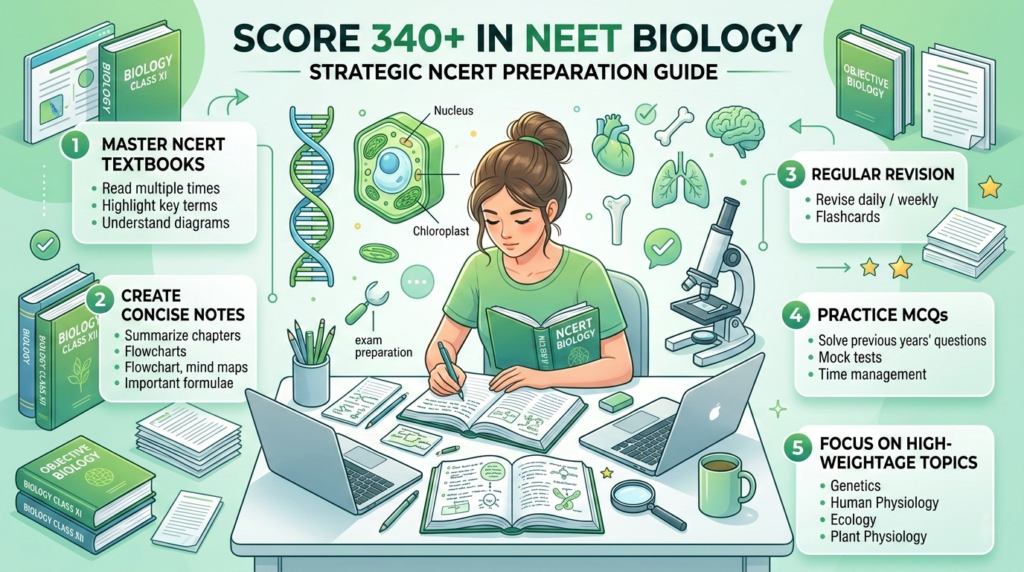
Every year, more than 20 lakh students appear for NEET, all competing for a limited number of MBBS seats in government and private medical colleges across India. With such intense competition, every mark matters.
Among all the subjects in the exam, Biology offers the biggest scoring opportunity, contributing 360 marks out of the total 720. Many NEET toppers secure over 340 marks in Biology alone, which significantly boosts their overall rank.
If you want to improve your chances of getting into a medical college, building the right strategy to score 340 in NEET Biology can make a massive difference.
This guide explains the exact preparation techniques, study methods, and revision strategies that help students achieve top scores in the Biology section.
Why Biology Is the Highest Scoring Section in NEET
Unlike Physics or Physical Chemistry, Biology does not involve lengthy calculations. Instead, the exam focuses heavily on conceptual clarity and textbook knowledge.
In fact, most experts estimate that around 85–90% of NEET Biology questions are derived directly from NCERT textbooks. Questions may appear in slightly modified forms, but the concepts almost always originate from NCERT lines, diagrams, or tables.
Because of this predictable pattern, students who focus on the right preparation method can achieve very high marks. Many successful candidates build their entire study plan around NCERT mastery, regular MCQ practice, and repeated revision.
When these three elements are combined effectively, achieving a high Biology score becomes much more realistic.
NCERT Should Be Your Primary Study Material
If there is one rule that almost every NEET topper follows, it is this:
NCERT is the foundation of Biology preparation.
Students often make the mistake of collecting too many reference books. While extra resources can be useful, the core content of the exam remains strongly tied to NCERT textbooks.
To make the most of NCERT, follow these steps:
- Read each chapter multiple times
- Highlight important lines and definitions
- Pay attention to diagrams, flowcharts, and tables
- Focus on examples and biological processes
Diagram-based questions are also very common in NEET. Many aspirants lose marks because they ignore diagrams during revision. Reviewing tricky diagrams regularly can help improve accuracy in the exam. You can explore some of the most frequently confusing Biology diagrams here.
Students who want to score 340 in NEET Biology should treat NCERT as their most important resource rather than relying heavily on multiple guides.
For official exam notifications, syllabus updates, and announcements, students should always check the official NEET website.
Focus on High-Weightage Chapters
Not all chapters carry equal importance in NEET. Some topics consistently produce a higher number of questions.
Understanding chapter weightage allows students to allocate study time more efficiently.
Important Class 11 Chapters
- Cell Structure and Function
- Biomolecules
- Plant Physiology
- Human Physiology
- Diversity in Living World
Important Class 12 Chapters
- Genetics and Evolution
- Biotechnology
- Human Reproduction
- Ecology
- Molecular Basis of Inheritance
Many of these chapters appear repeatedly in the exam. Students who master them thoroughly can secure a large portion of Biology marks.
In fact, Genetics, Human Physiology, and Ecology alone often contribute a significant number of questions each year.
Practice MCQs Daily
Reading theory is important, but question practice is equally essential.
MCQ practice helps students understand how NEET frames questions and tests conceptual understanding.
A strong daily practice routine might include:
- 80–100 Biology MCQs
- Topic-wise question banks
- Previous year NEET questions
- Weekly mock tests
When solving questions, focus not only on correct answers but also on understanding why certain options are incorrect. This habit improves analytical thinking and reduces mistakes during the exam.
Consistent practice also helps students build the speed and accuracy required to complete the Biology section efficiently.
Make Short Notes for Quick Revision
Biology contains a large amount of information, including terminology, scientific names, and biological processes. Without effective revision strategies, students may forget key details.
Creating short revision notes can solve this problem.
These notes should include:
- Important diagrams
- Key definitions
- Biological processes
- Flowcharts and summaries
- Important exceptions
The goal of these notes is to allow quick revision during the final weeks before the exam.
When the exam approaches, students can review their entire syllabus using these notes instead of rereading every chapter again.
Solve Previous Year NEET Papers
One of the most powerful preparation methods is solving previous year question papers.
These papers reveal the pattern, difficulty level, and frequently repeated concepts in the exam.
Students should aim to solve:
- At least 10–15 years of NEET questions
- Chapter-wise previous year questions
- Full-length mock exams
Many aspirants notice that NEET often repeats similar concepts with slight modifications. Understanding these patterns can give students a significant advantage during the actual exam.
Previous year papers also help identify weak areas that need additional practice.
Avoid These Common Preparation Mistakes
Even well-prepared students sometimes lose marks because of avoidable mistakes.
Here are some common problems that NEET aspirants should avoid:
Ignoring NCERT Diagrams
Many exam questions are based directly on diagrams.
Using Too Many Study Resources
Too many books can create confusion instead of clarity.
Skipping Revision
Without regular revision, it becomes difficult to retain large amounts of information.
Guessing Without Elimination
Blind guessing often leads to negative marking.
Not Practicing Enough Questions
Practice is essential to understand the exam pattern.
Avoiding these mistakes can significantly improve overall exam performance.
Effective Daily Study Routine
Students who want to achieve high marks in Biology should follow a consistent daily study plan.
A simple but effective routine may look like this:
- Study one NCERT chapter carefully
- Practice 80–100 MCQs from that topic
- Revise previously studied chapters
- Review important diagrams and notes
- Analyze mistakes from practice tests
This structured approach allows students to gradually strengthen their understanding of the subject.
When applied consistently over several months, this method can dramatically improve performance.
Can You Score 340+ in Biology?
Yes, scoring above 340 marks in Biology is completely possible.
Many NEET toppers achieve this score every year by focusing on the fundamentals:
- Thorough NCERT reading
- Regular MCQ practice
- Consistent revision
- Analysis of mistakes
Students who combine these strategies with discipline and patience often see significant improvements in their mock test scores.
If preparation is done systematically, Biology can become the most reliable scoring subject in the entire NEET exam.
Final Thoughts
Preparing for NEET requires dedication, smart planning, and consistent effort. While Physics and Chemistry demand extensive problem-solving, Biology offers a strong opportunity to secure high marks through concept clarity and structured revision.
Students who want to score 340 in NEET Biology should focus on mastering NCERT content, practicing questions daily, and revising the syllabus multiple times.
With the right preparation strategy and a disciplined routine, achieving a high score in Biology is not only possible but highly achievable.
Stay consistent, stay focused, and keep improving with every practice test.
FAQ Section
Can I score 340+ in NEET Biology by studying only NCERT?
Yes. Most NEET Biology questions are derived directly from NCERT textbooks, making them the most important study resource.
How many questions should I practice daily for NEET Biology?
Practicing around 80–100 MCQs daily is considered an effective strategy.
Which chapters are most important for NEET Biology?
Genetics, Ecology, Human Physiology, Plant Physiology, and Biotechnology are among the most frequently tested topics.
Is Biology easier than Physics in NEET?
Many students find Biology easier to score because it focuses more on conceptual knowledge rather than calculations.
[…] How to Score 340+ in NEET Biology […]