
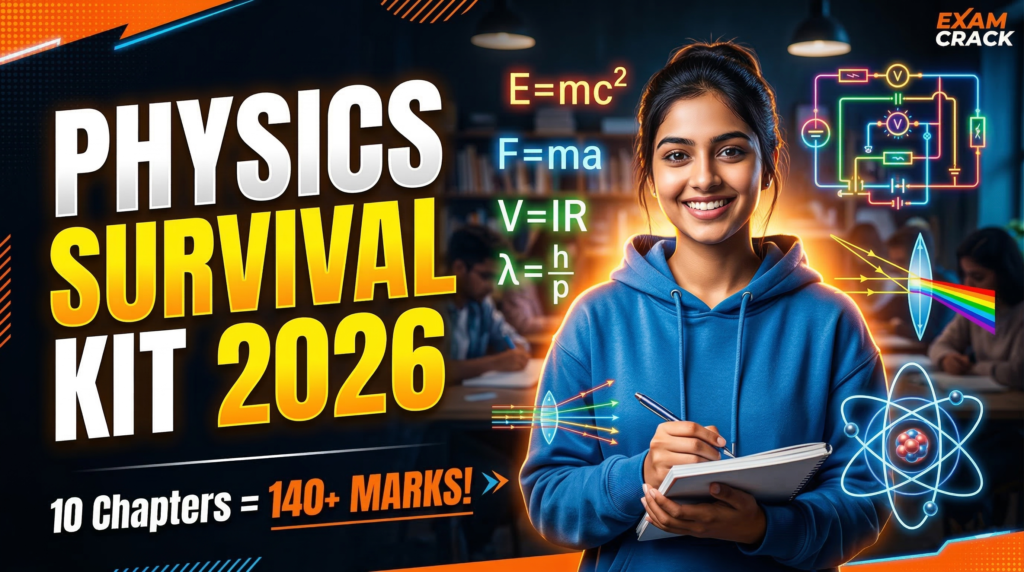
Physics often feels like the villain of the NEET journey. Many aspirants lose confidence here—but the truth is simple: Physics rewards strategy more than brute-force study.
The NEET Physics section contains 45 questions worth 180 marks, making it one of the most decisive parts of the exam. Even scoring 130–140 marks in Physics can dramatically boost your overall rank.
If you focus on the right chapters, master formulas, and practice PYQs, reaching 140+ marks becomes very achievable.
This NEET Physics survival kit 2026 highlights 10 high-yield chapters that consistently produce a large portion of the questions.
Why These NEET Physics Survival Kit 2026 Matters?
The NEET Physics syllabus includes topics from Class 11 and Class 12 NCERT, covering mechanics, thermodynamics, optics, electrodynamics, and modern physics.
But analysis of previous NEET papers shows something important:
- Electromagnetism contributes ~30% questions
- Mechanics contributes ~37%
- Modern Physics contributes ~16%
- Optics contributes ~10%
So if you prepare strategically, just a handful of chapters can generate 30+ correct answers.
Let’s break them down.
1. Current Electricity
This is one of the highest scoring chapters in NEET Physics. Every year, questions appear from concepts like resistors, circuit analysis, and Kirchhoff’s laws.
Students often underestimate this chapter because the theory seems simple. However, NEET frequently asks numerical questions involving multiple formulas in one problem.
Key topics to master:
- Ohm’s law
- Series and parallel resistance
- Kirchhoff’s laws
- Electrical power and energy
- Drift velocity and mobility
Why it matters:
If you understand circuit logic clearly, you can solve many questions within seconds. In many NEET papers, 3 or more questions appear from electricity-related chapters.
2. Ray Optics and Optical Instruments
Optics is a goldmine for marks. The questions usually revolve around mirrors, lenses, magnification, and optical instruments.
The best part? Most questions are formula-based.
Key concepts:
- Mirror and lens formula
- Magnification
- Refraction
- Total internal reflection
- Optical instruments like microscopes
NEET frequently asks numerical problems involving lenses and mirrors, making it a chapter you absolutely cannot skip.
3. Laws of Motion
This chapter forms the foundation of mechanics, and many other topics depend on it.
Understanding Newton’s laws will help you solve questions from:
- friction
- circular motion
- dynamics
Why this chapter is crucial:
Mechanics contributes a large portion of the NEET Physics paper. If your basics are weak here, solving higher-level problems becomes difficult.
4. Work, Energy, and Power
This chapter is conceptually beautiful and extremely scoring. NEET questions typically revolve around energy conservation and mechanical work.
Topics to focus on:
- Kinetic energy
- Potential energy
- Work-energy theorem
- Power
- Conservative forces
If you master the energy approach, many mechanics questions become much easier than force-based solutions.
5. Rotational Motion
Rotational motion is often considered difficult, but it is highly rewarding once understood.
NEET frequently asks conceptual questions from:
- Moment of inertia
- Angular momentum
- Rolling motion
- Torque
Students who practice enough problems from this chapter can easily score 2–3 questions per exam.
6. Electrostatics
Electrostatics is another core chapter in NEET Physics.
Key topics:
- Electric field and field lines
- Electric potential
- Capacitance
- Parallel plate capacitors
Electrostatics builds the foundation for current electricity and electromagnetic induction, making it extremely important.
7. Magnetic Effects of Current and Magnetism
This chapter connects electricity and magnetism and is part of the high-weightage electromagnetism unit.
Important topics include:
- Biot–Savart law
- Ampere’s law
- Magnetic force
- Motion of charged particles in magnetic fields
These concepts often appear in numerical problems involving magnetic fields and charged particles.
8. Thermodynamics
Thermodynamics questions are often straightforward and formula-driven.
Key topics include:
- First law of thermodynamics
- Heat engines
- Carnot cycle
- Thermal efficiency
If you memorize formulas and practice numerical problems, this chapter can give you quick marks in the exam.
9. Oscillations and Waves
Oscillations and waves appear regularly in NEET papers.
Key topics:
- Simple harmonic motion (SHM)
- Time period formulas
- Wave motion
- Doppler effect
Understanding SHM also helps in wave physics, making it a conceptually connected chapter.
10. Modern Physics
Modern physics is often considered the easiest high-weightage chapter.
Topics include:
- Photoelectric effect
- Atomic models
- Nuclear physics
- Radioactivity
These topics are mostly conceptual and formula-based, making them excellent for scoring marks quickly. Modern physics alone can produce 6–7 questions in NEET papers.
How These 10 Chapters Can Get You 140+ Marks
If you master these chapters:
- You cover 70–80% of the physics paper
- You reduce preparation stress
- You maximize scoring efficiency
High-weightage topics such as Current Electricity, Ray Optics, and Electrostatics repeatedly appear in NEET papers.
Combine these chapters with daily PYQ practice, and Physics becomes far less intimidating.
Smart Strategy to Master NEET Physics
Here is a simple approach:
Step 1 — Start with easy chapters
- Modern Physics
- Current Electricity
- Ray Optics
Step 2 — Move to mechanics
- Laws of Motion
- Work, Energy, Power
- Rotational Motion
Step 3 — Finish advanced topics
- Electrostatics
- Magnetism
- Thermodynamics
Step 4 — Solve PYQs
Past NEET questions are the best indicator of what NTA asks repeatedly.
For official updates, syllabus, and exam notifications, check the National Testing Agency NEET page.
Final Thoughts
Physics in NEET is not about studying every page of every book.
It is about mastering the chapters that matter most.
If you build strong fundamentals in these 10 chapters, practice PYQs consistently, and revise formulas regularly, scoring 140+ marks in NEET Physics 2026 becomes completely realistic.
Stay consistent, stay curious—and let physics become your scoring weapon instead of your weakness.
More NEET Preparation Guides
Looking to strengthen your NEET preparation strategy even further? Explore these expert guides covering biology revision strategies, organic chemistry preparation, memory-boosting study techniques, and important diagrams frequently asked in the NEET exam.
NEET Physics Survival Kit 2026 – FAQs
The most important chapters include Current Electricity, Ray Optics, Electrostatics, Modern Physics, Laws of Motion, and Thermodynamics. These topics regularly appear in NEET and mastering them helps students cover a large portion of the Physics paper.
Yes. By focusing on high-weightage chapters and practicing previous year questions consistently, aspirants can cover nearly 70–80% of the Physics section and realistically aim for 140+ marks.
The Physics section of NEET contains 45 questions. Each question carries 4 marks, making Physics a total of 180 marks in the examination.
NCERT provides the conceptual base for NEET Physics. However, solving numerical problems, mock tests, and previous year questions is essential to develop speed and accuracy.
All official updates, notifications, and exam announcements are published on the official NEET website managed by the National Testing Agency.
[…] NEET Physics Survival Kit – Important Chapters & Strategy […]