Thermodynamics is a high-weightage and concept-heavy chapter in NEET Physics. Every year, 2–3 questions are directly asked from this unit, often based on fundamental laws and simple applications. The best part is that most Physics Thermodynamics PYQs follow standard patterns, making this chapter highly scoring with the right preparation.
In this article, we’ll cover the most important Physics Thermodynamics PYQs, along with quick notes and concept-based explanations to help you revise efficiently.
Why Physics Thermodynamics PYQs Are Important
The importance of Thermodynamics PYQs lies in their predictability. NEET commonly asks questions from:
- Laws of thermodynamics
- Work, heat, and internal energy
- Isothermal and adiabatic processes
- Heat engines and efficiency
- Specific heat capacities
Practicing Physics Thermodynamics PYQs ensures you can quickly solve numerical and conceptual problems during the exam.
Quick Notes: Thermodynamics (Last Minute Revision)
Before solving Physics Thermodynamics PYQs, revise these core concepts:
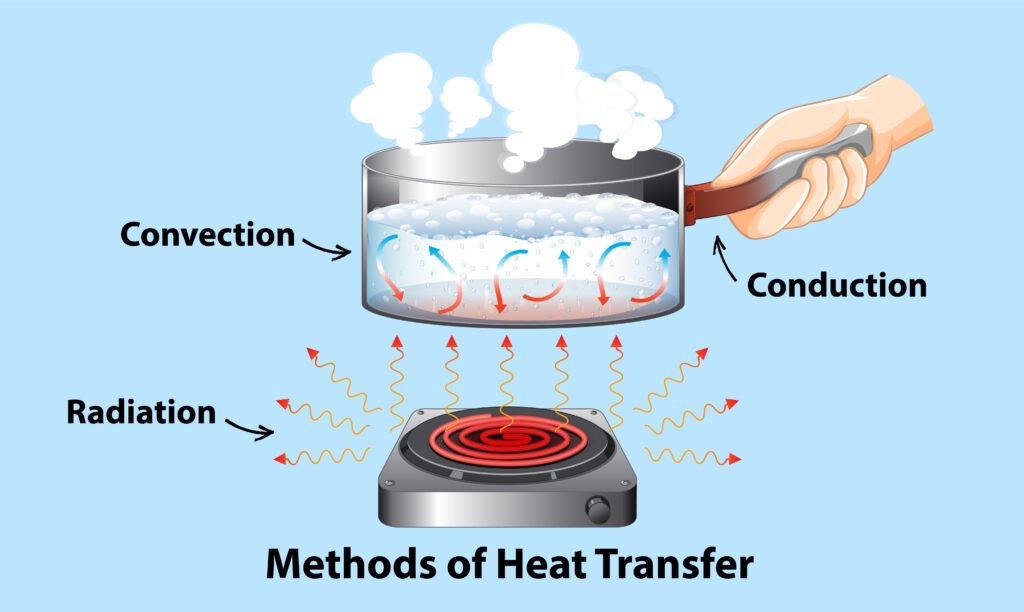
- Heat is energy transfer due to temperature difference
- Work is done when volume changes
- Internal energy depends only on temperature
- First law connects heat, work, and energy
- Isothermal process: temperature constant
- Adiabatic process: no heat exchange
- Efficiency of heat engine is always less than 100%
- Second law defines direction of heat flow
These ideas are repeatedly tested in Thermodynamics PYQs.
Top 10 Physics Thermodynamics PYQs (NEET Level)
Question 1
State the first law of thermodynamics
Answer:
Heat supplied to a system is used to increase internal energy and do work
Concept: Most basic and frequently asked in Thermodynamics PYQs
Question 2
What happens to internal energy in an isothermal process?
Answer:
It remains constant
Question 3
What is an adiabatic process?
Answer:
A process in which no heat is exchanged with surroundings
Question 4
What is the efficiency of a heat engine?
Answer:
Ratio of work done to heat supplied
Question 5
Can efficiency of a heat engine be 100%?
Answer:
No
Concept: Based on second law — very common in Physics Thermodynamics PYQs
Question 6
What happens when gas expands?
Answer:
Work is done by the system
Question 7
What happens when gas is compressed?
Answer:
Work is done on the system
Question 8
Which process is faster: isothermal or adiabatic?
Answer:
Adiabatic
Question 9
What is the sign of heat absorbed by system?
Answer:
Positive
Question 10
What is the sign of work done by system?
Answer:
Positive
Additional Practice Questions (High-Yield)
To strengthen your preparation of Thermodynamics PYQs, solve these:
- What is internal energy?
Answer: Total energy of molecules - Heat flows from?
Answer: Higher temperature to lower temperature - What is a cyclic process?
Answer: System returns to initial state - What happens to internal energy in cyclic process?
Answer: Zero change - Which law introduces entropy?
Answer: Second law - What is entropy?
Answer: Measure of disorder - What happens in reversible process?
Answer: System remains in equilibrium - What is irreversible process?
Answer: Cannot return to original state easily - Which process has maximum efficiency?
Answer: Carnot engine - What is the unit of heat?
Answer: Joule
These are based on patterns seen in Physics Thermodynamics PYQs.
Common Mistakes in Physics Thermodynamics PYQs
Students often make mistakes such as:
- Confusing sign conventions
- Mixing up isothermal and adiabatic processes
- Not understanding first law properly
- Ignoring conceptual meaning of entropy
- Over-focusing on formulas instead of concepts
Avoiding these errors improves accuracy in Physics Thermodynamics PYQs.
Final Strategy to Master Physics Thermodynamics PYQs
To score maximum in Physics Thermodynamics PYQs, follow this:
- Focus on understanding laws clearly
- Practice conceptual questions regularly
- Revise sign conventions
- Solve previous year questions multiple times
- Strengthen basic theory
Thermodynamics becomes easy when concepts are clear. Most Physics Thermodynamics PYQs are direct and logic-based.
FAQs on Physics Thermodynamics PYQs
1. How many questions come from Thermodynamics in NEET?
Around 2–3 questions are asked every year.
2. Are Physics Thermodynamics PYQs repeated?
Yes, many questions repeat with slight variations.
3. Which topic is most important?
First law and heat engines are most important.
4. Is Thermodynamics difficult for NEET?
It can be easy with conceptual clarity.
5. How to revise Physics Thermodynamics PYQs quickly?
Focus on laws, concepts, and PYQs instead of lengthy derivations.