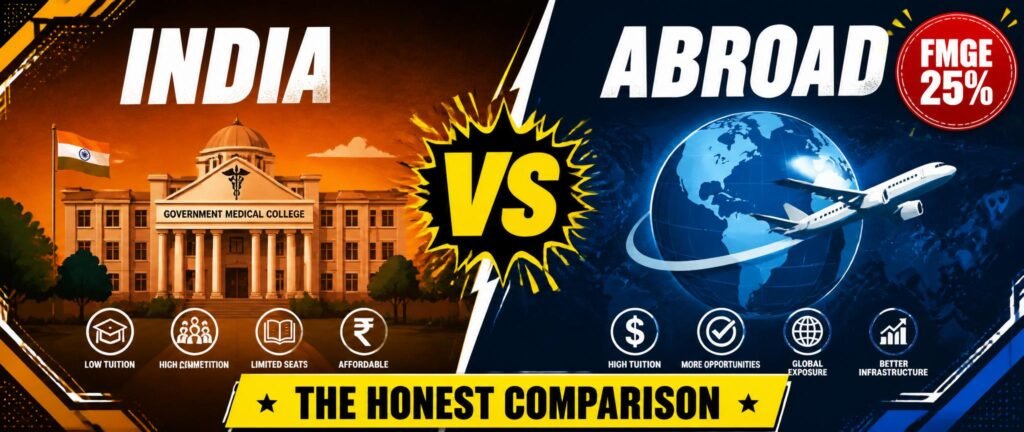
Roughly 25,000 Indian students leave for medical degrees overseas every year, most of them after missing a government seat and recoiling from private fees. The MBBS abroad vs India NEET 2026 decision is usually framed as a simple cost comparison — ₹25 lakh there versus ₹60 lakh here. That framing is incomplete and it costs students years. The number that actually decides your outcome is not tuition. It is the licensing exam pass rate. Before you weigh anything, read our deemed university fees guide and the private MBBS fees breakdown so you are comparing real numbers.
Table of Contents
MBBS Abroad vs India NEET 2026: The Cost Comparison, Honestly
| Route | Realistic Total Cost |
|---|---|
| Government college (India) | ₹2–5 lakh |
| State private college (India) | ₹25–60 lakh |
| Deemed university (India) | ₹53 lakh – ₹1.4 crore |
| MBBS abroad (NMC-compliant) | ₹20–45 lakh |
On tuition alone, MBBS abroad cost sits well below Indian private and deemed options. That gap is real and it is why the option exists. But before treating it as the deciding factor, check whether you have exhausted the cheaper route entirely — a state quota seat at ₹2–5 lakh beats every alternative on this table, and students routinely skip state counselling rounds they were eligible for. Review college options at your score and whether an education loan for MBBS makes an Indian seat viable before ruling either out.
The Number That Actually Matters: FMGE Pass Rate
To practise medicine in India after graduating abroad, you must clear the Foreign Medical Graduate Examination. The FMGE pass rate is where most of the honest conversation lives.
In the January 2026 session, roughly 25.4% of 42,872 candidates passed. Recent sessions have ranged between about 20% and 30%. Country-wise performance varies considerably — Georgia, Bangladesh, and Russia have historically posted stronger outcomes than the Philippines or Kyrgyzstan, though published figures differ by source and year.
Read that carefully. Around three in four foreign medical graduates do not clear the exam on a given attempt. Many need two or three attempts spread over eighteen months to two years, during which they cannot practise at all. Anyone weighing MBBS abroad vs India NEET 2026 should also know what careers with a NEET score exist outside MBBS entirely.
One important nuance in fairness: students from stronger universities who prepare systematically for the India-specific syllabus alongside their degree report far better outcomes — commonly cited in the 50–70% range. The low national average reflects preparation habits as much as institutional quality. If you go abroad and treat the licensing exam as a Year-1 priority rather than a Year-6 problem, your odds improve substantially.
NMC Rules You Cannot Negotiate Around
The NMC foreign medical graduate rules — formally the Foreign Medical Graduate Licentiate Regulations, 2021 — govern every foreign MBBS degree recognised in India. Violating any single condition disqualifies your degree entirely:
- NEET qualification is mandatory before you join — minimum 50th percentile for General category
- At least 54 months of academic study plus 12 months of clinical internship, completed in the same university and country
- English medium of instruction throughout
- The degree must license you to practise in that country, not just to hold a certificate
- The university must be listed in the World Directory of Medical Schools
The 54-month rule is the one agents most often omit. Several heavily marketed five-year programmes do not satisfy it without an additional internship year, and students discover this only after graduating. Verify the university listing yourself at search.wdoms.org before paying anyone a rupee. The NMC has issued public warnings about agents falsely claiming “NMC approval” for foreign colleges.
NExT Exam Changes the Comparison
The NExT exam — the National Exit Test — will replace both the FMGE and NEET PG. Critically, the NExT exam applies to everyone — a graduate of AIIMS, a deemed university, or a Russian state university all sit the same paper to obtain a licence.
This narrows one traditional advantage of studying in India. It does not eliminate it, because Indian curricula are built around the same syllabus NExT tests, while foreign curricula are not. But it does mean the “foreign graduate stigma” argument is weaker than it was five years ago.
Career Outcomes Beyond the Licence
Assuming you clear the licensing exam, the paths converge more than students expect:
- PG admission in India — through NExT, on equal footing with Indian graduates
- International pathways — a WHO-listed degree keeps USMLE (USA), PLAB (UK), and AMC (Australia) open
- Clinical exposure — this genuinely varies. Indian teaching hospitals typically carry far higher patient volumes than most overseas partner hospitals, which matters for practical training
Clinical exposure is often the underweighted factor in the MBBS abroad vs India NEET 2026 comparison, and it is the one that shapes you as a practitioner rather than as a licence-holder.
Who Should Actually Consider Abroad
Going overseas makes reasonable sense if:
- Your budget caps out around ₹20–45 lakh in total MBBS abroad cost and Indian private fees are genuinely unreachable
- You have exhausted AIQ and state counselling across all rounds
- You have verified the university’s WDOMS listing and 54-month compliance against the NMC foreign medical graduate rules yourself
- You accept that you will need to self-study the Indian syllabus throughout the degree
It makes poor sense if:
- You have a realistic government option you have not fully pursued across every round
- You are relying entirely on an agent’s assurances without independent verification
- You would be borrowing beyond your family’s capacity anyway
- A focused repeat attempt could realistically lift your score into government range
Decide on Evidence, Not on Brochures
The MBBS abroad vs India NEET 2026 question has no universal answer. Abroad is a legitimate, NMC-recognised route that has produced thousands of practising Indian doctors. It is also an industry with heavy marketing incentives and material information routinely left unsaid. Verify every claim independently, budget for licensing-exam attempts rather than assuming one, and exhaust your Indian government options completely before you sign anything. The degree is achievable either way. The licence is what you are actually buying.
❓ FAQ
Q: Is NEET mandatory to study MBBS abroad? A: Yes. Under NMC regulations, every Indian student must qualify NEET-UG before joining a foreign medical programme. Without a valid NEET qualification you cannot obtain the Eligibility Certificate and cannot appear for FMGE or NExT on return, regardless of where you studied.
Q: What is the current FMGE pass rate? A: In the January 2026 session, approximately 25.4% of 42,872 candidates cleared the exam. Recent sessions have generally ranged between 20% and 30%. Pass rates vary meaningfully by country and university, so check outcomes for the specific institution you are considering.
Q: How much does MBBS abroad actually cost? A: The realistic all-in total at NMC-compliant universities runs roughly ₹20–45 lakh over six years, including tuition, hostel, and living costs. This compares with ₹2–5 lakh for a government seat in India and ₹53 lakh to ₹1.4 crore for a deemed university.
Q: What is the 54-month rule? A: NMC requires a minimum of 54 months of academic study plus a 12-month clinical internship, completed in the same university and country. Programmes shorter than this are not recognised. This is the most commonly omitted condition in agent marketing, so verify it yourself.
Q: Will the NExT exam affect foreign medical graduates differently? A: The NExT exam applies uniformly to all medical graduates, whether they studied in India or abroad. Everyone must clear it to obtain a licence and to access PG admission. Indian curricula align more closely with the tested syllabus, so foreign graduates typically need additional self-directed preparation.
Q: How do I verify a foreign university is genuinely recognised? A: Check the university’s listing in the World Directory of Medical Schools at search.wdoms.org yourself. Do not rely on an agent’s claim of “NMC approval” — the NMC has issued public warnings that no such approval list exists for individual foreign colleges.