
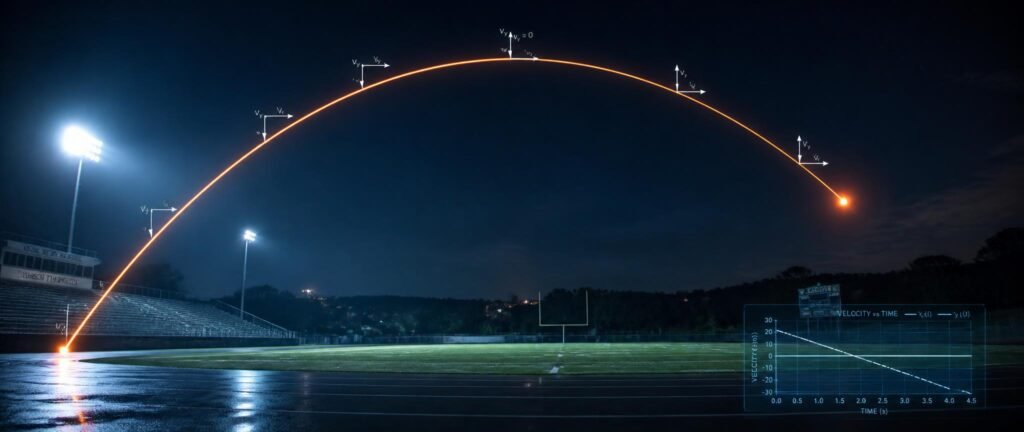
Kinematics covers two NCERT chapters, Motion in a Straight Line and Motion in a Plane, and together they form the base of all mechanics. This kinematics NEET PYQ analysis breaks down which question types NTA repeats, where students lose marks, and how to turn this unit into a guaranteed score.
Before diving in, make sure you have the bigger picture from our complete NEET Physics strategy. Kinematics is where that strategy starts.
You can also jump straight into practice with the free Motion in a Straight Line PYQs and Motion in a Plane PYQs, then return here to review the patterns.
Table of Contents
Why Kinematics Matters More Than Its Question Count
NEET typically asks one to two questions directly from Kinematics. But the ideas show up again inside Laws of Motion, Work and Energy, and even Electrostatics, where charged particles move under constant acceleration.
So weak kinematics quietly costs you marks in three or four other chapters. Fixing it early has a multiplier effect. If you usually freeze on numericals, our guide on building physics problem intuition is a good companion to this chapter.
Kinematics NEET PYQ Analysis: The Four Question Families
After sorting a decade of NEET physics PYQs from these two chapters, the questions fall into four clear families.
| Question family | Frequency | What it tests |
|---|---|---|
| Projectile motion NEET questions | Most frequent | Range, max height, time of flight, trajectory equation |
| Motion graphs NEET questions | Very frequent | Reading slope and area from x-t, v-t and a-t graphs |
| Equations of motion | Regular | Free fall, distance in nth second, stopping distance |
| Relative velocity NEET questions | Regular | River-boat, rain-man and two-body chase problems |
Projectile motion NEET questions lead the list almost every year. Graph questions are rising too, because they test understanding rather than formula recall. To see how Kinematics compares with other units, check the NEET 2027 chapter weightage breakdown.
Projectile Motion: The Formulas You Cannot Skip
For a projectile launched with speed u at angle θ:
- Time of flight: T = 2u sinθ / g
- Maximum height: H = u² sin²θ / 2g
- Horizontal range: R = u² sin2θ / g
- Maximum range occurs at θ = 45°, where R = u²/g
One pattern NTA loves: complementary angles (θ and 90° − θ) give the same range but different heights and times. Remember also that at the highest point, velocity is purely horizontal and equals u cosθ. Mixing these up is a classic way to lose marks, so learn how to reduce negative marking losses on doubtful options.
Motion Graphs: Slope and Area
Graph questions become simple once you fix two rules in your head:
- Slope of x-t gives velocity. Slope of v-t gives acceleration.
- Area under v-t gives displacement. Area under a-t gives change in velocity.
A curved x-t graph means changing velocity. A horizontal v-t line means zero acceleration. Many students lose marks by treating area below the time axis as positive when the question asks for displacement, not distance. A clean way to stop repeating such slips is to analyse your mock test errors after every practice session.
Relative Velocity: River and Rain Problems
Relative velocity NEET questions mostly come from two setups:
- River crossing in shortest time: head straight across. Time t = d / v_boat, and drift = v_river × t.
- River crossing by shortest path: aim upstream so the resultant is straight across. This needs v_boat > v_river.
For rain problems, the direction you hold your umbrella is along the velocity of rain relative to you, not relative to the ground.
Worked PYQ-Pattern Questions
Q1. A ball is thrown at 30° and another at 60° with the same speed. What is the ratio of their ranges?
Answer: 1 : 1. Complementary angles give equal range because sin60° = sin120°.
Q2. A body falls freely from rest. What is the ratio of distances covered in the 1st, 2nd and 3rd seconds?
Answer: 1 : 3 : 5. Using sₙ = u + (a/2)(2n − 1) with u = 0, distances go as the odd numbers.
Q3. A boat moves at 5 km/h in still water across a river 1 km wide flowing at 3 km/h. If it heads straight across, how long does it take?
Answer: 12 minutes. t = 1/5 h = 12 min. The river’s speed only changes the drift, not the crossing time.
Q4. The area under a v-t graph between two instants gives:
Answer: Displacement. Area under v-t is displacement. For distance, you take the magnitude of each part separately.
Common Traps to Avoid
- Using sin θ instead of sin 2θ in the range formula
- Assuming vertical velocity at the top is not zero
- Treating negative v-t area as positive for displacement
- Mixing up shortest-time and shortest-path river crossings
- Forgetting that acceleration in projectile motion is g downward throughout
Practise Every Kinematics PYQ
The fastest way to lock in these patterns is to solve real past questions, chapter by chapter. Both Kinematics chapters are available free on Ksquare Study:
👉 Solve Motion in a Straight Line NEET PYQs
👉 Solve Motion in a Plane NEET PYQs
Start with straight-line motion, then move to projectiles. Keep a separate list of every graph question you get wrong.
Conclusion
Kinematics rewards clear thinking more than heavy calculation. Use this kinematics NEET PYQ analysis to focus on projectiles, graphs and relative velocity, then practise until each question type feels familiar. Once kinematics clicks, every mechanics chapter after it becomes easier.
❓ FAQ
Q: How many questions come from Kinematics in NEET? A: Usually one to two questions come directly from Motion in a Straight Line and Motion in a Plane combined. Kinematics ideas also appear inside other mechanics questions.
Q: What is the most important topic in Kinematics for NEET? A: Projectile motion NEET questions are the most frequent, followed by motion graphs. Relative velocity questions also appear regularly.
Q: Is Kinematics hard for NEET? A: It feels hard mainly because of vectors and graphs. Once you learn slope and area rules and the projectile formulas, most questions become direct. This kinematics NEET PYQ analysis lists every pattern you need.
Q: Should I solve Kinematics PYQs chapter-wise or year-wise? A: Start chapter-wise so you see patterns clearly. Switch to year-wise full papers closer to the exam to build timing.
Q: Where can I find Kinematics NEET PYQs for free? A: Ksquare Study has all Motion in a Straight Line and Motion in a Plane previous year questions organised chapter-wise, free to practise.
Q: Which formula is used most in Kinematics PYQs? A: The range formula R = u² sin2θ / g is used most often, along with the equations of motion for uniform acceleration.