Physics decides whether you touch a top rank or stall in the 550s, and it comes down to which books you trusted. The best physics books for NEET 2027 are not ten titles crowding a shelf — they are two or three, studied completely, in the right order.
This guide covers exactly which books to use, in what sequence, and why. See our complete NEET 2027 book guide for the full three-subject picture, pair your reading with a real physics preparation strategy, and once theory is solid, work through past NEET physics papers and a structured mock test routine to convert reading into a real score.
Table of Contents
The Best Physics Books for NEET 2027: Start With NCERT
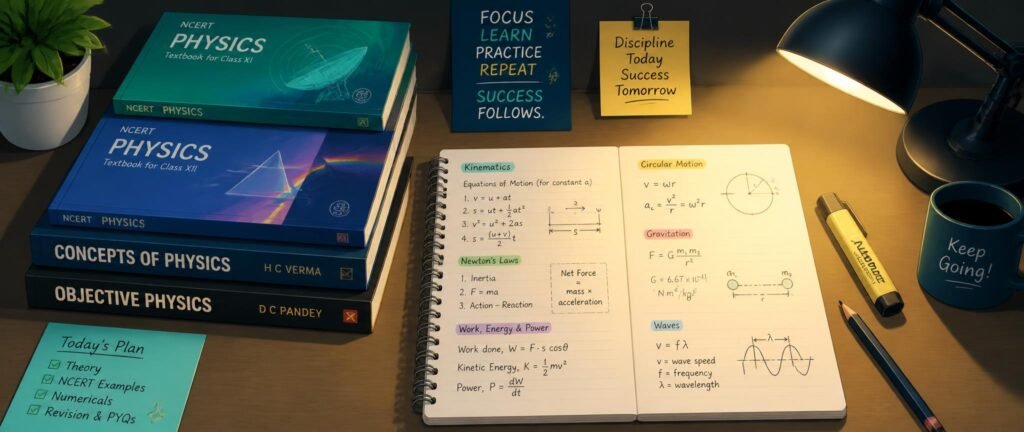
This is non-negotiable, and every topper repeats it for a reason: NCERT Physics for Class 11 and 12 is the gold standard, because every definition, formula, and solved example in it is directly examinable. Skipping NCERT to jump straight into a thick reference book is the single most common mistake NEET physics aspirants make.
Read both volumes cover to cover before touching anything else. Highlight formulas, work through every solved example by hand, and treat NCERT as your first and final word on theory — NEET physics reference books exist to build on this foundation, not replace it.
HC Verma: Concepts of Physics
Once NCERT is genuinely solid, HC Verma Concepts of Physics is where real conceptual depth comes from. Split across two volumes, it builds each idea from first principles and pushes you with exercises that sharpen problem-solving in a way NCERT alone cannot.
You do not need to solve every single exercise in HC Verma — many problems lean toward JEE-level difficulty and are not NEET’s focus. Concentrate on the concept-builder sections and the objective questions at the end of each chapter, and skip the deeper subjective derivations unless you have serious time to spare. Used this way, HC Verma Concepts of Physics remains a strong pick among the best physics books for NEET 2027 for anyone who wants to genuinely understand physics rather than memorise formulas.
DC Pandey: Objective Physics
Where HC Verma builds understanding, DC Pandey Objective Physics builds NEET-specific speed. Once your concepts are steady, this book is ideal for practising in the exact MCQ pattern the exam uses, with separate volumes covering mechanics, waves, optics, and modern physics.
If you are short on time, DC Pandey alone — paired tightly with NCERT — is often the more targeted choice, since its questions mirror NEET’s actual difficulty level far more closely than HC Verma’s occasionally JEE-leaning problems. Many students who are NEET-only, rather than also targeting JEE, find this the more efficient route.
HC Verma or DC Pandey — Do You Need Both?
This is the question every aspirant eventually asks, and the honest answer is: pick one, not both. HC Verma is better for deep conceptual grounding; DC Pandey is better for focused, NEET-pattern practice. Alternating between the two in the same week fragments your preparation instead of building it.
A sound approach for most students: use NCERT plus HC Verma through Class 11 to build fundamentals properly, then shift to NCERT plus DC Pandey through Class 12 for NEET-pattern speed and revision. Do not run both books in parallel — finish one phase before starting the next.
Rounding Out Your Physics Preparation
Once your two core resources are chosen, a few additions sharpen your final months without adding clutter:
- MTG Fingertips (Physics) — a compact, chapter-wise MCQ book, especially useful in the last 60 to 90 days for rapid revision.
- Previous year NEET papers — solving past physics papers shows you exactly how concepts get tested, which no textbook alone can replicate.
- A personal formula notebook — physics rewards daily formula revision more than any single book does, so keep one running list you revisit every morning.
Resist the urge to add a fourth or fifth reference book. A student who finishes one book completely will consistently outscore one who has skimmed three.
A Simple Physics Book Plan for NEET 2027
Here is a plan that keeps things focused rather than overwhelming:
- Months 1–4: NCERT Physics, Class 11 and 12, read fully and thoroughly.
- Months 4–8: HC Verma (concept-builder sections) or DC Pandey, chosen based on whether you also need JEE-level depth.
- Months 8–10: Previous year papers, subject-wise, timed.
- Final 60 days: MTG Fingertips for rapid MCQ revision, plus your formula notebook and regular mock tests.
This keeps your physics preparation to essentially three resources, mastered in sequence, rather than a shelf of half-read books.
Final Word
The best physics books for NEET 2027 are not a long list — they are NCERT, one strong reference between HC Verma and DC Pandey, and disciplined practice with previous year papers. Physics punishes scattered preparation more than any other NEET subject, so the fewer books you use properly, the better your score tends to be.
Choose your reference book based on your actual goal — deep understanding or NEET-pattern speed — commit to it fully, and let repetition through previous papers do the rest. That combination, applied consistently, is what actually moves a physics score from average to strong.
❓ FAQ Section
Q: What are the best physics books for NEET 2027? A: NCERT Physics for Class 11 and 12 is the essential foundation, paired with one reference book — either HC Verma’s Concepts of Physics for conceptual depth or DC Pandey’s Objective Physics for NEET-pattern practice. MTG Fingertips is a useful addition for final revision.
Q: Should I use HC Verma or DC Pandey for NEET 2027 physics? A: Choose one, not both. HC Verma builds deeper conceptual understanding but includes some JEE-level problems, while DC Pandey is more tightly focused on NEET’s actual difficulty and question pattern, making it the more time-efficient choice for NEET-only aspirants.
Q: Is NCERT enough for NEET 2027 physics, or do I need a reference book? A: NCERT alone is not sufficient for physics, unlike biology. While it covers all the theory needed, physics numericals require the additional practice that a reference book like HC Verma or DC Pandey provides.
Q: How many times should I read HC Verma or DC Pandey? A: Rather than multiple full re-reads, focus on solving the concept-builder and objective sections thoroughly once, then revisit only the chapters or question types where you consistently make mistakes during practice and mock tests.
Q: Can I crack NEET 2027 physics with only NCERT and one reference book? A: Yes. Students who score 650 and above typically use fewer books studied completely, rather than many books studied partially. NCERT plus one well-chosen reference book, combined with previous year papers, is a proven and sufficient combination.