Quick answer: A rotational motion NEET PYQ analysis shows that NTA asks about two questions a year from System of Particles and Rotational Motion, and they come from five areas: moment of inertia (standard values, parallel and perpendicular axes theorems, radius of gyration), conservation of angular momentum, rotational kinematics, centre of mass, and torque with equilibrium of rigid bodies. The 2024, 2025 and 2026 papers all asked moment of inertia questions.
This guide breaks down what NTA repeats, the formulas you must know and solved PYQ-pattern numericals. Before you start, get the bigger picture from our complete NEET Physics strategy, and follow official exam news on our NEET 2027 latest updates page.
Want to test yourself first? Solve the Rotational Motion PYQs for free, then use this guide to fix the gaps.
Table of Contents
Why Rotational Motion Deserves Extra Time
The chapter has about 100 past questions, and many students fear it. In practice, this rotational motion NEET PYQ analysis shows that most questions use one table of moments of inertia, the parallel axis theorem and three or four relations. For chapter notes, use our Rotational Motion class 11 notes, and for a quick warm-up, try these five quick Rotational Motion questions.
Rolling motion was removed from the rationalised NCERT book; our article on rolling motion NEET syllabus explains what is in and out. Planning your year? Our guide to the NEET 2027 registration date shows when the form is expected.
Rotational Motion NEET PYQ Analysis: What NTA Repeats
When you sort the past NEET physics PYQs from this chapter, five question types cover nearly everything.
| Question type | Frequency | What it tests |
|---|---|---|
| Moment of inertia | Most frequent | Standard values, parallel and perpendicular axes theorems, radius of gyration, bodies with cavities |
| Angular momentum | Very frequent | L = Iω, conservation, effect on kinetic energy |
| Rotational kinematics | Very frequent | Angular velocity, acceleration, number of revolutions |
| Centre of mass | Regular | Two-particle systems, motion of the centre of mass under internal forces |
| Torque and equilibrium | Regular | τ = r × F, principle of moments, rigid body equilibrium |
Moment of Inertia: The Table to Memorise
| Body | Axis | Moment of inertia |
|---|---|---|
| Ring | Through centre, perpendicular to its plane | MR² |
| Ring | About a diameter | ½MR² |
| Disc | Through centre, perpendicular to its plane | ½MR² |
| Disc | About a diameter | ¼MR² |
| Solid sphere | About a diameter | ⅖MR² |
| Hollow sphere | About a diameter | ⅔MR² |
| Thin rod | Through centre, perpendicular to length | ML²/12 |
| Thin rod | Through one end, perpendicular to length | ML²/3 |
Radius of gyration (K): I = MK². For a ring about its axis, K = R; for a disc about its axis, K = R/√2; for a rod about its centre, K = L/√12.
Parallel and Perpendicular Axes Theorems
- Parallel axis theorem: I = Icm + Md², where Icm is the moment of inertia about a parallel axis through the centre of mass and d is the distance between the two axes. It works for any body.
- Perpendicular axis theorem: for a flat (planar) body only, Iz = Ix + Iy, where x and y lie in the plane of the body and z is perpendicular to it.
These two theorems turn the standard values into almost any answer NEET asks. For example, a ring about a tangent in its plane has I = ½MR² + MR² = 3/2 MR².
Angular Momentum and Its Conservation
| Relation | Meaning |
|---|---|
| L = r × p | Angular momentum of a particle |
| L = Iω | Angular momentum of a rigid body |
| τ = dL/dt | Torque is the rate of change of angular momentum |
| Iω = constant | When the external torque is zero, angular momentum is conserved |
| KE = ½Iω² = L²/2I | Rotational kinetic energy |
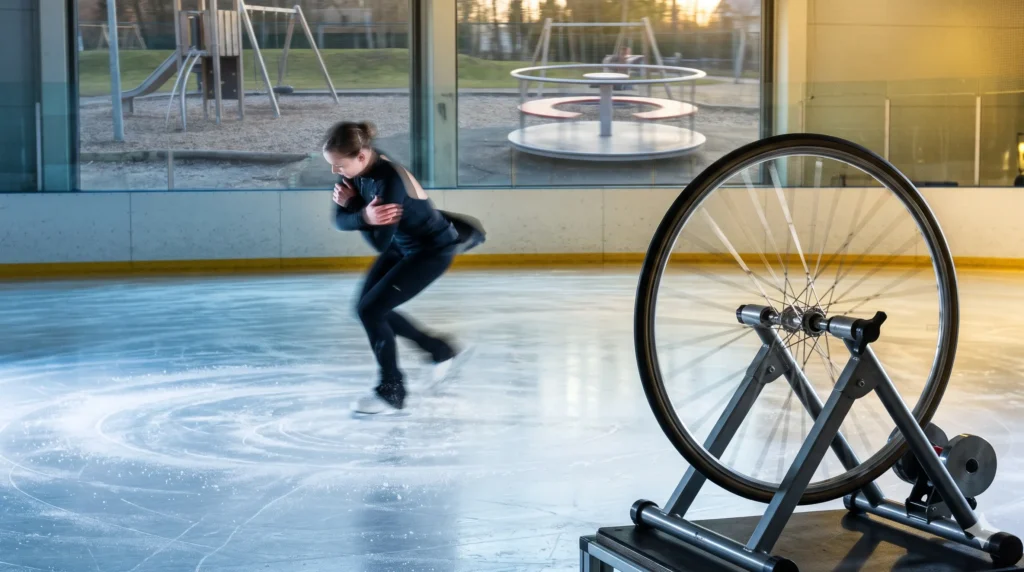
Conservation of angular momentum explains why an ice skater or ballet dancer spins faster when pulling the arms in: I falls, so ω rises. Because KE = L²/2I, the kinetic energy increases when I decreases, with the extra energy coming from the work done by the dancer’s muscles.
Rotational Kinematics
For constant angular acceleration α:
- ω = ω₀ + αt
- θ = ω₀t + ½αt²
- ω² = ω₀² + 2αθ
- Number of revolutions = θ/2π
Other relations: work done by a torque = τθ, and power = τω.
Centre of Mass
- For two particles: x(cm) = (m₁x₁ + m₂x₂)/(m₁ + m₂).
- Internal forces cannot change the motion of the centre of mass. If a shell explodes in mid-air, its centre of mass keeps moving along the same parabola.
- M × a(cm) = total external force. When the external force is zero, the total linear momentum of the system is conserved.
Torque and Equilibrium of Rigid Bodies
- Torque: τ = r × F, with magnitude τ = rF sinθ.
- A rigid body is in mechanical equilibrium when the net external force and the net external torque are both zero.
- Principle of moments (lever): load × load arm = effort × effort arm.
- A couple is a pair of equal and opposite forces with different lines of action; it produces rotation without translation.
Linear vs Rotational Motion
| Linear motion | Rotational motion |
|---|---|
| Displacement x | Angular displacement θ |
| Velocity v | Angular velocity ω |
| Acceleration a | Angular acceleration α |
| Mass m | Moment of inertia I |
| Force F = ma | Torque τ = Iα |
| Linear momentum p = mv | Angular momentum L = Iω |
| Kinetic energy ½mv² | Kinetic energy ½Iω² |
A Note on Rolling Motion
Rolling is not in the current syllabus, but NEET 2024 still had a rolling question. Keep two results as low-priority revision: the kinetic energy of a rolling body is ½mv²(1 + K²/R²), and when bodies roll down the same incline, the solid sphere reaches the bottom first, then the disc, then the ring.
Worked PYQ-Pattern Questions
Q1. The moment of inertia of a ring of mass M and radius R about its diameter is: (a) MR² (b) ½MR² (c) ¼MR² (d) 2MR²
Answer: (b) ½MR². By the perpendicular axis theorem, Ix + Iy = MR² and Ix = Iy, so each is ½MR².
Q2. A wheel starts from rest with an angular acceleration of 2 rad/s². How many revolutions does it make in 10 s?
θ = ½αt² = ½ × 2 × 10² = 100 rad. Revolutions = 100/2π.
Answer: About 15.9 revolutions.
Q3. Using the parallel axis theorem, find the moment of inertia of a thin rod about one end.
I = ML²/12 + M(L/2)² = ML²/12 + ML²/4.
Answer: ML²/3.
Q4. An ice skater pulls in her arms, halving her moment of inertia. What happens to her angular velocity and kinetic energy?
Angular momentum is conserved, so ω doubles. KE = L²/2I, so with L constant and I halved, KE doubles.
Answer: Angular velocity doubles; kinetic energy doubles.
Q5. The radius of gyration of a disc about its own axis is:
Answer: R/√2, since I = ½MR² = MK².
Q6. A shell explodes in mid-air. What happens to the path of its centre of mass?
Answer: It continues along the same parabola, because the forces of the explosion are internal.
Common Traps in This Chapter
- Using the perpendicular axis theorem for a solid sphere (it applies only to flat bodies)
- Writing ML²/12 for a rod about its end (that is about its centre)
- Saying kinetic energy stays constant when a skater pulls in her arms (angular momentum stays constant; KE rises)
- Forgetting to divide by 2π when converting radians to revolutions
- Thinking an explosion changes the path of the centre of mass
- Mixing up ½MR² (disc about its axis) with ¼MR² (disc about a diameter)
Practise Every Rotational Motion PYQ
This rotational motion NEET PYQ analysis shows you where the marks are. Solving real past questions makes the formulas automatic. Every System of Particles and Rotational Motion previous year question is available chapter-wise, free:
👉 Solve all Rotational Motion NEET PYQs
Keep the moment of inertia table beside you for the first round, then solve the second round without it.
Conclusion
Rotational Motion looks hard, but most of its questions come from one table and a few relations. Use this rotational motion NEET PYQ analysis to master moments of inertia and the two axes theorems, angular momentum and its conservation, rotational kinematics, centre of mass and torque. Then solve the past numericals until each one takes under a minute.
❓ FAQ
Q: How many questions come from Rotational Motion in NEET? A: Usually about two questions a year from System of Particles and Rotational Motion.
Q: What is the most important topic in Rotational Motion for NEET? A: Moment of inertia, including standard values and the parallel and perpendicular axes theorems, followed by conservation of angular momentum.
Q: Is rolling motion in the NEET 2027 syllabus? A: It is not in the current syllabus or the rationalised NCERT book, but a rolling question did appear in 2024, so keep the basic results as low-priority revision.
Q: When does the perpendicular axis theorem apply? A: Only to flat (planar) bodies such as rings, discs and plates, where Iz = Ix + Iy.
Q: Why does a spinning skater speed up when she pulls her arms in? A: Her moment of inertia decreases, and since angular momentum Iω is conserved, her angular velocity increases.
Q: Where can I practise Rotational Motion NEET PYQs for free? A: You can solve every Rotational Motion previous year question chapter-wise for free using the practice links in this article.