
Chemistry is often called the most scoring subject in NEET, but only if all three branches, Physical, Inorganic and Organic, get equal attention. This page puts every chapter in one place: chemistry notes for class 11 and 12 PDF download, chapter by chapter, with a link to practise each chapter’s NEET previous year questions right next to it.
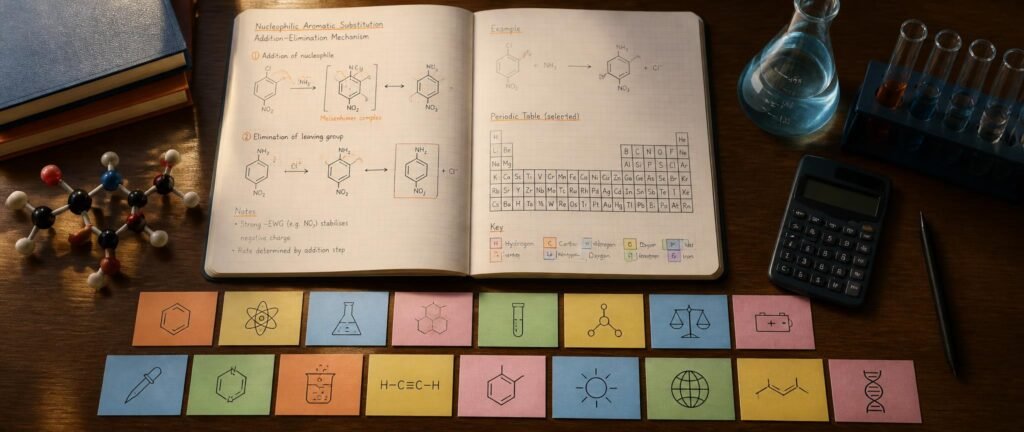
NCERT Chemistry has 19 chapters, 9 in Class 11 and 10 in Class 12. Every chapter in these chemistry notes for class 11 and 12 PDF download follows the same simple structure, so once you have used one, you know how to use all of them. If you are planning all three subjects, our physics notes for NEET and biology chapter-wise notes PDF are organised the same way.
What You Get in These Chemistry Notes
Each chapter page is written as chemistry notes for NEET 2027, not just for school exams. Here is what every chapter covers:
- Concepts in plain language, with the NCERT points NEET picks from
- Formula boxes for Physical Chemistry numericals
- Reactions and mechanisms set out step by step for Organic Chemistry
- Trends, exceptions and tables for Inorganic Chemistry
- Common mistakes and NEET traps to avoid
- A quick revision checklist at the end of each chapter
The full set of chemistry notes for class 11 and 12 PDF download is free in our study app. You can also read every chapter online, free, from the tables below.
Class 11 Chemistry Notes PDF – Chapter-wise List
Class 11 Chemistry builds the base for everything after it: the mole concept, atomic structure, bonding, equilibrium and the basics of organic chemistry. Weak Class 11 chemistry shows up as mistakes in almost every Class 12 chapter. Use this table to open any chapter’s notes or jump straight to its PYQs.
How the Class 11 Chapters Fit Together
| Branch | Chapters | Why it matters for NEET |
|---|---|---|
| Physical Chemistry | Some Basic Concepts of Chemistry, Structure of Atom, Thermodynamics, Equilibrium | Numericals and formulas; the mole concept is used in almost every later chapter. |
| Inorganic Chemistry | Classification of Elements and Periodicity in Properties, Chemical Bonding and Molecular Structure, Redox Reactions | Periodic trends, hybridisation and VSEPR shapes are asked very often. |
| Organic Chemistry | Organic Chemistry: Some Basic Principles and Techniques, Hydrocarbons | The base of all of organic chemistry: electronic effects, isomerism and reaction types. |
Tip: Finish Some Basic Concepts of Chemistry and Organic Chemistry: Some Basic Principles and Techniques first. They support every numerical and every organic reaction that comes later. Good class 11 chemistry notes PDF revision here pays off for the next two years.
Class 12 Chemistry Chapter Wise Notes PDF – Full List
Class 12 Chemistry has more organic chapters and more reactions to remember. Short, structured class 12 chemistry chapter wise notes PDF revision and regular PYQ practice make the biggest difference here.
How the Class 12 Chapters Fit Together
| Branch | Chapters | Why it matters for NEET |
|---|---|---|
| Physical Chemistry | Solutions, Electrochemistry, Chemical Kinetics | Formula-based numericals; quick marks with regular practice. |
| Inorganic Chemistry | The d- and f-Block Elements, Coordination Compounds | Coordination compounds, isomerism and the properties of transition elements are frequent. |
| Organic Chemistry | Haloalkanes and Haloarenes, Alcohols, Phenols and Ethers, Aldehydes, Ketones and Carboxylic Acids, Amines, Biomolecules | Named reactions, conversions and mechanisms; the largest block of Class 12 Chemistry. |
Warning: Don’t try to memorise organic reactions as a list. Learn the mechanism once, and most reactions in a chapter will make sense on their own.
How to Use Chemistry Notes for Class 11 and 12 PDF Download for NEET 2027
Each branch of chemistry needs a slightly different approach, but the same short loop works for every chapter:
- Read the chapter notes once, slowly. In Physical Chemistry, work out each formula; in Organic, follow each mechanism step.
- Solve that chapter’s NEET PYQs the same day, using the PYQ link in the tables above. This shows you exactly how NEET asks that chapter.
- Mark your mistakes and go back to the matching section. Most mistakes come from units in numericals, exceptions in Inorganic, and reagents in Organic.
- Revise from the PDF every week. Reactions and trends fade quickly without regular revision.
Repeat this loop for all 19 chapters, one chapter at a time. That is how chemistry notes for NEET 2027 turn into marks, not just reading time.
Which Chapters to Do First
If time is short, start with the chapters that support the rest of the syllabus:
- Class 11: Some Basic Concepts of Chemistry, Chemical Bonding and Molecular Structure, and Organic Chemistry: Some Basic Principles and Techniques
- Class 12: Coordination Compounds, Chemical Kinetics, and Aldehydes, Ketones and Carboxylic Acids
These chapters connect to many others and are tested regularly.
NEET Chemistry Tips That Save Marks
Good NEET chemistry notes PDF revision is only half the job. These habits protect the marks you have already earned:
- Balance the three branches. Don’t spend all your time on Organic while Physical numericals go unpractised.
- Keep a reaction notebook. Write each named reaction with its reagent and conditions on one page.
- Learn trends with their exceptions. NEET Inorganic questions often target the exception.
- Check units in numericals. Many wrong options come from unit mistakes, not wrong concepts.
- Read NCERT Inorganic carefully. Many Inorganic questions come straight from NCERT lines and tables.
Most lost marks in NEET Chemistry come from small slips with units, exceptions and reagents, not from not knowing the chapter.
Get Every Chapter PDF Free
Every chapter’s NEET chemistry notes PDF is free in our NEET study app. Open it, apply the coupon code, and the full set of chemistry notes for class 11 and 12 PDF download unlocks at no cost, ready for offline revision.
Conclusion
Chemistry can be your most scoring subject when all three branches move together. With chemistry notes for class 11 and 12 PDF download covering all 19 chapters, a link to each chapter’s NEET PYQs, and a simple read–solve–revise loop, you can turn it into a reliable source of marks. Pick one chapter from the tables above today, finish the loop, and move to the next one tomorrow.
Frequently Asked Questions
Q. Where can I get chemistry notes for class 11 and 12 PDF download for free? Every chapter’s notes PDF is free in our NEET study app; unlock it with the coupon code. You can also read all 19 chapters online from the tables on this page.
Q. How many chapters are there in Class 11 and Class 12 Chemistry? NCERT Chemistry has 9 chapters in Class 11 and 10 in Class 12, so 19 in total. All 19 are listed on this page in NCERT order, from the Class 11 list to the class 12 chemistry chapter wise notes PDF list, each with its own notes page and NEET PYQ link.
Q. Are these chemistry notes enough for NEET 2027? These chemistry notes for NEET 2027 cover the NCERT chapters that NEET Chemistry is based on, with formulas, reactions, trends and common traps for each. Use them along with the NCERT textbook and regular PYQ practice, and check the official NEET 2027 syllabus from NTA once it is released.
Q. Which Chemistry chapters are most important for NEET? Chemical bonding, coordination compounds, organic basics, chemical kinetics, equilibrium and the organic reaction chapters usually account for a large share of NEET Chemistry questions, so give them extra time in your NEET chemistry notes PDF revision.
Q. Where can I practise NEET Chemistry PYQs chapter-wise? Each chapter in the Class 11 and Class 12 tables above has a PYQ link that opens that chapter’s NEET previous year questions, free and with answers.
Q. Which branch of Chemistry should I start with? Start with Physical and basic Organic Chemistry from Class 11, because they support everything after them. Class 11 chemistry notes PDF revision of the mole concept and organic basics early on makes Class 12 much easier.