Quick answer: An evolution NEET PYQ analysis shows that NTA asks about two questions a year from this chapter, and most come from five areas: homologous and analogous organs, human evolution (brain sizes and the order of ancestors), the Hardy-Weinberg principle and the factors that disturb it, types of natural selection with adaptive radiation, and the origin of life with the Miller experiment. Almost every question is a direct NCERT example or line.
This guide breaks down what NTA repeats, the tables to memorise and PYQ-pattern questions with answers. For the topic that sits right before it in Class 12, see our Genetics PYQ analysis.
Want to test yourself first? Solve the Evolution PYQs for free, then use this guide to fix the gaps.
Table of Contents
Why Evolution Is a Reliable Scoring Chapter
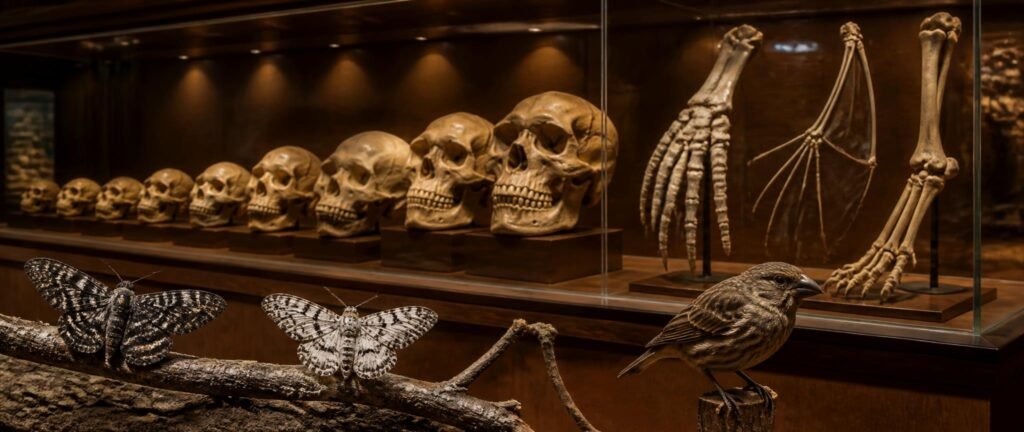
Evolution has one of the largest PYQ banks in Zoology, yet its questions keep returning to the same NCERT examples: whale and bat forelimbs, Darwin’s finches, the peppered moth, Homo habilis and Neanderthal man. Learn those examples well and the chapter becomes almost guaranteed marks. For chapter notes, use our Evolution class 12 notes, and to see where it sits among other chapters, check the NEET 2027 chapter weightage.
Our list of the most repeated biology chapters shows how often Class 12 Zoology chapters like this one return in past papers.
Evolution NEET PYQ Analysis: What NTA Repeats
When you sort the past NEET biology PYQs from this chapter, five question types cover nearly everything.
| Question type | Frequency | What it tests |
|---|---|---|
| Homologous and analogous organs | Most frequent | Divergent vs convergent evolution, NCERT examples |
| Human evolution | Very frequent | Order of ancestors, brain capacities, features of each |
| Hardy-Weinberg principle | Very frequent | Allele frequency calculations, five disturbing factors |
| Natural selection and adaptive radiation | Regular | Stabilising, directional and disruptive selection; Darwin’s finches; marsupials |
| Origin of life and theories | Regular | Miller experiment, Oparin–Haldane, Lamarck, Darwin, de Vries |
For a quick warm-up, try these five quick Evolution questions.
Homologous and Analogous Organs
| Feature | Homologous organs | Analogous organs |
|---|---|---|
| Structure | Same basic structure | Different structure |
| Function | Different functions | Same function |
| Type of evolution | Divergent evolution | Convergent evolution |
| Animal examples | Forelimbs of whale, bat, cheetah and human; vertebrate hearts and brains | Wings of butterfly and bird; eyes of octopus and mammals; flippers of penguin and dolphin |
| Plant examples | Thorn of Bougainvillea and tendril of Cucurbita | Sweet potato (root modification) and potato (stem modification) |
The most common trap is the potato pair: they store food in the same way but come from different organs, so they are analogous, not homologous.
Other Evidences for Evolution
- Fossils in rock layers show that life forms have changed over time.
- Industrial melanism: in England before industrialisation, white-winged peppered moths (Biston betularia) were more common. After industrialisation, tree trunks were darkened by soot and lichens disappeared, so dark-winged moths survived better and became more common.
- Anthropogenic action: excessive use of herbicides, pesticides and antibiotics has selected resistant varieties in a short time.
Adaptive Radiation and Convergent Evolution
- Adaptive radiation is the evolution of different species from one ancestor, spreading into new habitats. NCERT examples: Darwin’s finches on the Galapagos Islands, and Australian marsupials.
- When more than one adaptive radiation produces similar forms in isolated areas, it is called convergent evolution. Example: placental mammals and Australian marsupials, such as the placental wolf and the Tasmanian wolf.
Theories of Evolution
| Scientist | Idea | NCERT example |
|---|---|---|
| Lamarck | Use and disuse of organs | Long neck of the giraffe |
| Darwin | Natural selection and branching descent; fitness means reproductive fitness | Darwin’s finches |
| Alfred Wallace | Reached similar conclusions to Darwin | Worked in the Malay Archipelago |
| Hugo de Vries | Mutation theory: large, sudden changes (saltation) that are random and directionless | Evening primrose (Oenothera lamarckiana) |
A favourite comparison: Darwinian variations are small and directional, while de Vries’s mutations are large and directionless.
Hardy-Weinberg Principle
In a population that is not evolving, allele frequencies stay constant from generation to generation.
p + q = 1 and p² + 2pq + q² = 1
Here p and q are the frequencies of the two alleles, p² and q² are the homozygous frequencies, and 2pq is the heterozygous frequency.
Five factors disturb Hardy-Weinberg equilibrium:
- Gene migration (gene flow)
- Genetic drift (when it happens by chance in a small founding group, it is called the founder effect)
- Mutation
- Genetic recombination
- Natural selection
Types of Natural Selection
| Type | What happens | Effect on the curve |
|---|---|---|
| Stabilising | More individuals acquire the mean character | Peak gets higher and narrower |
| Directional | More individuals acquire a value other than the mean | Peak shifts to one side |
| Disruptive | More individuals acquire values at both extremes | Two peaks form |
Origin of Life
| Idea or experiment | Key point |
|---|---|
| Spontaneous generation | Disproved by Louis Pasteur using pre-sterilised flasks |
| Oparin and Haldane | First life came from pre-existing non-living organic molecules (chemical evolution) |
| S.L. Miller (1953) | Electric discharge in a closed flask of CH₄, H₂, NH₃ and water vapour at 800 °C produced amino acids |
| Panspermia | Units of life (“spores”) transferred to Earth from other planets |
Human Evolution: The Table NTA Keeps Asking
| Ancestor | Time | Key features |
|---|---|---|
| Dryopithecus and Ramapithecus | About 15 million years ago | Hairy, walked like gorillas and chimpanzees; Ramapithecus was more man-like, Dryopithecus more ape-like |
| Australopithecines | About 2 million years ago | East African grasslands; hunted with stone weapons, ate fruit |
| Homo habilis | — | First human-like being; brain 650–800 cc; probably did not eat meat |
| Homo erectus | About 1.5 million years ago | Brain about 900 cc; probably ate meat; fossils found in Java (1891) |
| Neanderthal man | 1,00,000–40,000 years ago | Brain about 1400 cc; lived in east and central Asia; used hides and buried the dead |
| Homo sapiens | Arose in Africa | Modern Homo sapiens appeared between 75,000 and 10,000 years ago; cave art about 18,000 years ago; agriculture about 10,000 years ago |
The brain sizes 650–800 cc, 900 cc and 1400 cc are asked as a matching question more often than anything else in this section.
Worked PYQ-Pattern Questions
Q1. Which pair shows analogous organs? (a) Forelimbs of whale and bat (b) Thorn of Bougainvillea and tendril of Cucurbita (c) Sweet potato and potato (d) Hearts of fish and mammals
Answer: (c) Sweet potato and potato. One is a root and the other a stem, so they are analogous. The other options are homologous.
Q2. In a population, the frequency of the recessive homozygous genotype (q²) is 0.16. What is the frequency of heterozygotes?
q = √0.16 = 0.4, so p = 1 − 0.4 = 0.6. Heterozygotes = 2pq = 2 × 0.6 × 0.4 = 0.48.
Answer: 0.48, or 48%.
Q3. The brain capacity of Homo erectus was about: (a) 650–800 cc (b) 900 cc (c) 1400 cc (d) 1650 cc
Answer: (b) 900 cc. Homo habilis had 650–800 cc, and Neanderthal man about 1400 cc.
Q4. Darwin’s finches are an example of:
Answer: Adaptive radiation. Different species evolved from one ancestral seed-eating form to fill different niches.
Q5. Which of these does not disturb Hardy-Weinberg equilibrium? (a) Gene migration (b) Genetic drift (c) Random mating in a large population (d) Mutation
Answer: (c). Random mating in a large population is one of the conditions that keeps the equilibrium; the others are disturbing factors.
Q6. In Miller’s experiment, which of these was not used in the flask? (a) CH₄ (b) NH₃ (c) O₂ (d) H₂
Answer: (c) O₂. The early atmosphere was reducing, so Miller used methane, ammonia, hydrogen and water vapour.
Common Traps in This Chapter
- Calling sweet potato and potato homologous
- Swapping the brain sizes of Homo habilis (650–800 cc) and Homo erectus (900 cc)
- Saying Homo habilis ate meat (NCERT says it probably did not)
- Mixing up Ramapithecus (more man-like) and Dryopithecus (more ape-like)
- Forgetting that Hugo de Vries worked on the evening primrose
- Linking industrial melanism with the white moth increasing after industrialisation
Practise Every Evolution PYQ
This evolution NEET PYQ analysis shows you where the marks are. Solving real past questions makes the examples and numbers automatic. Every Evolution previous year question is available chapter-wise, free:
👉 Solve all Evolution NEET PYQs
Keep the ancestors table and the homology table beside you for the first round, then solve the second round without them.
Conclusion
Evolution has a large PYQ bank, but its questions keep returning to the same NCERT examples. Use this evolution NEET PYQ analysis to master homologous and analogous organs, the human evolution table, the Hardy-Weinberg principle and the types of natural selection. Then practise the past questions until every example comes to you without thinking.
❓ FAQ
Q: How many questions come from Evolution in NEET? A: Usually about two questions a year, mostly direct NCERT examples, human evolution facts and Hardy-Weinberg questions.
Q: What is the most important topic in Evolution for NEET? A: Homologous and analogous organs are the most tested, followed by human evolution and the Hardy-Weinberg principle.
Q: Are sweet potato and potato homologous or analogous? A: Analogous. Sweet potato is a modified root and potato is a modified stem, but both store food.
Q: What are the five factors that disturb Hardy-Weinberg equilibrium? A: Gene migration or gene flow, genetic drift, mutation, genetic recombination and natural selection.
Q: What was the brain capacity of Neanderthal man? A: About 1400 cc. Homo habilis had 650–800 cc and Homo erectus about 900 cc.
Q: Where can I practise Evolution NEET PYQs for free? A: You can solve every Evolution previous year question chapter-wise for free using the practice links in this article.