
The NCERT lab manual is the most under-revised, over-tested section of the entire NEET syllabus. Students spend hours on theory chapters and barely glance at the practicals appendix — right up until NEET physics chemistry practical questions show up on the actual paper, testing a vernier scale reading or a titration colour change that was covered in a single afternoon lab session years ago. This article pulls together the specific experimental physics NEET NCERT content and practical chemistry NEET high yield topics — the experiments, apparatus details, and error-analysis questions that repeat most often — so lab manual revision stops being an afterthought.
Table of Contents
Why NEET Physics Chemistry Practical Questions Deserve Dedicated Prep
Practical-based questions feel unfamiliar precisely because they’re rarely revised with the same intensity as theory chapters, even though NTA draws directly and repeatedly from the same NCERT lab manual experiments every single year. This gap is exactly why NEET physics chemistry practical questions catch well-prepared students off guard — these questions don’t require lab access to master, they require knowing the apparatus, the standard procedure, and the specific numbers (least counts, standard errors, characteristic colours) that NCERT’s practical sections state explicitly.
This connects closely with building genuine physics intuition, since practical questions reward understanding why a procedure works — why a screw gauge is more precise than a vernier caliper, why a null-point method cancels out certain errors — rather than memorising the steps mechanically. This is exactly the mindset separating students who guess on NEET physics chemistry practical questions from those who actually reason through them.
High-Yield Physics Experiments From the Lab Manual
These NEET practical based questions physics papers return to most consistently span a narrow, learnable set of experiments — not the entire lab manual.
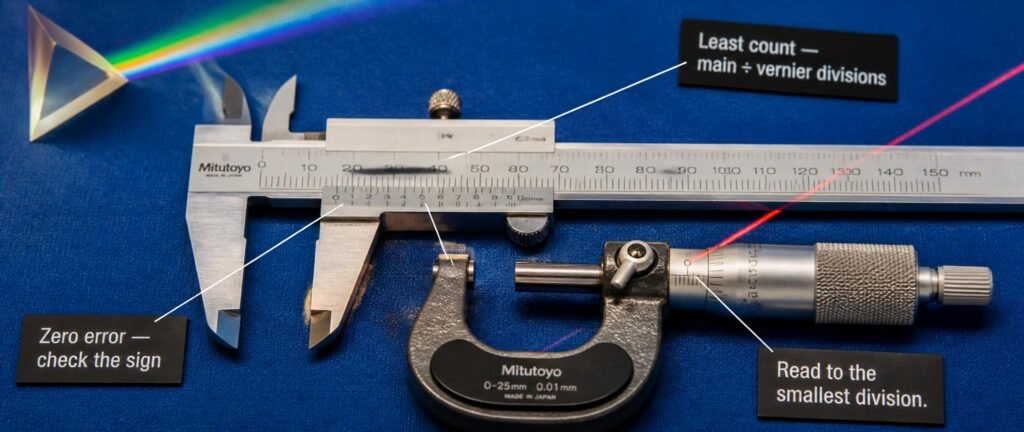
- Vernier calipers and screw gauge (least count and zero error). The vernier caliper’s least count formula (1 main scale division ÷ number of vernier scale divisions) and the screw gauge’s least count (pitch ÷ number of circular scale divisions) are tested directly and frequently, along with positive and negative zero error correction — a distinction NEET loves testing through slightly-off diagrams.
- Simple pendulum: time period versus length. This experiment is a goldmine for graph-based questions, since plotting T² against L gives a straight line whose slope directly yields 4π²/g — a favourite way to test whether students understand graphical data extraction, not just the pendulum formula itself.
- Verification of Ohm’s law using a potentiometer setup. Circuit diagram identification questions frequently ask you to spot a missing ammeter, a wrongly placed rheostat, or an incorrectly connected galvanometer.
- Meter bridge experiment for unknown resistance. The balance-point condition and the underlying Wheatstone bridge principle are tested both conceptually and numerically, often through a “what happens if the balance point shifts” style question.
- Focal length of a concave mirror or convex lens using the u-v method. Sign convention errors are the single most common trap here — NEET frequently uses this experiment specifically to test whether students apply the Cartesian sign convention correctly under pressure.
- Resonance tube for the speed of sound. The end-correction concept — accounting for the small extra length beyond the tube’s open end — is a frequently overlooked detail that shows up as a direct numerical trap.
Dimensional analysis shortcuts are unexpectedly useful here too, since checking whether a calculated slope or intercept has the right physical units is often the fastest way to catch a setup error in a graph-based practical question before committing to a final answer. Having the right physics reference books that include a proper practicals section helps here too, since many standard references treat lab manual content as an afterthought despite its consistent presence on the actual exam.
High-Yield Chemistry Experiments From the Lab Manual
These NEET chemistry lab manual questions cluster around a handful of recurring procedures, making focused revision far more efficient than trying to cover every possible experiment equally.
This overlaps significantly with a solid grasp of the organic chemistry reagent list, since many identification tests below are simply theory-chapter reagents applied in a lab context. Similarly, inorganic chemistry color tests feed directly into salt analysis, since the flame tests and precipitate colours tested in theory are exactly what practical salt-analysis questions expect you to recall. Solving previous year papers specifically for practical-based questions is the fastest way to see exactly which experiments NTA returns to most often.
- Detection of functional groups. Tollens’ and Fehling’s tests for aldehydes, the ceric ammonium nitrate test for alcohols, and bromine water decolourisation for unsaturation are all frequently tested, usually through “which test confirms which group” style questions rather than full procedural recall.
- Salt analysis: cation and anion identification. Characteristic flame colours, specific precipitate colours with group reagents, and gas evolution tests (like the smell and litmus behaviour of evolved gases) form a dense, high-yield cluster of practical chemistry facts.
- Acid-base and redox titrations. Indicator colour changes at the endpoint — phenolphthalein turning pink in basic conditions, methyl orange shifting in acidic conditions — and the specific colour change in a KMnO₄ redox titration (from purple to colourless, or the reverse persisting pink endpoint) are tested precisely, not approximately.
- pH determination using universal indicator or a pH meter. Questions here often test the colour-to-pH mapping directly, expecting exact recall rather than general acid/base reasoning.
- Preparation of standard solutions. Molarity and normality calculations from a given mass and volume appear as short, calculation-based practical questions distinct from the main stoichiometry chapter.
This overlaps significantly with the specific tests and colours covered in the earlier sections, since practical recall works best when tied directly to the theory it’s built on.
The Graph-Reading Skill That Physics Practicals Test Repeatedly
A large share of physics practical questions aren’t really about the experiment at all — they’re about reading a graph correctly. NEET frequently shows a plotted line and asks what the slope or intercept physically represents, or shows a slightly different graph shape and asks what experimental error would produce it. Practicing this specific skill — translating a graph’s shape into physical meaning — pays off across nearly every experiment listed above, since the underlying reasoning (slope equals rate, intercept equals initial condition, non-linearity equals a broken assumption) repeats regardless of which apparatus generated the data.
Common Errors in Least Count and Zero Error Questions
Positive zero error is subtracted from the observed reading; negative zero error is added — a rule students frequently apply backwards under exam pressure specifically because the sign convention feels counterintuitive at first glance. A vernier caliper or screw gauge diagram showing the zero mark slightly off-center is one of NEET’s most reliable practical-question setups, and getting comfortable reading these diagrams correctly, quickly, under time pressure is worth deliberate, repeated practice rather than a single theoretical explanation.
Building a System to Revise Practicals
Treat the lab manual as its own dedicated revision unit, separate from theory chapters, with a simple table: Experiment Name, Key Apparatus, Formula or Reading Rule, and One Common Trap. Revise this table on its own spaced schedule rather than folding it into general Physics or Chemistry revision, since practical questions test a distinct kind of recall — procedural and numerical precision — that general concept revision doesn’t naturally reinforce.
Final Word
Lab manual questions feel like an afterthought until they cost four marks for a reading rule that takes thirty seconds to memorise properly. NEET physics chemistry practical questions aren’t testing whether you’ve held a screw gauge in your hands — they’re testing whether you’ve actually sat down with the lab manual the same way you’d sit down with a theory chapter, which is precisely the gap this revision system is built to close. Treat NEET physics chemistry practical questions as their own scoring category, and this becomes one of the most reliable, least-competed sources of marks on the entire paper.
Frequently Asked Questions
Q: How many marks do practical-based questions typically account for in NEET? A: The exact number varies by year, but Physics and Chemistry practical questions consistently appear across recent NEET papers, making dedicated lab manual revision a meaningful and reliable source of marks rather than an occasional bonus.
Q: Do I need to have performed these experiments myself to answer questions about them? A: No. NEET tests knowledge of the procedure, apparatus, formulas, and common errors as described in the NCERT lab manual, not hands-on experience, so thorough manual revision is sufficient preparation.
Q: Which physics experiments are most frequently tested? A: The simple pendulum, screw gauge and vernier caliper least count questions, and the meter bridge experiment appear especially often, largely because they combine conceptual understanding with precise numerical recall.
Q: Which chemistry practicals should I prioritise if I’m short on time? A: Functional group detection tests and salt analysis (cation/anion identification) offer the highest return for revision time invested, since they’re tested frequently and rely on compact, memorisable fact sets.
Q: Are graph-based practical questions harder than direct recall questions? A: They require a different skill — interpreting slope and intercept meaning — rather than being inherently harder. Students who practice this translation skill specifically tend to find these questions become straightforward with repetition.
Q: Should practicals be revised alongside theory chapters or separately? A: Separately, ideally with their own dedicated revision table, since practical questions test specific procedural and numerical details that general theory revision often doesn’t reinforce on its own.