
Somewhere in a NEET exam hall right now, a student is burning ninety precious seconds setting up a full derivation for a numerical that could have been solved in fifteen. The formula sheet in their head is correct. The instinct to reach for it first is the problem. The best dimensional analysis tricks NEET physics rewards aren’t back-up plans for when you forget a formula — they’re a faster, calculus-free lane that runs parallel to full derivation, and the students hitting 170+ in Physics use dimensional analysis tricks NEET physics constantly, often without even solving the “real” equation at all.
Table of Contents
Why Dimensional Analysis Tricks NEET Physics Actually Rewards More Than You’d Expect
NEET Physics is built almost entirely on algebra-level formulas dressed up to look like calculus problems. A question about escape velocity, time period, or drift velocity looks intimidating because of the Greek letters and derivation history behind it — but the actual number-crunching required in the exam hall rarely needs the calculus that originally derived the formula. What it does need is a sharp eye for dimensions, magnitudes, and limiting behaviour, which is exactly where dimensional analysis tricks NEET physics questions consistently reward speed over depth.
This works best once you’ve done the groundwork of building physics intuition first, because dimensional shortcuts are a layer on top of understanding, not a replacement for it — you still need to know what a formula represents before you can sanity-check it this fast. These calculus free physics NEET techniques also pair well with the right physics reference books that explicitly teach dimensional reasoning rather than just listing formulas to memorise.
The Core Trick: Let Dimensions Fight Your Battles For You
Every physical quantity in NEET Physics can be broken into powers of Mass [M], Length [L], and Time [T]. Force is [M¹L¹T⁻²]. Energy is [M¹L²T⁻²]. Once you can write these fluently, you gain a superpower most students never use aggressively enough, and it’s arguably the single most valuable of all dimensional analysis tricks NEET physics has to offer: you can check whether an entire equation is even possible before doing a single calculation.
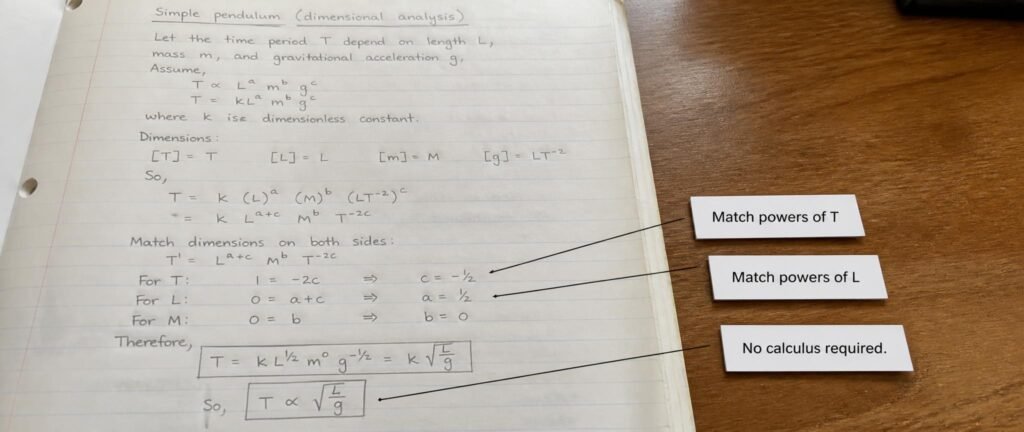
Take the classic pendulum time period formula, T = 2π√(l/g). Most students memorise this. Almost none derive it in the exam hall using calculus, because they don’t need to — dimensional analysis alone tells you the shape of the answer. Time has dimension [T¹]. Length l has dimension [L¹]. Acceleration due to gravity g has dimension [L¹T⁻²]. If T depends on some combination l^a · g^b, then dimensionally: [T¹] = [L¹]^a · [L¹T⁻²]^b = [L^(a+b) T^(-2b)]. Matching powers of T gives -2b = 1, so b = -1/2. Matching powers of L gives a + b = 0, so a = 1/2. The result — T ∝ √(l/g) — falls out in three lines, with zero calculus, and it’s exactly the relationship the “real” derivation eventually reaches through a differential equation you’ll never actually need to solve on exam day.
The Instant-Elimination Trick: Cross Out Options Before You Calculate
Here’s where dimensional analysis becomes a genuine time-machine. In a four-option NEET question, at least one wrong option is almost always dimensionally impossible — meaning you can eliminate it in under two seconds without touching a single number. If a question asks for a frequency and one option has units of metres, that option is dead on arrival, full stop, regardless of how it was derived. This overlaps directly with the elimination technique for guessing, because a dimensionally impossible option is one of the cleanest, fastest eliminations available in the entire exam — no ambiguity, no partial credit for “close enough.” This kind of dimension elimination NEET shortcuts thinking is especially powerful in rotational motion numericals and current electricity formula checks, where unfamiliar-looking formulas make a quick dimension check the fastest way to build confidence before committing to a full calculation. Managing exam time around Physics specifically benefits from this kind of fast screening becoming automatic well before exam day, since every second saved here is a second available for a numerical that genuinely needs full calculation.
A subtler version of this trick works on the numbers themselves, not just the units. If a numerical answer for a car’s speed comes out to 4,500 — and the question is clearly describing everyday highway driving — you don’t need to recheck your algebra to know something’s wrong. You need a sense of scale. This is the entire spirit of Fermi estimation, one of the most reliable NEET physics quick estimation methods available: before solving precisely, ask what order of magnitude the answer should land in, and treat any option wildly outside that range as suspicious immediately.
Approximation Tricks That Save Real Seconds
These NEET physics approximation techniques don’t replace precise calculation — they screen out setup errors before you’ve invested a full minute in a wrong direction.
- Round g to 10, not 9.8, unless the question demands precision. NEET rarely tests your ability to multiply by 9.8 — it tests whether you understand the physics. Rounding shaves seconds off every kinematics and gravitation numerical without meaningfully changing the answer’s magnitude.
- Use small-angle and small-quantity approximations aggressively. For small angles, sin θ ≈ θ and tan θ ≈ θ (in radians) — a substitution that turns intimidating trigonometric expressions into simple linear ones, particularly useful in oscillations and optics.
- Binomial approximation for small corrections. When you see (1 + x)^n with x much smaller than 1, approximate it as 1 + nx instead of expanding fully. This single trick quietly powers half of the “small correction” numericals in gravitation, relativity-adjacent, and error-analysis questions.
- Check units mid-calculation, not just at the end. If you’re three steps into a calculation and the units stop making sense, you’ve made an error — catching it at step three costs far less time than catching it after computing a wrong final answer. This habit alone is one of the more underrated dimension elimination NEET shortcuts, since most students only check units as an afterthought once they already suspect something is wrong.
The Limiting-Case Trick: Physics’ Best-Kept Secret
This is the single most underused shortcut in NEET Physics, and it deserves far more attention than it gets among calculus free physics NEET techniques generally. Whenever a formula involves a variable that can meaningfully go to zero, infinity, or some obvious extreme, plug that extreme in and see if the result matches physical common sense. If it doesn’t, the formula (or the option) is wrong — full stop, no further calculation needed.
Take a projectile range formula, R = (v²sin2θ)/g. Set θ = 0. Physically, a projectile launched horizontally along the ground shouldn’t travel any horizontal range in this idealised sense — and sin(0) = 0, so R = 0. Correct. Now set θ = 90°. A projectile launched straight up goes straight up and comes straight back down — zero horizontal range. sin(180°) = 0, so R = 0 again. Correct. This limiting-case check takes four seconds and instantly validates (or destroys) an entire formula, which is invaluable for unfamiliar rotational or circular motion setups especially, since those formulas often look unfamiliar enough that a quick sanity check saves you from a completely wrong setup.
The same logic applies beautifully to circuits. If a formula for equivalent resistance gives a larger value for resistors in parallel than either individual resistor, something has gone wrong — parallel resistance should always be smaller than the smallest individual resistor, a limiting-case intuition worth double-checking whenever a circuit numerical feels unfamiliar.
Putting It All Together: The Three-Second Scan
Before committing to a full calculation, run this sequence on any unfamiliar-looking numerical: first, check dimensions — does the formula even produce the right type of quantity? Second, check magnitude — is the expected answer in a sane range for the physical scenario described? Third, check a limiting case — does the formula behave sensibly at an extreme value of one variable? Any one of these three checks catching a problem saves you from a wrong answer and the negative marking that comes with it, all without solving a single full numerical. This three-second scan only pays off under real time pressure if it’s already automatic well before exam day.
Final Word
Calculus never actually shows up in the NEET Physics answer sheet — it lives quietly behind the formulas, doing its job long before you ever see the question. What you’re actually being tested on is whether you can recognise structure, sanity-check magnitude, and eliminate the impossible fast enough to leave time for the numericals that genuinely need full calculation. Master these dimensional analysis tricks NEET physics rewards, and Physics stops being the subject you’re racing against and starts being the subject you’re racing ahead in — because once dimensional analysis tricks NEET physics questions demand become instinct, most numericals reveal their answer’s shape before you’ve even picked up your pen.
Frequently Asked Questions
Q: Can dimensional analysis actually derive a full formula, or only check one? A: It can derive the shape of many formulas — like the pendulum time period example — up to an unknown constant like 2π, which dimensional analysis alone cannot determine. For NEET’s purposes, that’s usually enough to eliminate wrong options or double-check your setup.
Q: Is it risky to round g to 10 instead of 9.8 in every question? A: For most conceptual and speed-focused numericals, rounding is safe and expected. Only avoid it in questions that explicitly demand high precision or where the answer options are close enough that rounding could shift you to a neighbouring option.
Q: How do I know which limiting case to test in an unfamiliar formula? A: Look for a variable that has an obvious physical extreme — an angle going to 0° or 90°, a mass going to zero, a distance going to infinity — and check whether the formula’s behaviour at that extreme matches what you’d physically expect.
Q: Does relying on approximation techniques hurt accuracy in NEET Physics? A: Not when used correctly. These techniques are for elimination and sanity-checking, not for replacing precise calculation on the final numerical you commit to. Used as a screening layer, they improve accuracy by catching setup errors early.
Q: Which chapters benefit most from dimensional analysis tricks? A: Mechanics, gravitation, oscillations, and electromagnetism benefit the most, since these chapters are formula-dense and frequently test relationships between quantities rather than pure memorised numbers.
Q: Should I practice these tricks separately, or will they develop naturally? A: They develop far faster with deliberate practice. Pick five previously solved numericals and explicitly redo them using only dimensional checks, magnitude estimation, and limiting cases before verifying with the full calculation.
[…] Dimensional analysis shortcuts are unexpectedly useful here too, since checking whether a calculated slope or intercept has the right physical units is often the fastest way to catch a setup error in a graph-based practical question before committing to a final answer. Having the right physics reference books that include a proper practicals section helps here too, since many standard references treat lab manual content as an afterthought despite its consistent presence on the actual exam. […]
[…] rubber, because it has a higher Young’s modulus. Many of these are ratio questions, and our dimensional analysis shortcut tricks help you check them […]