
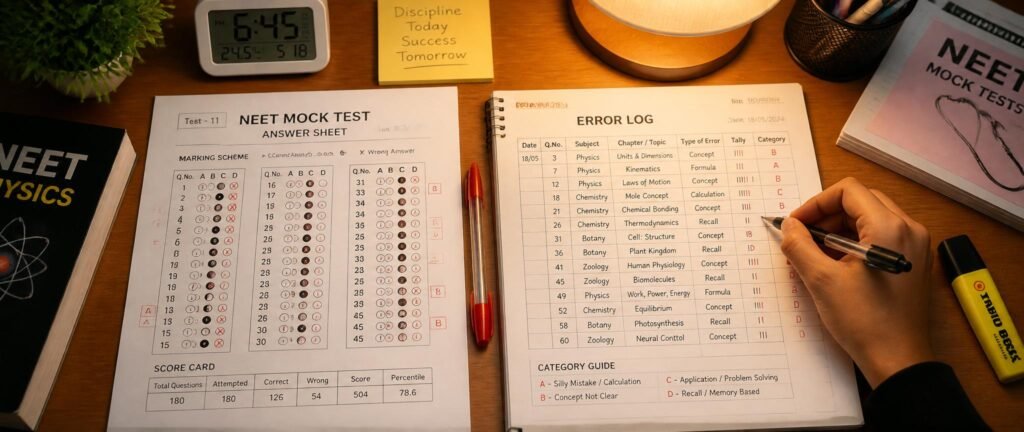
Most students don’t know how to analyse NEET mock test results — they treat them as score checks. They finish a paper, look at the number, feel good or bad about it, and move on. That’s not how mock tests work — and it’s the reason many students plateau despite taking test after test.
Re-NEET 2026 mock test analysis is the process that turns a mock score into actual improvement. Without it, you’re just practising your weaknesses repeatedly without fixing them. With it, every mock test becomes a targeted diagnostic tool that tells you exactly what to revise before June 21.
Table of Contents
The Problem With Just Checking Your Score
Understanding how to analyse NEET mock test results starts with recognising what a score alone cannot tell you. A score of 520 tells you almost nothing useful on its own. It doesn’t tell you whether you lost marks in Physics numericals or Biology assertion-reason questions. It doesn’t tell you if you’re making silly errors or knowledge gaps. It doesn’t tell you whether your time management cost you 20 marks.
Knowing how to analyse NEET mock test results properly extracts all of that information — and turns it into a specific action plan for your next revision session.
Step 1: Categorise Every Wrong Answer
Immediately after finishing a mock test, go through every question you got wrong and put it into one of four categories:
Category A — Knowledge Gap You didn’t know the answer because you haven’t studied that concept or chapter adequately. Fix: go back to the NCERT chapter and revise it within 24 hours.
Category B — Silly Error You knew the concept but made a calculation mistake, misread the question, or selected the wrong option by accident. Fix: no revision needed — but note the pattern. If Category B errors consistently happen in Physics numericals, you need to slow down by 15 seconds per question on numericals.
Category C — Confusion Between Options You narrowed it down to two options and picked the wrong one. Fix: this signals partial knowledge — go back to the NCERT line that separates these two options. It’s almost always a single sentence you skimmed over.
Category D — Time Pressure You left it blank or guessed because you ran out of time. Fix: this is a time management problem, not a knowledge problem. Review the Re-NEET 2026 time management strategy and adjust your section-wise time allocation.
This categorisation is the foundation of effective Re-NEET 2026 mock test analysis — and the starting point of any serious NEET mock test error analysis process. Most students’ errors split roughly 40% Category A, 25% Category B, 25% Category C, and 10% Category D — though your distribution will be different.
Step 2: Track Your Error Pattern Across Tests
One wrong answer tells you nothing. Three wrong answers in the same chapter tells you everything. This cross-test NEET mock test error analysis is what turns scattered mistakes into a pattern you can fix.
Your NEET mock test error analysis tool is simple — after every mock test, maintain an error log — a notebook page or spreadsheet with three columns: Chapter, Category (A/B/C/D), and Date. After 3–4 mock tests, patterns emerge clearly:
- If Genetics appears 6 times in Category A → dedicate a full revision session to Genetics before the next test
- If Physics Optics appears 4 times in Category B → you’re rushing that section; slow down
- If Electrochemistry appears 5 times in Category C → you know it partially; find the one NCERT paragraph you keep missing
This cross-test pattern analysis is what separates structured Re-NEET 2026 mock test analysis from random revision. Your Re-NEET 2026 Biology quick revision and Re-NEET 2026 Chemistry formula sheet are the revision tools — the error log tells you exactly which sections of them to prioritise.
Step 3: Analyse Your Attempt Pattern
Your score doesn’t just depend on what you knew — it depends on how you attempted the paper. After each mock, answer these three questions:
Did you finish all 180 questions? If no, note how many were left unattempted and which subject they were from. If you consistently leave 15+ Physics questions untouched, your attempt order needs to change — do Physics earlier or reduce time spent per question.
How many questions did you attempt that you got wrong? Calculate your accuracy rate: Correct ÷ Attempted × 100. If your NEET mock test accuracy rate is below 70%, you’re attempting too many uncertain questions. Apply a stricter negative marking filter — only attempt if you can eliminate 2 options.
Which section took the most time? If Chemistry consistently runs over 55 minutes, something is wrong in how you’re approaching Chemistry questions. Use the Biology last 15 days plan period to sharpen the fastest section so it creates more time buffer for Chemistry and Physics.



Step 4: The 24-Hour Revision Rule
The most important rule in Re-NEET 2026 mock test analysis: every Category A error (knowledge gap) — the core of Re-NEET 2026 weak area revision — must be revisited within 24 hours of the mock test.
After 24 hours, memory consolidation during sleep has processed the test experience — your brain is primed to accept the correct information. After 48 hours, that window starts to close. After a week, you’ve largely forgotten the specific question that exposed the gap.
The revision doesn’t need to be deep. Read the relevant NCERT paragraphs, understand the concept, and write down the key line in your error log. That’s enough. Deep Re-NEET 2026 weak area revision is reserved for chapters where Category A errors appear more than 3 times across tests.
What a Good Mock Score Actually Means
A score improvement from 480 to 540 across three mock tests means your Re-NEET 2026 mock test analysis is working. But don’t confuse mock score with actual exam score — mock tests from coaching institutes often skew easier or harder than the actual paper.
What matters is the trajectory and the error reduction:
- Fewer Category A errors in chapters you’ve revised → your analysis is working
- Same Category B errors repeating → you’re not addressing the root habit
- Improving accuracy rate → your negative marking filter is calibrating correctly
Use mock scores as directional indicators, not absolute predictors. The Re-NEET 2026 exam pattern article gives you the official question distribution so you can also check whether your mock test mirrors the actual NEET format.
Final Word
Every mock test you’ve taken is data. Most of it is sitting unused in discarded answer sheets.
Start your Re-NEET 2026 mock test analysis today — categorise your errors, build your error log, apply the 24-hour rule. Re-NEET 2026 weak area revision driven by error data, not guesswork, is what drives the biggest score jumps in the final weeks. The students who improve most are not the ones who take the most mock tests. They’re the ones who get the most out of each one.
FAQ Section
Q: How many mock tests should I take before Re-NEET 2026? A: Quality over quantity. Two well-analysed mock tests per week produce more improvement than one unanalysed test per day. If you take a mock test without completing a full Re-NEET 2026 mock test analysis, you’ve wasted the test.
Q: How long should mock test analysis take? A: Categorising errors for a 180-question paper typically takes 45–60 minutes. That time is not optional — it’s the most productive revision session you can do that day. A mock test without analysis is just a score; a mock test with analysis is a revision plan.
Q: Should I re-attempt the questions I got wrong? A: Yes — but specifically Category A and Category C errors. Re-attempt them 24–48 hours after the test (not immediately), after revisiting the relevant NCERT content. This is the only way to confirm the knowledge gap has been filled.
Q: My mock scores keep fluctuating. Is that normal? A: Completely normal. Score fluctuation of ±30–40 marks between mock tests is standard and often reflects paper difficulty variation, not your actual preparation level. Focus on your error categories and accuracy rate — these are more stable indicators of progress than raw score.
Q: What is a good NEET mock test accuracy rate to target? A: Target 80%+ accuracy (correct answers ÷ attempted questions). Below 70% means you’re attempting too many uncertain questions and losing marks to negative marking. A NEET mock test accuracy rate above 85% with a high attempt rate means your preparation is strong.
Q: Should I use only official NTA mock tests or coaching institute tests? A: Use both, but trust NTA mock tests more for difficulty calibration. Coaching institute tests often have different difficulty curves. For Re-NEET 2026 mock test analysis, what matters is your error pattern — which is consistent regardless of which test you’re using.
[…] — treating each mock as a diagnostic tool rather than a performance review. Pair this with analyzing mock test performance patterns across several attempts, and you start seeing which mistakes are one-off slips and which […]