
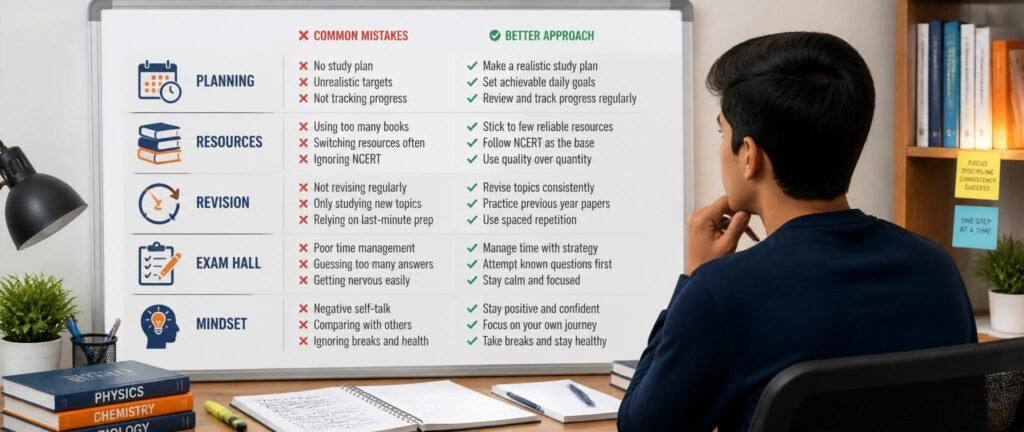
Most students who don’t crack NEET didn’t fail because they were incapable — they failed because of avoidable mistakes that compounded quietly over months of preparation. Understanding the common NEET 2027 mistakes that drain marks is as valuable as knowing the right study strategy, because every mistake you identify now is a mistake you’re not making in the exam hall. This guide breaks them into five clear categories so you can audit your own preparation honestly. Check your test habits against a strong NEET 2027 mock test strategy and, if you’re early in your journey, align your timeline with this guide on when to start NEET 2027 before any of these mistakes have a chance to take root.
Table of Contents
Why Common NEET 2027 Mistakes Keep Repeating
These mistakes are common because they feel logical in the moment. Using a thick reference book feels thorough. Skipping revision to cover new chapters feels productive. Attempting every question feels brave. The problem is that NEET punishes each of these instincts specifically — and students repeat them because nobody told them how costly the habit is until after the result.
Category 1 — Planning and Timeline Mistakes
Starting too late. The most expensive mistake in NEET is losing months before genuinely beginning. Late starters compress revision cycles, skip mock test series, and spend the final weeks in panic mode rather than consolidation mode.
No priority order. Treating every chapter as equally important wastes time in low-yield areas while high-yield ones remain weak. The NEET 2027 syllabus weightage should drive your entire study sequence — start with the chapters that carry the most marks, not the ones you happen to find interesting.
Ignoring Class 11. Nearly half of NEET comes from Class 11 topics. Students in Class 12 frequently deprioritise this half of the syllabus and pay for it in the final score.
Category 2 — Resource and Study Method Mistakes
Abandoning NCERT for reference books. NCERT is the primary source of most NEET questions, particularly in Biology and inorganic chemistry. Students who leave NCERT half-read in favour of thicker, more “serious-looking” books often score less, not more. Knowing the true role of NCERT vs reference books saves months of misdirected effort.
Collecting too many books and finishing none. Five half-read books produce worse results than one thoroughly mastered source. Resource hoarding creates the illusion of preparation while avoiding the discomfort of deep practice.
Passive reading. Reading the same chapter repeatedly without testing recall feels like studying. It isn’t. Marks in NEET come from active retrieval — solving questions, recalling from a blank page, making errors and fixing them — not from recognising familiar text.
Category 3 — Revision and Consistency Mistakes
Leaving revision entirely to the end. Without spaced revision built into the daily schedule, everything studied in August is gone by January. Revision is not an end-of-prep activity — it’s a continuous one. A disciplined NCERT revision for NEET 2027 system running in parallel with new learning is what separates retaining students from re-learning students.
Studying in bursts with no routine. A 12-hour Sunday session followed by three skipped days produces less learning than four steady three-hour weekdays. Consistency compounds; irregularity doesn’t. A fixed daily routine for NEET 2027 is what protects your study hours from life’s interruptions.
Comfort zone studying. Spending the most time on subjects you already know best feels rewarding but produces diminishing returns. Weak chapters, not strong ones, hold the most improvement potential.



Category 4 — Exam-Hall Mistakes
Attempting uncertain questions. Negative marking means a wrong answer costs five effective marks — the one deducted plus the four not earned. Attempting questions outside genuine confidence, hoping for luck, reliably depresses scores.
Changing correct first answers. Studies on test-taking consistently show that first instincts are more often right than the second-guessed revision. Changing an answer without a clear, logical reason is a common source of avoidable marks lost.
Poor time management. Running out of time in the last 20 minutes creates panic that causes impulsive marking, unanswered Biology questions, and rushed Physics. Timed mock practice is the only reliable fix.
Not reading questions carefully. Tricky NEET questions often hinge on a single word — “incorrect,” “not,” “except.” Students who read fast under pressure frequently answer the question they expected rather than the one asked.
Category 5 — Mindset Mistakes
Comparing progress to peers. Another student’s mock scores, study hours, or chapter completion are irrelevant to your preparation. Comparison creates anxiety that disrupts the very focus improvement requires.
Treating one bad mock as a signal to quit. A low mock score is data, not destiny. Students who abandon their preparation after a poor result throw away the most useful feedback the mock provides.
Underestimating Biology. Biology is 360 of 720 marks. Students who pour disproportionate energy into Physics and Chemistry while giving Biology leftover time consistently leave the most marks on the table. Repeaters who want to boost their NEET 2027 score should audit their subject time split first.
The Most Common NEET 2027 Mistakes Pattern to Avoid
The costliest pattern isn’t one mistake — it’s the cluster. A student who skips NCERT, delays revision, avoids mocks, and guesses under exam pressure is stacking five compounding errors. Each one makes the others worse. Fix them one category at a time, starting with planning, and the rest become easier.
Final Thoughts
Common NEET 2027 mistakes are avoidable by design. The students who score highest aren’t the most talented — they’re the ones who eliminated these errors early, built consistent habits, and treated every gap as fixable rather than final. Run an honest audit of your preparation against each category above. The mistakes you catch now won’t cost you marks on exam day.
FAQ Section
Q: What is the biggest mistake students make in NEET preparation? A: Skipping NCERT in favour of reference books while delaying mock tests — two mistakes that compound and leave students with gaps they don’t discover until exam day.
Q: Do students lose marks due to negative marking in NEET? A: Yes. Attempting questions outside genuine confidence is one of the most common score leaks. Each wrong answer costs four effective marks — one deducted plus three not earned.
Q: What study habit mistakes hurt NEET scores the most? A: Passive reading instead of active recall, comfort zone studying of familiar topics, and leaving revision entirely to the final weeks.
Q: Is ignoring Class 11 a big mistake for NEET 2027? A: Very. Nearly half of NEET comes from Class 11 topics. Students who deprioritise this half of the syllabus consistently underperform their potential.
Q: How do I avoid silly mistakes in NEET 2027? A: Practise under timed mock conditions to build reading accuracy, never change a first answer without a logical reason, and use a skip-and-return system for uncertain questions.
Q: What are common last-minute NEET preparation mistakes? A: Picking up entirely new topics in the final days, disrupting sleep for extra study hours, and attempting too many uncertain questions during the actual exam.