
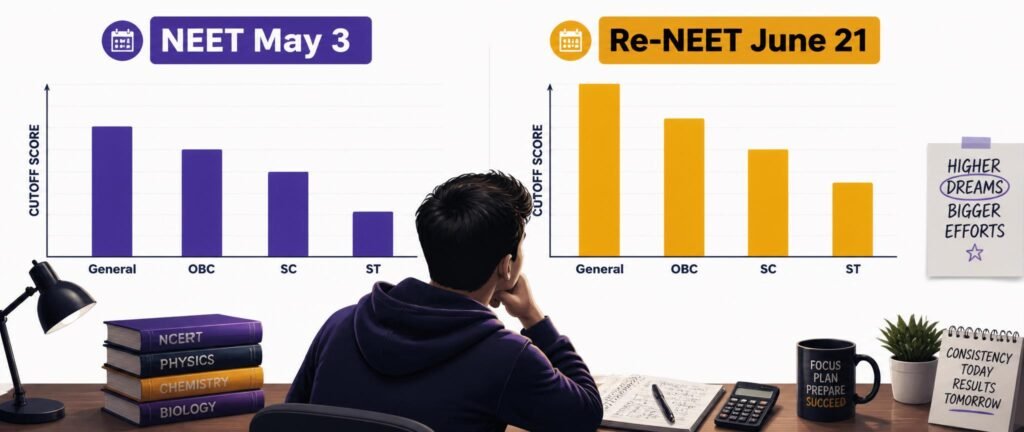
The Re-NEET 2026 cutoff comparison is the question every student preparing for June 21 actually wants answered — not just “what is the cutoff” but specifically: will the bar be higher than the original May 3 exam? And if so, by how much?
The honest answer is: yes, the admission cutoff for Re-NEET 2026 is expected to be higher than the original NEET 2026 — for reasons that are completely data-backed and predictable. But the qualifying cutoff (the minimum marks to pass NEET) is unlikely to change significantly.
This Re-NEET 2026 cutoff comparison article breaks down exactly what changed, what didn’t, and what score you actually need to aim for on June 21.
Table of Contents
First — Understanding the Two Different Cutoffs
This is the #1 confusion among students. There are actually two completely separate cutoffs in NEET, and they are not the same number.
Cutoff Type 1: The Qualifying Cutoff (NTA)
This is the minimum marks to pass NEET — the threshold you must cross to be eligible for counselling. It is set by NTA as a percentile, not a fixed mark:
- General / EWS category → 50th percentile
- OBC / SC / ST category → 40th percentile
- UR / EWS-PwD → 45th percentile
- OBC / SC / ST-PwD → 40th percentile
This is the number most articles quote. In 2025, crossing this meant roughly 144 marks for General and 113 marks for OBC/SC/ST. But crossing it only means you’re eligible to participate in counselling — it does not mean you get a seat.
Cutoff Type 2: The Admission Cutoff (MCC / State Counselling)
This is the actual score at which the last candidate got a seat in a college. This is dramatically higher:
- Government MBBS (AIQ): 615–650+ for General
- Government MBBS (State Quota): 570–620 for General
- Private MBBS: 400–550 depending on college and state
When students ask “will the cutoff go higher in Re-NEET 2026?” — they are asking about Type 2. That is where the real answer lies in any Re-NEET 2026 cutoff comparison, and that is what this article focuses on.
Students who have already been tracking the Re-NEET 2026 cut-off marks history will know this distinction is critical.
5-Year Official Qualifying Cutoff Trend (NEET 2021–2025)
Here is the verified NTA-published qualifying cutoff data from the past five years. Understanding this NEET 2026 cutoff category wise trend is the foundation for any realistic Re-NEET 2026 target:
| Year | General / EWS | OBC / SC / ST | UR/EWS-PwD | OBC/SC/ST-PwD |
|---|---|---|---|---|
| 2021 | 720–138 | 137–108 | 137–122 | 121–108 |
| 2022 | 715–117 | 116–93 | 116–105 | 104–93 |
| 2023 | 720–137 | 136–107 | 136–121 | 120–107 |
| 2024 | 720–162 | 161–127 | 161–144 | 143–127 |
| 2025 | 686–144 | 143–113 | 143–127 | 126–113 |
Key observation from NEET cutoff trend analysis 2026: The qualifying cutoff is not a fixed number — it fluctuates with paper difficulty. The 2024 spike to 162 happened because NEET 2024 was an easier paper. The 2025 drop back to 144 happened because the paper was tougher.
The qualifying percentile itself (50th for General, 40th for reserved) never changes — what changes is the marks that correspond to that percentile in any given year.



NEET 2026 (May 3) — What Was the Expected Cutoff?
Before making any Re-NEET 2026 cutoff comparison, we need to establish what the NEET 2026 cutoff category wise was expected to look like had the May 3 exam stood.
The original NEET UG 2026 exam was conducted on May 3, 2026 and subsequently cancelled due to the paper leak. Based on post-exam analysis from multiple coaching institutes before cancellation:
- Paper difficulty (May 3): Overall easy to moderate
- Biology: Easy — largely direct NCERT
- Chemistry: Moderate
- Physics: Toughest section — numerical-heavy and calculation-based
Because the paper was easier than 2025, the expected qualifying cutoff for NEET 2026 (May 3) was projected at:
| Category | Expected Qualifying Marks (May 3 paper) |
|---|---|
| General / EWS | 155–165 |
| OBC / SC / ST | 125–135 |
| UR/EWS-PwD | 140–150 |
| OBC/SC/ST-PwD | 120–130 |
And the expected admission cutoff for Government MBBS seats (had the May 3 result been used):
| Category | AIQ Govt MBBS | State Quota Govt MBBS |
|---|---|---|
| General / EWS | 615–630+ | 590–610+ |
| OBC | 580–600+ | 555–575+ |
| SC | 510–530 | 490–515 |
| ST | 480–510 | 460–490 |
These are the numbers that serve as the baseline for the Re-NEET 2026 cutoff comparison.
Re-NEET 2026 (June 21) — Will the Cutoff Be Higher?
This is the core question. Here is the complete Re-NEET 2026 cutoff comparison analysis:
Factor 1: Paper Difficulty Will Likely Be Moderate-to-Tough
Historical data is clear: re-examinations in India are almost never made easier than the original. The 2015 AIPMT re-exam and NEET 2024 re-exam both followed a moderate-to-tough pattern. After the May 3 cancellation — where NTA is under severe public and legal scrutiny — it is widely expected that the June 21 paper will be more concept-driven and less predictable, to preserve fairness and prevent rank inflation.
A tougher paper → lower raw scores → lower qualifying cutoff marks (but the same percentile threshold).
Factor 2: 22.79 Lakh Better-Prepared Students
This is the factor most students miss. Even if the paper difficulty remains identical to May 3, the Re-NEET 2026 cutoff comparison changes because:
- All 22.79 lakh students have had 6–7 extra weeks of preparation since May 3
- Students who scored poorly in May are targeting aggressive improvement
- Students who scored well are trying to protect or improve their rank. If you are still finalising your subject strategy, the Re-NEET 2026 19-day sprint breaks it down hour by hour
- The competitive intensity at the 600+ score band is significantly higher than it was on May 3
More competition in the high-score band → higher admission cutoff, even at the same paper difficulty.
Factor 3: No New Seats — Same Supply, More Competition
The total available MBBS seats in India (~1.09 lakh government + private combined) has not increased between May 3 and June 21. The demand (22.79 lakh candidates) is exactly the same. Supply unchanged + intensified demand = admission cutoff moves up.
Students tracking the MBBS admission counselling roadmap will understand why seat supply directly drives cutoff numbers.
Re-NEET 2026 Expected Cutoff — Category-Wise Projections
Based on the above factors, here is the expected Re-NEET 2026 cutoff comparison against the May 3 projections:
Expected Qualifying Cutoff (Minimum to Pass NEET)
| Category | NEET May 3 (Expected) | Re-NEET June 21 (Expected) | Direction |
|---|---|---|---|
| General / EWS | 155–165 | 145–160 | ↓ Slightly lower |
| OBC / SC / ST | 125–135 | 115–128 | ↓ Slightly lower |
| UR/EWS-PwD | 140–150 | 130–145 | ↓ Slightly lower |
| OBC/SC/ST-PwD | 120–130 | 112–125 | ↓ Slightly lower |
The qualifying cutoff is expected to be marginally lower in Re-NEET 2026 if the paper is tougher — which is what historical re-exam data suggests. In other words, the Re-NEET 2026 expected qualifying marks will likely sit slightly below the May 3 projections of 155–165 for General. The Re-NEET 2026 expected qualifying marks for reserved categories are also expected to ease by 5–8 marks from the May 3 projection.
Expected Admission Cutoff (Government MBBS Seats)
| Category | NEET May 3 AIQ (Expected) | Re-NEET June 21 AIQ (Expected) | Direction |
|---|---|---|---|
| General / EWS | 615–630 | 620–640 | ↑ Higher |
| OBC | 580–600 | 585–605 | ↑ Higher |
| SC | 510–530 | 515–535 | ↑ Slightly higher |
| ST | 480–510 | 485–515 | ↑ Slightly higher |
Bottom line on the Re-NEET 2026 cutoff comparison: The qualifying bar may be slightly easier to cross. But the admission bar — the score you actually need for a government MBBS seat — is likely to be 5–15 marks higher than what was expected after May 3.
What Does This Mean for You — Score-Wise?
Here is the practical breakdown for different student profiles — use this Re-NEET 2026 cutoff comparison alongside your current mock test scores to find which band you’re in:
If you scored 450–500 in May 3:
The Re-NEET 2026 cutoff comparison works in your favour for qualifying — you can still cross the 40th–50th percentile threshold. But for a government seat, you need to push significantly beyond this range. Focus on Biology and Chemistry to gain 60–80 additional marks.
If you scored 500–580 in May 3:
You are in the most competitive band. The Re-NEET 2026 admission cutoff for many state quota government seats falls in this range. Every 10 marks here can mean 10,000 rank positions. Use your Re-NEET 2026 last-month strategy to target consistent improvement.
If you scored 580–620 in May 3:
You were borderline for government MBBS. Given that the Re-NEET 2026 cutoff is expected to be slightly higher, you cannot afford complacency. This score range needs another 20–30 marks on June 21 to remain safe.
If you scored 620+ in May 3:
You are in a strong position. The Re-NEET 2026 cutoff comparison still matters — the AIQ top colleges require 650+ — but your margin is comfortable for state quota government seats. Focus on rank protection, not panic revision.
The One Mistake to Avoid: Targeting Just the Qualifying Cutoff
Every year, lakhs of students make the same error — they study to “just clear the cutoff” and then discover that 145 marks (which clears the qualifying cutoff) gets them absolutely no medical seat anywhere in India.
The qualifying cutoff = 50th percentile = roughly 11 lakh students pass out of 22 lakh. A government MBBS seat = top ~55,000 ranks out of 22 lakh candidates.
These are completely different finish lines. Don’t train for the wrong one.
The total Re-NEET students data shows exactly how thin the margins are at the 600+ score band — understanding competition density is as important as knowing the cutoff number itself.
Safe Score Targets for Re-NEET 2026 (June 21)
Based on the Re-NEET 2026 cutoff comparison and expert projections, here are the recommended safe score targets:
The Re-NEET 2026 safe score government MBBS thresholds below are based on five-year admission data and expert analysis — not speculation.
| Goal | General | OBC | SC | ST |
|---|---|---|---|---|
| Just qualify NEET | 145+ | 115+ | 115+ | 115+ |
| Private MBBS (decent college) | 450–500 | 430–480 | 380–430 | 360–400 |
| Govt MBBS (State Quota) | 590–615 | 560–585 | 490–515 | 465–490 |
| Govt MBBS (AIQ) | 625–640+ | 595–615+ | 520–540+ | 490–515+ |
| AIIMS / Top Govt Colleges | 680+ | 660+ | 620+ | 600+ |
These are expected ranges based on NEET cutoff trend analysis 2026 and five years of NTA data. The official Re-NEET 2026 expected qualifying marks and admission cutoffs will be declared with the Re-NEET result.
Final Word: Chase Marks, Not the Cutoff
The NEET cutoff trend analysis 2026 and the Re-NEET 2026 cutoff comparison together tell one clear story — the bar is not going down. Between better-prepared students, an expected moderate-to-tough paper, and no change in seat supply, the admission cutoff for government MBBS will be at least as high as it would have been after May 3 — possibly 5–15 marks higher.
The smartest thing you can do is ignore what the cutoff “might be” and focus entirely on maximising your own score. A student who targets 640 and lands at 625 is in a far better position than a student who targets 590 and lands at 590.
Don’t aim for the cutoff. Aim well past it. Check the Re-NEET 2026 exam day checklist to make sure everything else is in order for June 21.
FAQ Section
Q: Is the Re-NEET 2026 qualifying cutoff the same as the NEET 2026 qualifying cutoff? A: The qualifying percentile is identical — 50th for General/EWS and 40th for OBC/SC/ST. What may differ is the marks that correspond to that percentile. If Re-NEET 2026 is harder than the May 3 paper, the qualifying marks will be slightly lower. If it is easier, they will be higher.
Q: What is the expected Re-NEET 2026 qualifying cutoff for General category? A: Based on an expected moderate-to-tough paper on June 21, the Re-NEET qualifying cutoff for General category is projected between 145–160 marks. However, this is an estimate — the official cutoff is declared with the result.
Q: Will the admission cutoff for government MBBS be higher in Re-NEET 2026 than the original? A: Yes, most analysts expect a marginal increase of 5–15 marks in the government MBBS admission cutoff compared to what was expected after the cancelled May 3 paper. The primary reason is that all 22.79 lakh students have had extra preparation time, increasing competition in the high-score band.
Q: What is the difference between qualifying cutoff and admission cutoff in NEET? A: The qualifying cutoff is the minimum marks to pass NEET (around 144–165 for General). The admission cutoff is the score at which the last candidate actually got an MBBS seat in a specific college. For government MBBS (AIQ), the admission cutoff for General category is typically 615–640+ — nearly 5 times higher than the qualifying cutoff.
Q: What score is safe for a government MBBS seat in Re-NEET 2026 for General category? A: For AIQ government MBBS, a safe score is 625–640+. For state quota government MBBS, 590–615 is considered the Re-NEET 2026 safe score government MBBS range for General category. These are expected figures — your state, category, and specific college preferences will affect your individual target.
Q: Does Re-NEET 2026 use the same cutoff as the cancelled May 3 exam? A: No. The May 3 exam stands cancelled. The Re-NEET 2026 result and its cutoffs will be calculated entirely based on the June 21 examination. The May 3 scores have no role in determining cutoffs or seats for the 2026 admissions cycle.