
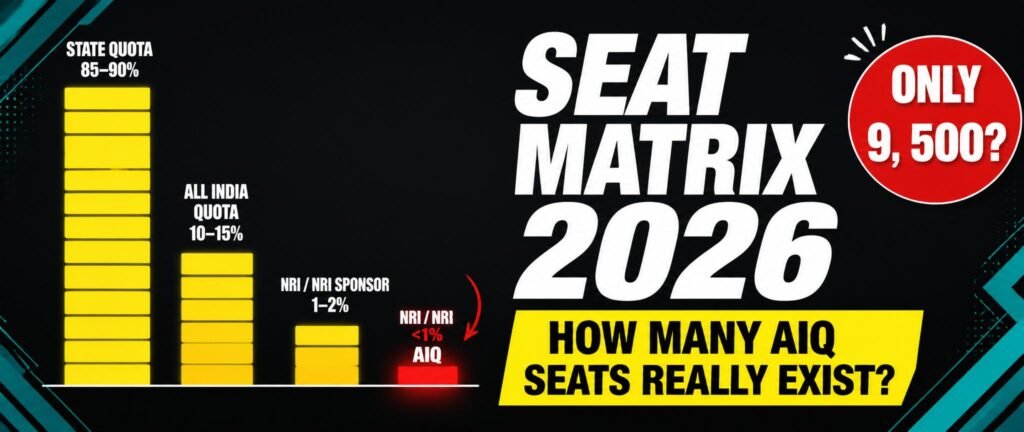
Every counselling season, students look at “1.36 lakh MBBS seats” and assume they are competing for all of them. They are not. The NEET UG 2026 seat matrix splits that number across quotas, states, and counselling authorities — and the pool you can actually reach through MCC is a fraction of the headline figure. Understanding this breakdown before choice filling is the difference between a realistic preference list and a wasted round. If you have already completed your MCC registration step-by-step, this guide shows you exactly how many seats sit in the All India Quota pool and where the rest go. For the parallel track, see our guide on state quota counselling portals.
Table of Contents
What Is the NEET UG 2026 Seat Matrix?
A seat matrix is the official document listing every approved MBBS and BDS seat available for admission — broken down by college, state, quota, and category. Two bodies control it:
- NMC (National Medical Commission) approves the total number of seats each college may admit, published through the Medical Assessment & Rating Board (MARB).
- MCC (Medical Counselling Committee) publishes the round-wise MCC seat matrix PDF for All India Quota counselling on mcc.nic.in before each round opens.
The NEET UG 2026 seat matrix is not static. Seats get added when new colleges receive approval, and seats get withdrawn due to pending court cases, compliance failures, or approval issues. This is why MCC republishes it before every round.
Total MBBS Seats in India for 2026
As per the official NMC MBBS seat matrix 2026, here is the national picture:
| Category | Seats |
|---|---|
| Total MBBS seats | 1,36,939 |
| Government colleges | 63,296 |
| Private colleges | 73,643 |
| Total medical colleges | 823 |
| New seats added over 2025 | +9,911 |
| New medical colleges | 25 |
Of the 25 new colleges, 7 are government (adding 400 seats) and 18 are private (adding 2,000 seats) — meaning roughly 83% of newly created capacity is private. Importantly, this matrix excludes Institutes of National Importance such as AIIMS, JIPMER, and PGIMER, which maintain separate seat pools. For the full state-wise picture, read our breakdown of total MBBS seats in India.
How Many AIQ Seats Are Actually Available?
This is where most students miscalculate. The AIQ seats in NEET 2026 pool is not 15% of 1.36 lakh — it is 15% of the government seat pool only, plus several fully centralised institution categories.
Here is what MCC actually fills:
| Pool | Approximate Seats | Coverage |
|---|---|---|
| 15% AIQ in government colleges | ~9,500 | 15% of 63,296 govt seats |
| AIIMS (20 campuses) | ~2,257 | 100% of seats |
| JIPMER Puducherry | ~243 | 100% of seats |
| Central universities (BHU, AMU, DU, JMI, IPU) | ~1,000+ | 100% of seats |
| ESIC medical colleges | ~1,830 total | AIQ + IP quota split |
| Deemed universities (~88 institutions) | ~15,000+ | 100% of seats |
| AFMC Pune | 150 | 100% of seats |
In the 2025 cycle, MCC handled roughly 26,500 seats in total — about 20% of all MBBS seats in India. The 2026 figure will be broadly similar, adjusted for the newly approved colleges.
The practical takeaway: if you are targeting government MBBS through AIQ, you are realistically competing for around 9,500 seats nationally, not 63,000. Everything else in the AIQ seats in NEET 2026 pool is either an elite central institution with punishing cutoffs or a deemed university with fees running into crores. Study these separately — read our guide on AIIMS and JIPMER admission ranks, and for the lesser-known options, check AFMC and ESIC seat details.
Where the Remaining Seats Go
The NEET 2026 seat distribution beyond AIQ breaks down like this:
- 85% state quota in government colleges — roughly 53,800 seats, filled by state counselling authorities and restricted by domicile
- Private college seats — approximately 73,643 seats, filled through a mix of state counselling, management quota, and NRI quota
- Minority and institutional quotas — reserved seats in specific colleges under state or institutional rules
This is precisely why registering for both AIQ and state counselling matters. The state pool is over five times larger than the AIQ government pool, and the competition is limited to your own state’s candidates. Use our college predictor by rank to see which specific colleges fall in your range, then build your smart choice filling strategy around the current NEET UG 2026 seat matrix rather than guesswork.
State-Wise Seat Distribution: Where the Seats Are
The MBBS seat matrix 2026 is heavily concentrated in a handful of states:
| State | Approximate MBBS Seats |
|---|---|
| Karnataka | 15,395 |
| Uttar Pradesh | 14,000 |
| Tamil Nadu | 13,999 |
| Maharashtra | 13,099 |
| Telangana | ~9,500 |
| Gujarat | ~7,250 |
| Rajasthan | ~5,418 |
| Madhya Pradesh | ~4,181 |
These four leading states alone account for close to 40% of national MBBS capacity. If you hold domicile in any of them, your state quota options are substantially stronger than your AIQ odds at the same rank — a NEET 2026 seat distribution reality that most students discover far too late.
AIQ Category-Wise Reservation
Within the 15% All India Quota pool, central government reservation applies:
- General/Unreserved — approximately 40.5%
- OBC-NCL — 27%
- SC — 15%
- EWS — 10%
- ST — 7.5%
- PwD — 5% horizontal reservation across all categories
Note that these are central norms. State counselling uses state-specific reservation percentages, which frequently differ and may include categories the central system does not recognise.
How to Read the MCC Seat Matrix PDF
MCC publishes the seat matrix on mcc.nic.in before each round. Here is how to use it:
- Download the round-specific PDF — do not rely on last round’s file, since seats change between rounds.
- Filter by institute type — government, deemed, central, ESIC, AFMC. Each has different fee structures and eligibility.
- Check quota columns — confirm whether a listed seat is AIQ, IP quota, or institutional.
- Check category columns — the matrix shows category-wise availability per college. A college may have zero seats in your category even if it shows overall vacancies.
- Cross-reference with previous closing ranks — seat availability alone means nothing without knowing where your rank fits.
Reading the NEET UG 2026 seat matrix properly takes twenty minutes and can reshape your entire preference list. Most students skip it and rely on hearsay instead.
Why the Seat Matrix Changes Mid-Counselling
Students often panic when seat numbers shift between rounds. Common reasons:
- New college approvals arriving after Round 1 has begun
- Court orders withdrawing or restoring seats at specific colleges
- Compliance failures — colleges that miss NMC requirements lose seats
- Bank guarantee deadlines — private colleges granted new seats must submit an E-Bank Guarantee to MARB within a set window to secure their Letter of Permission
Because of this volatility, always re-download the MCC seat matrix PDF before each round rather than working from an old copy. The MBBS seat matrix 2026 you saw during Round 1 may look materially different by the Mop-Up round.
Use the Matrix, Do Not Just Read It
The NEET UG 2026 seat matrix is the single most useful document in counselling, and most students never open it. Knowing that AIQ realistically means around 9,500 government seats — not 63,000 — changes how you build your preference list, whether you prioritise state counselling, and how aggressively you chase deemed universities. Download it, filter it by your category and quota, cross-check it against previous closing ranks, and build your list from data instead of hope.
❓ FAQ
Q: How many total MBBS seats are available through NEET UG 2026? A: The official NMC matrix lists 1,36,939 MBBS seats across 823 medical colleges — 63,296 in government colleges and 73,643 in private colleges. This excludes AIIMS, JIPMER, and other Institutes of National Importance, which maintain separate seat pools.
Q: How many AIQ seats are there in NEET 2026? A: The 15% All India Quota in government colleges works out to roughly 9,500 seats. However, MCC also fills 100% of seats at AIIMS, JIPMER, central universities, deemed universities, ESIC, and AFMC — bringing the total MCC-managed pool to approximately 26,500 seats.
Q: Where can I download the official seat matrix? A: MCC publishes the round-wise seat matrix PDF on mcc.nic.in before each counselling round. The NMC state-wise approved seat matrix is published separately on the NMC website. Always use the round-specific version.
Q: Does the seat matrix change during counselling? A: Yes, frequently. Seats are added when new colleges receive approval and withdrawn due to court cases, compliance issues, or missed bank guarantee deadlines. Re-download the matrix before every round rather than reusing an older file.
Q: Are BDS seats included in the same matrix? A: BDS seats are published in a separate matrix by the Dental Council framework, though MCC handles AIQ BDS counselling alongside MBBS. Check the dental-specific matrix on the MCC portal if you are considering BDS options.
Q: Which state has the most MBBS seats in 2026? A: Karnataka leads with approximately 15,395 seats, followed by Uttar Pradesh (14,000), Tamil Nadu (13,999), and Maharashtra (13,099). These four states together account for close to 40% of India’s total MBBS capacity.