
Quick answer: A human health and disease NEET PYQ analysis shows that this is one of the highest-scoring Zoology chapters, with about two to three questions a year. NTA keeps returning to five areas: common diseases with their pathogens (especially the life cycle of Plasmodium), immunity (innate vs acquired, antibodies, active vs passive), lymphoid organs, cancer, and drugs of abuse with their plant sources. The 2026 papers asked malaria twice, plus lymphoid organs, colostrum and opioids.
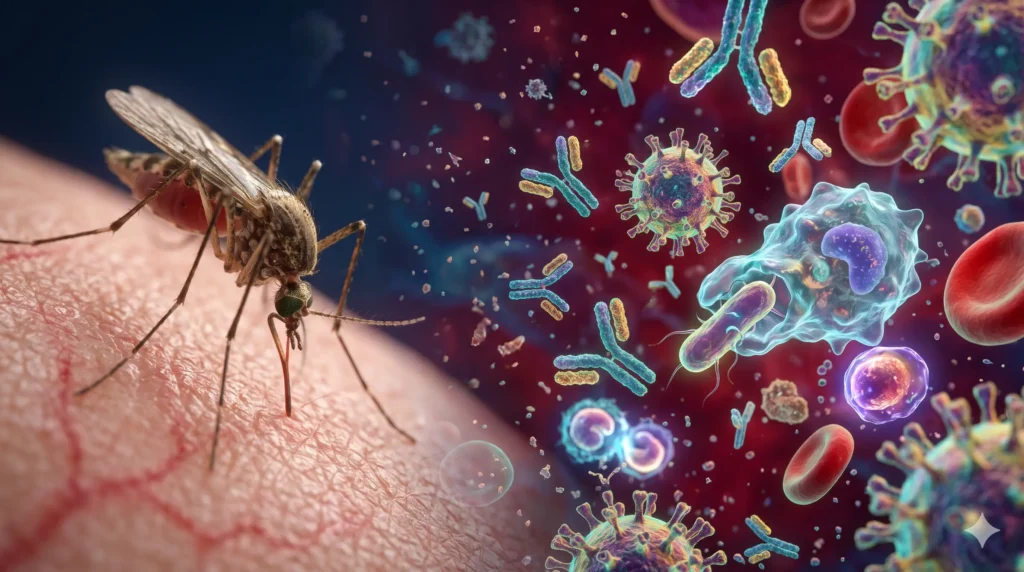
This guide breaks down what NTA repeats, the tables you must know and PYQ-pattern questions with answers. For a concept-first explanation, read our Human Health and Disease guide, and keep track of official news on our NEET 2027 latest updates page.
Want to test yourself first? Solve the Human Health and Disease PYQs for free, then use this guide to fix the gaps.
Table of Contents
Why This Chapter Deserves Extra Time
With more than 120 past questions, Human Health and Disease has one of the largest PYQ banks in NEET Biology, and almost every question is a direct match: pathogen to disease, plant to drug, organ to function. For chapter notes, use our Human Health class 12 notes, and to see where it sits among other chapters, check the NEET 2027 chapter weightage.
The immunity section builds on blood cells from our Body Fluids PYQ analysis. And if you are planning your year, our guide to the NEET 2027 registration date shows when the application form is expected.
Human Health and Disease NEET PYQ Analysis: What NTA Repeats
When you sort the past NEET biology PYQs from this chapter, five question types cover nearly everything.
| Question type | Frequency | What it tests |
|---|---|---|
| Common diseases | Most frequent | Pathogen, symptoms, diagnosis and vector for each disease; Plasmodium life cycle |
| Immunity | Very frequent | Innate barriers, acquired immunity, antibody structure, active vs passive immunity, allergy, autoimmunity |
| Lymphoid organs | Regular | Primary vs secondary organs, roles of bone marrow, thymus, spleen and MALT |
| Drugs and alcohol abuse | Regular | Opioids, cannabinoids, cocaine, their plant sources and effects |
| AIDS and cancer | Regular | HIV life cycle, ELISA, carcinogens, detection and treatment |
Common Human Diseases
| Disease | Pathogen | Key facts |
|---|---|---|
| Typhoid | Salmonella typhi (bacterium) | Small intestine; sustained fever of 39–40 °C; confirmed by the Widal test; Mary Mallon (“Typhoid Mary”) was a carrier |
| Pneumonia | Streptococcus pneumoniae, Haemophilus influenzae (bacteria) | Alveoli fill with fluid; in severe cases lips and nails turn grey to bluish |
| Common cold | Rhinoviruses | Nose and respiratory passage, not lungs; lasts 3–7 days |
| Malaria | Plasmodium vivax, P. malariae, P. falciparum | Spread by female Anopheles; P. falciparum causes malignant malaria, the most serious form |
| Amoebiasis (amoebic dysentery) | Entamoeba histolytica (protozoan) | Large intestine; stools with mucus and blood clots; houseflies are mechanical carriers |
| Ascariasis | Ascaris (roundworm) | Internal bleeding, anaemia, blocked intestine; eggs spread through soil, water and plants contaminated by faeces |
| Filariasis (elephantiasis) | Wuchereria bancrofti, W. malayi | Lymphatic vessels of the lower limbs; spread by female mosquitoes |
| Ringworm | Microsporum, Trichophyton, Epidermophyton (fungi) | Dry, scaly lesions on skin, nails and scalp; favoured by heat and moisture |
Aedes mosquitoes spread dengue and chikungunya, and the fish Gambusia is introduced into ponds to eat mosquito larvae.
Life Cycle of Plasmodium
The malaria life cycle was asked twice in 2026, so learn its order:
- An infected female Anopheles bites a human and injects sporozoites, the infectious form.
- The parasites multiply first in the liver cells, then attack red blood cells, causing them to rupture.
- The rupture of RBCs releases a toxic substance, haemozoin, which causes chills and high fever recurring every three to four days.
- Some parasites form gametocytes in the RBCs. A female Anopheles takes these up when it bites an infected person.
- Fertilisation and development happen in the mosquito’s stomach, and the sporozoites formed are stored in its salivary glands.
Asexual reproduction happens in the human host; sexual stages happen in the mosquito.
Immunity
| Type | Key facts |
|---|---|
| Innate (non-specific) | Physical barriers (skin, mucus lining of respiratory, gut and urogenital tracts); physiological barriers (stomach acid, saliva, tears); cellular barriers (neutrophils, monocytes, natural killer lymphocytes, macrophages); cytokine barriers (interferons from virus-infected cells) |
| Acquired (specific) | Has memory: the primary response is weak, and the secondary (anamnestic) response is strong; carried out by B-lymphocytes (antibodies) and T-lymphocytes |
| Humoral immunity | Antibody-mediated, by B-lymphocytes |
| Cell-mediated immunity | By T-lymphocytes; responsible for graft rejection |
- Each antibody has four peptide chains: two small light chains and two longer heavy chains, so it is written H₂L₂. Types include IgA, IgM, IgE and IgG.
- Active immunity: the body makes its own antibodies, after infection or vaccination. It is slow.
- Passive immunity: ready-made antibodies are given. Examples: colostrum, the yellowish first milk rich in IgA; antibodies passing from mother to foetus through the placenta; anti-tetanus and snake antivenom injections.
- Allergy is an exaggerated response to allergens such as dust mites, pollen and animal dander. IgE antibodies are produced, and mast cells release histamine and serotonin. Antihistamines, adrenalin and steroids reduce the symptoms.
- Autoimmunity is an attack on self-cells; rheumatoid arthritis is the NCERT example.
- The hepatitis B vaccine is produced from yeast using recombinant DNA technology.
Lymphoid Organs
| Type | Organs | Role |
|---|---|---|
| Primary | Bone marrow and thymus | Immature lymphocytes differentiate into antigen-sensitive lymphocytes; bone marrow is the main lymphoid organ where all blood cells form; the thymus is large at birth and shrinks with age |
| Secondary | Spleen, lymph nodes, tonsils, Peyer’s patches of the small intestine, appendix | Lymphocytes meet antigens and multiply; the spleen filters blood and stores erythrocytes |
Mucosa-associated lymphoid tissue (MALT) forms about 50% of the lymphoid tissue in the human body. Lymphoid organ questions were asked in 2024, 2025 and 2026.
AIDS and Cancer
AIDS is caused by HIV, a retrovirus with an RNA genome. It spreads by sexual contact with an infected person, transfusion of infected blood, sharing infected needles, and from an infected mother to her child through the placenta.
- HIV first enters macrophages, where its RNA is copied into viral DNA by reverse transcriptase. The viral DNA joins the host DNA, turning the macrophage into an “HIV factory”.
- HIV then enters helper T-lymphocytes (TH), whose numbers steadily fall, so the patient suffers opportunistic infections.
- AIDS is diagnosed by ELISA. Anti-retroviral drugs only partly help and prolong life.
Cancer cells lose contact inhibition and keep dividing. Benign tumours stay in place, while malignant tumours spread through metastasis.
| Carcinogen type | Examples |
|---|---|
| Physical | Ionising radiation (X-rays, gamma rays); non-ionising UV |
| Chemical | Chemicals in tobacco smoke |
| Biological | Oncogenic viruses with viral oncogenes; cellular oncogenes (proto-oncogenes) |
Cancer is detected by biopsy and histopathology, blood and bone marrow tests (for leukaemia), radiography, CT and MRI. It is treated by surgery, radiation therapy, chemotherapy and immunotherapy (for example, α-interferon, which activates the immune system).
Drugs and Alcohol Abuse
| Drug | Source | Effect |
|---|---|---|
| Heroin (smack; diacetylmorphine) | Acetylation of morphine from the latex of the poppy, Papaver somniferum | An opioid; a depressant that slows body functions |
| Cannabinoids (marijuana, hashish, charas, ganja) | Inflorescences of Cannabis sativa | Affect the cardiovascular system |
| Cocaine (coke, crack) | Erythroxylum coca, native to South America | Interferes with dopamine transport; a stimulant causing euphoria; large doses cause hallucinations |
| Hallucinogens | Atropa belladonna, Datura | Hallucinations |
| Nicotine | Tobacco | Stimulates the adrenal gland to release adrenaline and noradrenaline, raising blood pressure and heart rate |
- Opioids bind to opioid receptors in the central nervous system and gut.
- Morphine is a very effective sedative and painkiller used after surgery.
- Smoking raises carbon monoxide in the blood, lowering oxyhaemoglobin, and is linked to cancers of the lung, urinary bladder and throat.
- Chronic alcohol use causes cirrhosis of the liver.
Drugs of abuse with their plant sources were asked in 2023, 2024 and 2026.
Worked PYQ-Pattern Questions
Q1. In the life cycle of Plasmodium, the infectious form injected by the mosquito is the: (a) Gametocyte (b) Sporozoite (c) Merozoite (d) Trophozoite
Answer: (b) Sporozoite.
Q2. Typhoid is confirmed by the:
Answer: Widal test.
Q3. Colostrum provides which type of immunity, and which antibody does it contain?
Answer: Passive immunity, through IgA antibodies.
Q4. Which are the primary lymphoid organs? (a) Spleen and lymph nodes (b) Bone marrow and thymus (c) Tonsils and Peyer’s patches (d) Thymus and spleen
Answer: (b) Bone marrow and thymus.
Q5. Heroin is obtained from:
Answer: Acetylation of morphine, which comes from the latex of the poppy plant Papaver somniferum.
Q6. HIV mainly destroys which cells, causing immune deficiency?
Answer: Helper T-lymphocytes (TH cells).
Common Traps in This Chapter
- Saying sporozoites multiply first in RBCs (they multiply first in the liver)
- Calling colostrum active immunity (it is passive)
- Placing the spleen among primary lymphoid organs
- Saying the common cold affects the lungs
- Calling cocaine a depressant (it is a stimulant; heroin is a depressant)
- Writing ELISA for typhoid (typhoid uses the Widal test; ELISA is for AIDS)
Practise Every Human Health and Disease PYQ
This human health and disease NEET PYQ analysis shows you where the marks are. Solving real past questions makes the matches automatic. Every previous year question from this chapter is available chapter-wise, free:
👉 Solve all Human Health and Disease NEET PYQs
Keep the disease, immunity and drug tables beside you for the first round, then solve the second round without them.
Conclusion
Human Health and Disease has a large PYQ bank, but its questions keep returning to the same matches. Use this human health and disease NEET PYQ analysis to master the disease table, the Plasmodium life cycle, immunity, lymphoid organs, AIDS, cancer and drugs of abuse. Then practise the past questions until each match comes without thinking.
❓ FAQ
Q: How many questions come from Human Health and Disease in NEET? A: Usually two to three questions a year, making it one of the highest-scoring Zoology chapters.
Q: What is the most important topic in this chapter for NEET? A: Common diseases and their pathogens, especially the life cycle of Plasmodium, followed by immunity and lymphoid organs.
Q: What is the difference between active and passive immunity? A: In active immunity, the body produces its own antibodies after infection or vaccination. In passive immunity, ready-made antibodies are given, as in colostrum or antivenom.
Q: Which cells does HIV attack? A: It first enters macrophages and then helper T-lymphocytes, whose numbers fall steadily, weakening the immune system.
Q: What causes the recurring fever in malaria? A: The rupture of red blood cells releases a toxic substance called haemozoin, which causes chills and high fever every three to four days.
Q: Where can I practise Human Health and Disease NEET PYQs for free? A: You can solve every previous year question from this chapter chapter-wise for free using the practice links in this article.
Related posts:
 Human Reproduction NEET PYQ Analysis: Gametogenesis, Menstrual Cycle and Pregnancy
 Evolution NEET PYQ Analysis: Human Evolution, Hardy-Weinberg and Evidences
 Sexual Reproduction in Flowering Plants NEET PYQ Analysis: Pollination, Embryo Sac and Double Fertilisation
 Reproductive Health NEET PYQ Analysis: Contraception, STIs and ART