
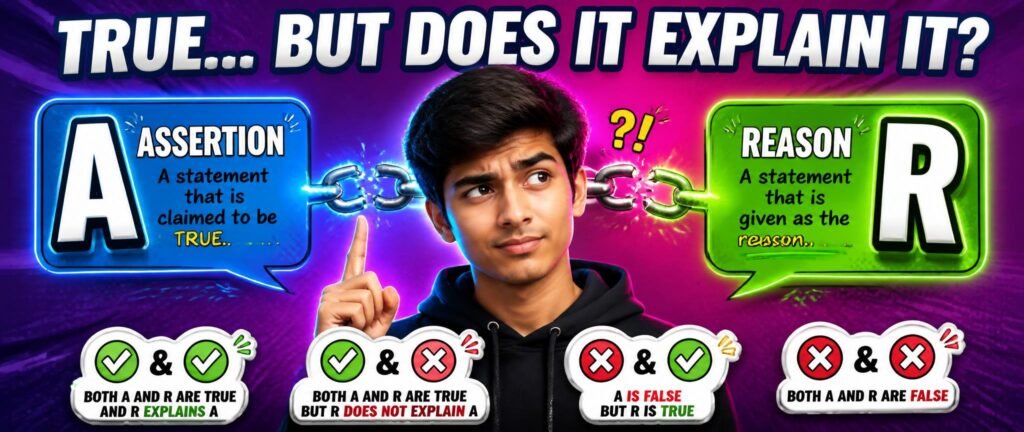
A few years ago, Assertion-Reason questions were a small, predictable slice of NEET — memorise the fact, pick the option, move on. That’s no longer true. Modern NEET assertion reason questions tricks have to account for a testing style that increasingly rewards students who understand why a fact is true, not just whether it’s true. This article breaks down the format, the shift in how NTA is framing these questions, and the exact method for solving them fast and correctly, so you walk in with genuine NEET assertion reason questions tricks rather than guesswork.
Table of Contents
Why NEET Assertion Reason Questions Tricks Matter More Than Ever
Assertion-Reason questions used to reward straightforward memorisation — if you knew both statements were textbook-true, you were usually done. Recent papers have moved toward NEET statement based questions where both parts can be individually true, but the logical connection between them is what’s actually being tested. This is a subtler skill than plain recall, and it’s exactly why generic “just know your NCERT” advice isn’t enough anymore for this question type specifically.
Getting comfortable with this shift pairs naturally with retaining NCERT facts long-term, since Assertion-Reason questions are unforgiving of shallow familiarity — you need to know a fact well enough to judge whether a different statement correctly explains it, not just whether you recognise the fact itself. It’s also worth reviewing your mock test mistakes specifically for this question type, since Assertion-Reason errors reveal exactly which chapters you understand at a surface level rather than a functional one. This shift mirrors a broader pattern across NEET, similar to NTA’s shift toward diagram questions — both changes reward functional, connected understanding of NCERT content rather than isolated fact recall.
The Four-Option A-R Format, Decoded
Every Assertion-Reason question in NEET follows the same four-option structure, and knowing it cold is non-negotiable:
- Option A: Both Assertion and Reason are true, AND Reason correctly explains the Assertion.
- Option B: Both Assertion and Reason are true, BUT Reason does NOT correctly explain the Assertion.
- Option C: Assertion is true, but Reason is false.
- Option D: Assertion is false, but Reason is true (or both are false, depending on the exact paper’s format).
The single most common mistake students make is jumping straight to option A the moment both statements sound correct, without checking whether the Reason actually explains the Assertion. That distinction between B and A is where most marks are lost.
The Independent-Evaluation Method
The fastest, most reliable way to solve these questions is to evaluate the Assertion and the Reason completely separately before even considering their relationship.
- Step 1: Read only the Assertion. Decide true or false, based purely on NCERT fact, ignoring the Reason entirely.
- Step 2: Read only the Reason. Decide true or false, again in isolation, as if it were a standalone statement.
- Step 3: Only now, if both are true, ask whether the Reason logically and directly explains the Assertion — not just whether they’re topically related.
- Step 4: Select the matching option based on your three independent judgments.
This four-step process is the actual core of any workable NEET assertion reason questions tricks list — everything else in this article supports this one method. It’s also worth practicing this method directly against solving previous year papers, since real NEET Assertion-Reason questions reveal the format’s traps far better than generic A-R question banks do.
This method matters because active recall based revision trains exactly the skill Step 1 and Step 2 require — judging a statement’s truth without any supporting context, the same way you’d need to under exam pressure. Consistent, thorough NCERT revision habits — reading not just for what’s true, but for why it’s true — remain the single best long-term preparation for this format, far more effective than cramming A-R question banks in the final weeks.
How NTA’s Testing Style Has Shifted
Older Assertion-Reason questions often paired an obviously true Assertion with an equally obvious Reason, testing recall more than reasoning. Recent NEET papers increasingly use Reasons that are factually correct on their own but describe a different mechanism than the one actually responsible for the Assertion — a subtler trap that specifically punishes students who stopped at “both statements sound right.” Students preparing only for the old-style format are increasingly caught off guard by this newer, more reasoning-heavy version.
Subject-Wise Assertion Reason Patterns
Assertion reason questions NEET biology sets rely on most heavily, since Biology’s dense factual content — physiological mechanisms, taxonomic relationships, structure-function pairs — lends itself naturally to this format. Chemistry uses it most often around periodic trends and reaction mechanisms, where a Reason might cite a real trend that doesn’t actually explain the specific Assertion given. Physics uses it least frequently, but when it appears, it usually tests whether a formula’s underlying assumption genuinely applies to the scenario described.
Common Traps Students Fall Into
Beyond the Option A vs. B confusion already mentioned, a few other traps show up repeatedly in questions using these NEET assertion reason questions tricks. Students often assume a Reason is automatically correct simply because it’s a true statement from a different part of the same chapter — proximity in the textbook isn’t the same as causal explanation. Another common trap is negative-statement fatigue: when both Assertion and Reason contain “not” or “never,” students frequently misjudge one or both simply from the cognitive load of parsing double negatives under time pressure. This is one of the more overlooked NEET assertion reason questions tricks worth practicing deliberately.
Building Practice Around This Format
Don’t treat Assertion-Reason as a separate topic to study — treat it as a lens you apply while revising every chapter. As you revise, occasionally pause on a fact and ask “what’s the actual reason this is true?” This single habit does more for how to solve assertion reason NEET questions confidently than solving isolated A-R practice sets in bulk.
Consistent, thorough NCERT revision habits — reading not just for what’s true, but for why it’s true — remain the single best long-term preparation for this NTA assertion reason pattern, far more effective than cramming A-R question banks in the final weeks.
Final Word
The Assertion-Reason format hasn’t gotten harder because NTA changed the rules — it’s gotten harder because it now genuinely tests whether you understand NCERT, not just whether you’ve read it. Master the independent-evaluation method, stay alert to the Option A vs. B trap, and these NEET assertion reason questions tricks stop being a coin flip and start being one of the more predictable, scoreable parts of the paper.
Frequently Asked Questions
Q: How many Assertion-Reason questions typically appear in NEET? A: The number varies by year, but recent NEET papers have consistently included Assertion-Reason questions across Biology, Chemistry, and Physics, making this format a meaningful and recurring part of the exam.
Q: What’s the biggest mistake students make with Assertion-Reason questions? A: Assuming both statements being individually true automatically means the Reason explains the Assertion, without actually checking whether the logical connection is genuine.
Q: Is it better to memorise Assertion-Reason answer patterns or understand the underlying logic? A: Understanding the logic is essential, since NTA increasingly designs distractors specifically to punish memorised patterns rather than genuine comprehension of the relationship between statements.
Q: Which subject has the trickiest Assertion-Reason questions? A: Biology has the highest volume, but Chemistry’s periodic trend and mechanism-based Assertion-Reason questions are often considered the trickiest, since Reasons frequently cite real but irrelevant trends.
Q: How should I practice this question type specifically? A: Rather than solving isolated A-R question banks exclusively, practice applying the independent-evaluation method while revising regular chapter content, so the skill becomes automatic under exam conditions.
Q: Do negative statements make Assertion-Reason questions harder? A: Yes. Statements containing “not” or “never” require extra care, since double negatives increase the chance of misjudging either the Assertion or the Reason under time pressure.
[…] Question styles: statement-based, match-the-column and diagram questions, plus tricky formats you can learn by decoding assertion-reason question patterns […]
[…] of these facts also appear in statement-based questions. Our guide to assertion reason question tricks helps you handle that format with […]
[…] two statements; decide whether each is true and whether one explains the other. Our assertion-reason question tricks cover the […]
[…] explain why students who only solve PYQs often plateau around 550–600. For the newer formats, our assertion-reason question tricks are a good start, and our NEET 2027 mock test strategy covers the stamina […]