Here is what makes this chapter unusual. In most of Physics, a wrong answer means you misunderstood something. In ray optics for NEET 2027, a wrong answer usually means you got a minus sign wrong.
The concepts in ray optics for NEET 2027 are not hard. Light reflects, light bends, images form. What trips students is that the mirror formula and the lens formula look almost identical and differ in exactly one place — and the magnification formulas differ too, in the opposite direction.
Learn those four expressions as two contrasting pairs and most of the chapter’s difficulty disappears. Set it against the wider physics strategy and subject-wise chapter weightage when planning your hours.
Table of Contents
Ray Optics for NEET 2027: The Sign Problem
This is the whole chapter in one section, so read it slowly.
The Cartesian sign convention in optics measures all distances from the pole of a mirror or the optical centre of a lens. Distances measured in the direction of incident light are positive; those measured against it are negative. Heights above the principal axis are positive, below it negative.
Because light conventionally travels left to right and the object sits on the left, the object distance is negative in almost every problem you will see. Students who forget this get the magnitude right and the sign wrong, which on an MCQ is simply wrong.
Then the pairs:
| Mirrors | Lenses | |
|---|---|---|
| Formula | 1/v + 1/u = 1/f | 1/v − 1/u = 1/f |
| Magnification | m = **−**v/u | m = **+**v/u |
Look at that table again. The formula that adds has the magnification that subtracts, and vice versa. There is no intuitive reason for a student to remember which is which — so don’t rely on intuition. Write both rows at the top of every optics practice sheet until it’s automatic, and keep them in spaced revision that sticks alongside your formula list.
Mirror formula and lens formula confusion is, by a wide margin, the largest single source of lost marks in ray optics for NEET 2027.
What Gets Asked
| Topic | Typical Questions |
|---|---|
| Mirrors and image formation | 0–1 |
| Refraction and total internal reflection | 1 |
| Lenses, lens maker’s formula, power | 1–2 |
| Prism and dispersion | 0–1 |
| Optical instruments | 0–1 |
Start making effective condensed notes from the first read here. Usually 2–4 questions, worth 8–16 marks. Modest on its own, but this is high-return material: the formula count is small, the numericals are short, and almost none of it requires the conceptual work that the harder mechanics chapters demand.
Confirm the current chapter scope against the official NMC syllabus, since optics content was touched in the rationalisation — the chapters removed from the syllabus piece explains how to check.
Reflection and Mirrors
Focal length is half the radius of curvature. Under the Cartesian convention, a concave mirror has negative focal length and a convex mirror positive.
Because these questions are short, managing time in the exam becomes easier if you bank them early. Beyond the formula, know the standard image cases by heart: object beyond centre of curvature, at C, between C and F, at F, and inside F. Each gives a predictable image position, nature and size, and questions frequently describe the image and ask for the object position rather than the reverse.
Refraction and Total Internal Reflection
Snell’s law and refractive index come first, then apparent depth — an object in water appears shallower by a factor of the refractive index.
Total internal reflection NEET questions turn on one condition that students state incompletely: light must travel from a denser to a rarer medium, and the angle of incidence must exceed the critical angle. Both conditions, every time. The critical angle relates to refractive index directly, and the standard applications — optical fibres, mirages, the sparkle of a diamond — are asked as recall.
Lenses and Power
The lens maker’s formula relates focal length to refractive index and the two radii of curvature. Getting the radii signs right is the usual difficulty, and it follows the same Cartesian convention as everything else.
Convex lenses have positive focal length, concave negative — the reverse of mirrors, which is another reason to keep the two systems firmly separated in your head.
Power is the reciprocal of focal length, and focal length must be in metres to give dioptres. Every year, students substitute centimetres. For lenses in contact, powers add directly, which makes combination problems trivial once you avoid the unit error.
Build all of this onto a single sheet — the formula set is small enough to fit on one page and dense enough that you’ll want it there.
Prism and Optical Instruments
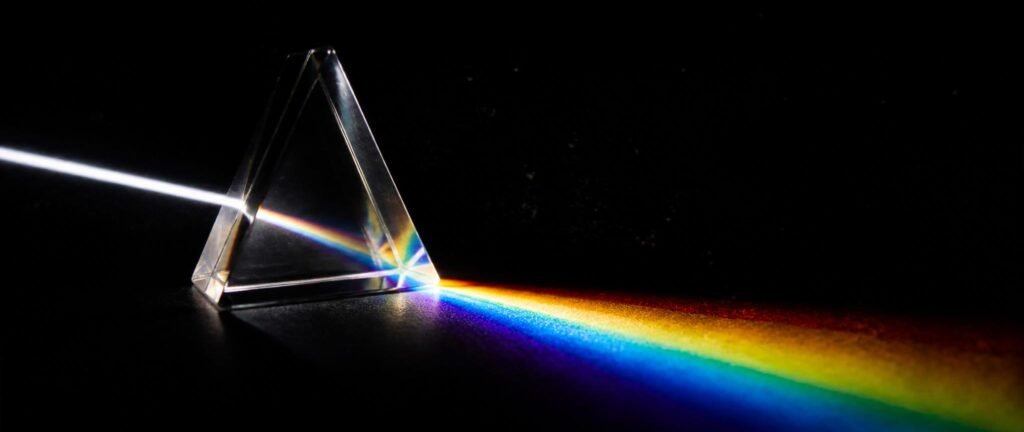
For prisms: the deviation relationship, the condition at minimum deviation where the ray passes symmetrically, and the prism formula linking refractive index to the prism angle and minimum deviation. Dispersion and the order of colours follow from refractive index varying with wavelength.
Optical instruments for NEET questions are mostly magnifying power formulas. For an astronomical telescope in normal adjustment, magnifying power is the ratio of objective to eyepiece focal length, and tube length is their sum. Compound microscopes use a different expression — know which is which, and know that a telescope wants a long-focal-length objective while a microscope wants a short one.
The Traps
- Mixing mirror and lens formulas. The plus-minus reversal, and the magnification reversal on top of it.
- Positive object distance. It’s negative in almost every problem.
- Focal length sign conventions reversed between mirrors and lenses.
- Power calculated with centimetres instead of metres.
- Stating only one condition for total internal reflection.
- Radii signs in the lens maker’s formula.
- Telescope and microscope magnification formulas swapped.
Every one of these is mechanical. None requires understanding you don’t already have, which is why repetition genuinely closes them.
How to Practise
Practise ray optics for NEET 2027 by writing the sign convention and both formula pairs at the top of the page before every session. Do this for two weeks and you’ll stop needing to.
Then work through problems in blocks — twenty on mirrors, twenty on lenses, then mixed sets where you have to identify which system you’re in before writing anything. That last step is the one that matters. Finish with timed sets — the clock is kinder here than almost anywhere in Physics.
Final Word
Ray optics for NEET 2027 is among the most forgiving chapters in the syllabus for anyone willing to be disciplined about signs. The physics is visual and intuitive; the arithmetic is short.
The students who lose marks here almost never misunderstood image formation. They wrote 1/v + 1/u for a lens. Fix your sign convention in optics and this chapter becomes reliable scoring territory.
❓ FAQ Section
Q: How many questions come from ray optics in NEET? A: Typically 2–4, worth 8–16 marks, spread across mirrors, refraction, lenses, prisms and optical instruments. Lens-based questions usually carry the largest share.
Q: What’s the difference between the mirror and lens formulas? A: The mirror formula is 1/v + 1/u = 1/f while the lens formula is 1/v − 1/u = 1/f. The magnification formulas also differ — m = −v/u for mirrors and m = v/u for lenses. Mixing them is the most common error in the chapter.
Q: Why is object distance always negative? A: Under the Cartesian convention, distances measured against the direction of incident light are negative. Since the object conventionally sits to the left of the mirror or lens, its distance comes out negative in nearly every problem.
Q: What are the conditions for total internal reflection? A: Two, and both are required — light must travel from a denser medium to a rarer one, and the angle of incidence must exceed the critical angle. Stating only one is a common partial answer.
Q: Why do my power calculations keep coming out wrong? A: Almost always a unit error. Power in dioptres requires focal length in metres, and questions frequently give it in centimetres. Convert before substituting.
Q: Is ray optics hard? A: Conceptually, no — it’s one of the more intuitive chapters in Physics. The difficulty is entirely in sign discipline, which makes it high-return for students who take the conventions seriously.