
After mechanics, this is the largest block in the paper. Current electricity for NEET 2027 and electrostatics together account for roughly a quarter of Physics — and unlike mechanics, most of it is formula-driven rather than intuition-driven.
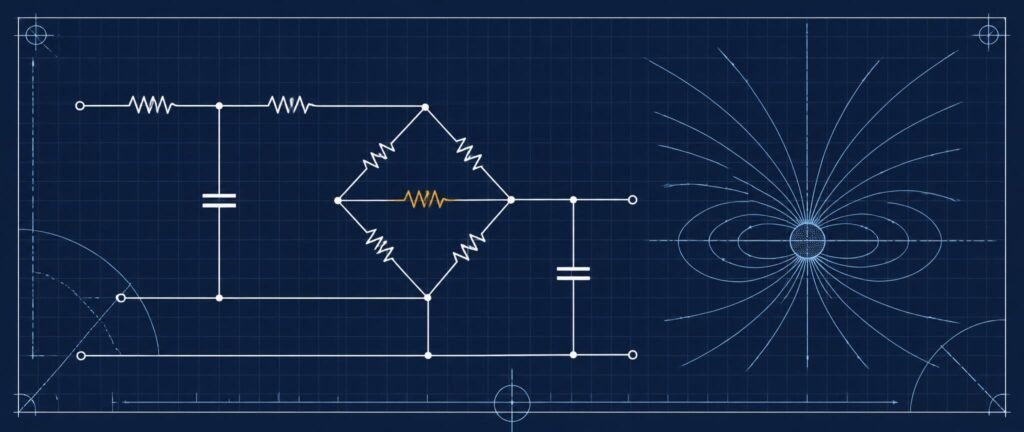
That sounds like good news, and for current electricity for NEET 2027 it mostly is. But the two halves fail students in completely different ways, and treating them as one block is why preparation goes wrong.
Set this against the wider physics strategy and subject-wise chapter weightage before allocating your hours.
Table of Contents
Two Halves, Two Different Problems
Electrostatics for NEET 2027 fails on concept. Students know the formulas and still pick wrong answers, because the chapter is built on distinctions — field versus potential, flux versus field, enclosed charge versus all charge — that don’t announce themselves in the question.
Current electricity for NEET 2027 fails on speed. The concepts are simpler, but questions require reducing a circuit correctly and quickly. Students who understand it perfectly still lose marks running out of time.
Different diagnosis, different fix. Electrostatics needs careful reading; current electricity needs volume practice. If you’re doing the same thing for both, one of them isn’t working. Where the easier physics chapters reward a formula sheet, this block does not.
Confirm the current chapter scope against the official NMC syllabus first, since parts of this block were touched in the rationalisation — the chapters removed from the syllabus piece covers how to check properly.
What’s Actually Tested
| Chapter | Typical Questions |
|---|---|
| Electric Charges and Fields | 1–2 |
| Electrostatic Potential and Capacitance | 1–2 |
| Current Electricity | 2–3 |
Electrostatics for NEET 2027 and current electricity together give around 4–7 questions, or 16–28 marks. Current Electricity alone usually carries the most of any single chapter in this block, as solving previous year papers filtered to these chapters makes clear within an hour.
Electrostatics: Field, Flux and Potential
Electrostatics for NEET 2027 starts with Coulomb’s law and the superposition principle, but the marks concentrate further in.
Electric field versus potential. Field is a vector, potential is a scalar — and that difference is the source of most errors. Inside a uniformly charged spherical shell, the field is zero while the potential is non-zero and constant. A question that gives you one and asks for the other is testing exactly this.
Gauss’s law. The Gauss law for NEET applications worth memorising are the standard three: an infinite line charge, an infinite plane sheet, and a charged spherical shell inside and outside. Note that the field due to an infinite sheet is independent of distance — counter-intuitive, therefore asked.
The critical subtlety: flux through a closed surface depends only on the charge enclosed, but the field at any point on that surface depends on all charges present. Students conflate these constantly.
Because these questions run long, managing time in the exam matters here more than in any other physics block, and making effective condensed notes keeps the formula count manageable.
Dipoles. Dipole moment, field along the axis and along the perpendicular bisector, and torque in a uniform field. Know that net force on a dipole in a uniform field is zero while torque is not.
Equipotential surfaces. Always perpendicular to field lines, and no work is done moving a charge along one. Park all of this in spaced revision that sticks, because the distinctions blur fast.
Capacitance: The Reversal Nobody Remembers
This deserves its own warning, because it’s the single most common error in the entire block.
Capacitors combine the opposite way to resistors. In series, capacitance adds reciprocally. In parallel, it adds directly. Resistors do the reverse. Under time pressure, students apply the resistor rule to a capacitor network without noticing.
Beyond that, capacitors and capacitance NEET questions cover the parallel plate formula, the effect of inserting a dielectric, and the three equivalent expressions for stored energy. Know what changes and what stays constant when a dielectric is inserted with the battery connected versus disconnected — that distinction appears regularly.
Write the two combination rules at the top of your formula sheet.
Current Electricity for NEET 2027: The Circuit Half
Drift velocity. Small — millimetres per second — yet current is established almost instantly, because the field propagates through the conductor at near light speed. That apparent contradiction is a favourite question.
Resistance and resistivity. Resistivity is a property of the material; resistance is a property of the object. Metals show increasing resistivity with temperature; semiconductors show the opposite. Both directions get asked.
EMF and internal resistance. Terminal voltage is less than EMF while a cell is discharging and greater while charging. Know the series and parallel combinations of cells.
Kirchhoff’s laws. The Kirchhoff law NEET questions you’ll face reduce to two rules — junction (charge conservation) and loop (energy conservation). The difficulty is never the rules; it’s sign convention discipline. Fix a direction, keep it, and don’t switch halfway.
Wheatstone bridge. Learn the balanced condition and, more usefully, learn to recognise a balanced bridge in a circuit that has been drawn to disguise it. When balanced, the central resistor carries no current and can be removed — which turns a hard problem into an easy one.
The Traps
- Capacitor combination rules reversed. Worth stating twice.
- Assuming zero field means zero potential. It doesn’t.
- Using enclosed charge to find the field rather than the flux.
- Sign errors in Kirchhoff loops. The most common source of wrong numerical answers.
- Missing a balanced Wheatstone bridge in a redrawn circuit.
- Confusing resistivity with resistance in temperature or dimension questions.
- Forgetting internal resistance when a question gives you EMF.
Most of these are single-line errors, which means repetition genuinely fixes them.
How to Practise
Electrostatics rewards reading questions slowly. Current electricity rewards solving many circuits until reduction becomes automatic.
Do forty circuit problems in one sitting — series, parallel, mixed, bridges — until you stop drawing them out step by step. Then move to timed sets, because this block is won or lost on the clock.
Final Word
This block is worth more than modern physics and rotational motion combined. Those are where you bank marks cheaply; this is where you earn them properly.
Give current electricity for NEET 2027 the hours it deserves. Learn the two combination rules cold, keep your Kirchhoff signs disciplined, and put in enough circuit volume that reduction stops being something you think about.
❓ FAQ Section
Q: How many questions come from electrostatics and current electricity in NEET? A: Typically 4–7 across the three chapters, roughly 16–28 marks. Current Electricity usually carries the largest share. Counts vary year to year, so check recent papers.
Q: How do capacitors combine in series and parallel? A: The opposite way to resistors. In series, capacitance adds reciprocally; in parallel, it adds directly. This reversal is the single most common error in the block, so verify it every time.
Q: Can the electric field be zero where the potential is not? A: Yes. Inside a uniformly charged spherical shell the field is zero while the potential is constant and non-zero. Field and potential are related but independent quantities, and NEET tests that distinction directly.
Q: What’s the fastest way to solve circuit problems? A: Volume practice until reduction becomes automatic. Learn to spot a balanced Wheatstone bridge in a disguised circuit, since removing the central resistor collapses a hard problem into a simple one.
Q: Is Gauss’s law worth memorising in full? A: Memorise the three standard applications — infinite line charge, infinite plane sheet, and spherical shell inside and outside. Most Gauss’s law questions reduce to one of these.
Q: Is NCERT enough for this block? A: For theory and derivations, largely yes. But circuit problems need far more practice volume than NCERT provides, so add previous year papers and problem sets specifically for Current Electricity.