
Modern physics is a chapter students skip. Rotational motion for NEET 2027 is the opposite problem entirely — students attempt it, feel reasonably confident, and get it wrong. That’s a worse outcome, because negative marking turns a shaky chapter into an active loss.
The reason is specific. Every other mechanics chapter rewards intuition. This one punishes it. Where the easier physics chapters reward memorising a formula sheet, this one does not. Two objects of identical mass roll down the same incline and arrive at different times, and nothing in your everyday experience predicts that.
Set this against the wider physics strategy and use subject-wise chapter weightage to decide how much time it deserves.
Table of Contents
Why This Chapter Behaves Differently
Rotational mechanics is taught as a set of analogies to linear motion — force becomes torque, mass becomes moment of inertia, momentum becomes angular momentum. The analogies are real, and they’re also where students get caught.
Mass is a single number. Moment of inertia is not: it depends on the axis you choose. Change the axis and the same object has a completely different value. Students who treat moment of inertia as “rotational mass” and stop there will get most questions wrong, because NEET tests exactly that distinction.
That is rotational motion for NEET 2027 in one sentence: the axis matters, and the shape matters, and the mass often doesn’t.
Rotational Motion for NEET 2027: What’s Actually Tested
| Topic | Typical Questions | Difficulty |
|---|---|---|
| Centre of mass | 0–1 | Low |
| Moment of inertia and theorems | 1 | Medium |
| Torque and angular momentum | 0–1 | Medium |
| Rolling motion | 1 | High |
Rotational motion for NEET 2027 usually carries 2–3 questions, worth 8–12 marks. That’s less than modern physics — but unlike modern physics, this is where students lose marks rather than leave them. Getting to neutral here is worth as much as gaining elsewhere.
Build a one-page sheet as you go. Making effective formula notes matters here because the formula count is high and the differences between them are small.
The Moment of Inertia Values to Memorise
There is no way around learning moment of inertia for NEET by heart. These are the standard bodies:
| Body | Axis | Moment of Inertia |
|---|---|---|
| Ring | Central, perpendicular to plane | MR² |
| Disc / solid cylinder | Central axis | ½MR² |
| Solid sphere | Diameter | (2/5)MR² |
| Hollow sphere | Diameter | (2/3)MR² |
| Rod | Through centre, perpendicular | (1/12)ML² |
| Rod | Through one end, perpendicular | (1/3)ML² |
Note the rod appears twice. Same object, same mass, different axis, different answer. That pair alone explains why the chapter is misread. Confirm the pattern by solving previous year papers filtered to this chapter.
The Two Theorems Students Misapply
Parallel axis theorem: I = I_cm + Md². Works for any rigid body, but only when your reference axis passes through the centre of mass. Students apply it from an arbitrary axis and get nonsense.
Perpendicular axis theorem: I_z = I_x + I_y. This works only for planar laminar bodies — a disc, a ring, a flat sheet. Applying it to a sphere or a cylinder is one of the most common errors in the chapter, and it’s an error NEET deliberately baits.
Fold both into spaced revision that sticks rather than relearning them in April.
Angular Momentum and Its One Condition
Angular momentum conservation NEET questions almost always reduce to a single check: is the net external torque zero? If yes, L = Iω stays constant.
The classic setup is the spinning skater pulling their arms in — I decreases, ω increases, L holds. Any question involving a change in mass distribution during rotation is testing this.
Be careful with the condition. Internal forces don’t matter. External forces that produce no torque about the axis don’t matter either. Students conserve angular momentum when they shouldn’t, or fail to when they should, purely by skipping this check.
Rolling Motion: Where the Marks Actually Are
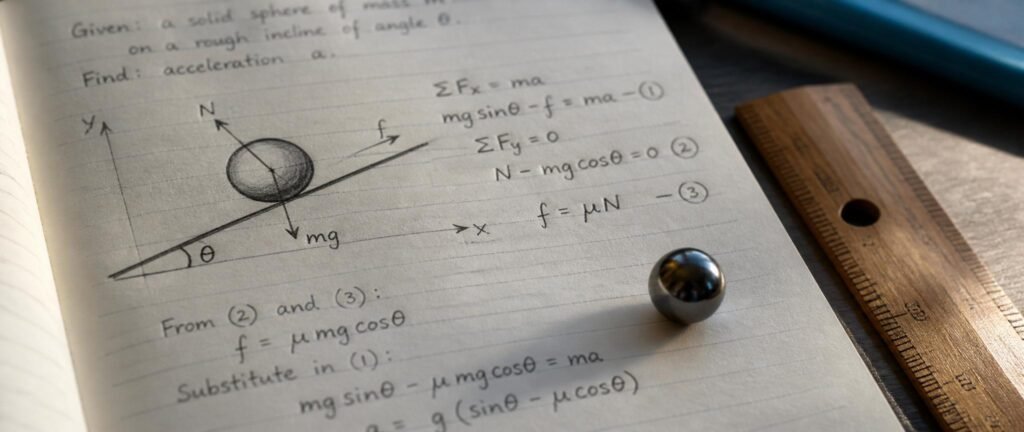
This is the highest-yield sub-topic and the one worth the most practice. Rolling motion problems NEET sets you every year, and they follow a narrow pattern.
For rolling without slipping down an incline:
a = g sinθ / (1 + k²/R²)
Everything follows from that k²/R² term:
| Body | k²/R² | Order Down the Incline |
|---|---|---|
| Solid sphere | 0.4 | Fastest |
| Disc / cylinder | 0.5 | Second |
| Hollow sphere | 0.67 | Third |
| Ring | 1.0 | Slowest |
Mass and radius do not appear. Two spheres of wildly different size and mass reach the bottom together. Shape is the only thing that matters. This result is counter-intuitive, which is exactly why it’s asked so often.
Also know the energy split: total kinetic energy is ½mv²(1 + k²/R²), and the rotational fraction is k²/R² divided by (1 + k²/R²).
The Traps, Listed
- Wrong axis. Always ask which axis before reaching for a formula.
- Perpendicular axis theorem on a 3D body. Laminar only.
- Assuming mass affects rolling acceleration. It doesn’t.
- Conserving angular momentum without checking net external torque.
- Forgetting rotational KE when applying energy conservation to a rolling body.
- v = ωR only holds for rolling without slipping. If it’s slipping, that relation is gone.
How to Practise This Chapter
Reading theory repeatedly does nothing here. The chapter is learned through problems.
Do twenty questions on moment of inertia and the two theorems until axis identification is automatic. Then twenty on rolling motion problems NEET has asked before. Then mixed rotational motion numericals under time pressure, because these problems are long and the real exam failure is running out of clock, not running out of understanding.
Final Word
Rotational motion for NEET 2027 is not a chapter you can leave until March. It needs problem volume, and problem volume needs months.
The good news is that rotational motion for NEET 2027 is finite. A dozen moment of inertia values, two theorems, one conservation condition and one rolling formula covers almost everything NEET asks. Learn those properly and the chapter stops being a place where marks disappear.
❓ FAQ Section
Q: How many questions come from rotational motion in NEET? A: Typically 2–3, worth 8–12 marks, sometimes combined with centre of mass. The count varies year to year, so check recent papers for the current pattern.
Q: Why do students lose marks in rotational motion? A: Because they attempt it with false confidence. The chapter relies on axis-dependent quantities and counter-intuitive results, so answers that feel right are often wrong — and negative marking makes that expensive.
Q: Do I need to memorise all moment of inertia formulas? A: Yes, for the standard bodies — ring, disc, solid and hollow sphere, rod about centre and about one end, and solid cylinder. Both theorems are also essential, since NEET frequently asks about non-standard axes.
Q: Which body reaches the bottom of an incline first? A: The solid sphere, followed by disc or cylinder, then hollow sphere, then ring. The order depends only on k²/R² — shape — and not on mass or radius at all.
Q: When can I conserve angular momentum? A: Only when the net external torque about the axis is zero. Check this explicitly every time rather than assuming it, because NEET builds questions specifically around cases where it fails.
Q: Is NCERT enough for rotational motion? A: NCERT gives you the theory but not enough problem variety. You’ll need previous year papers and additional numericals, particularly for rolling motion and combined energy problems.
[…] visualising habit carries directly into rotational motion problem solving, since rotational motion is really just kinematics wearing a different formula set — the same v-t […]
[…] laws sit underneath almost every mechanics question, from circular motion to rotation. Our guide to rotational motion builds directly on the force analysis you learn […]
[…] enough.” This kind of dimension elimination NEET shortcuts thinking is especially powerful in rotational motion numericals and current electricity formula checks, where unfamiliar-looking formulas make a quick dimension […]