
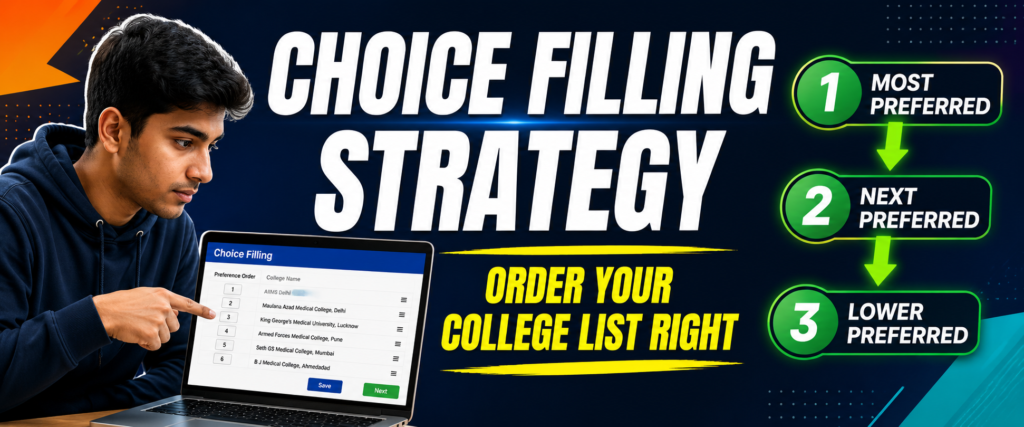
Your NEET rank gets you into counselling. Your Re-NEET 2026 choice filling strategy decides where you actually take admission. Every year, thousands of students with decent ranks end up at colleges they never wanted — not because their score was low, but because they arranged their preference list poorly. If you have already completed your MCC registration step-by-step guide and paid the fee, the choice filling window is the single most important step still left in your NEET 2026 college preference list. One wrong move here — listing a private college above a government college, filling too few options, or forgetting to lock — can cost you lakhs of rupees or an entire year. Before you open the MCC portal, check the official counselling schedule and dates so you know exactly how much time you have.
Table of Contents
How the MCC Seat Allotment Algorithm Actually Works
Before you fill a single choice, understand how the system processes your list. The MCC allotment algorithm is sequential and top-down:
- It reads your preference list starting from choice number 1.
- It checks whether your All India Rank qualifies for that college and course based on seat availability, category, and quota.
- If yes, it allots that seat immediately and stops. It does not check your remaining choices.
- If no, it moves to choice number 2, then 3, and so on until it finds a match or exhausts your list.
This means placing your dream college at position 1 does not reduce your chances of getting a realistic college at position 15. The algorithm only allots the highest preference your rank can secure. There is zero disadvantage to listing an aspirational college at the top. Since the same logic repeats across all four counselling rounds, your Re-NEET 2026 choice filling strategy should account for how preferences carry forward between rounds. Students who understand this build their NEET 2026 college preference list with confidence instead of fear.
The Three-Tier Framework for Your Re-NEET 2026 Choice Filling Strategy
The smartest way to build your preference list is to split it into three tiers. This structure ensures you have a shot at your dream college while protecting yourself from ending up with nothing. Use previous years’ closing ranks and predict your college chances to sort colleges into these tiers.
Tier 1 — Aspirational Choices (Top 20% of Your List)
These are colleges where last year’s closing rank was slightly above your current rank. You might not get them, but if cutoffs dip even slightly due to increased seats or candidate redistribution, you are in. Examples include top AIIMS campuses, JIPMER, MAMC, or the best government colleges in your preferred state.
Rule: Always place these at the very top. You lose nothing by listing them.
Tier 2 — Realistic Choices (Middle 50% of Your List)
These are government and central university colleges where your rank comfortably falls within previous years’ closing AIR ranges. This tier should form the core of your MCC choice filling 2026 preference list. Include colleges across multiple states here — do not limit yourself to only one region.
If you scored in the 400–500 range and need clarity on which colleges are realistic, check our guide on college options at your score.
Tier 3 — Safety Choices (Bottom 30% of Your List)
These are colleges you would accept rather than wait for the next round or risk losing your deposit. Include ESIC colleges, newer AIIMS campuses, private deemed universities within your budget, and state government colleges in less popular locations.
Critical rule: Never add a college to your safety tier that you would refuse if allotted. Getting allotted a seat you reject in Round 2 or later means forfeiting your security deposit under the anti-seat-blocking rules 2026. Only add colleges you are genuinely willing to join.
Factors to Consider Before Ordering Your NEET Counselling College Order
Ranking colleges purely by reputation is a mistake. Your Re-NEET 2026 choice filling strategy should account for these real-world factors — ignoring even one of them is among the most common mistakes that cost seats during counselling:
- Government vs private fees: A government MBBS seat costs ₹10,000–₹50,000 per year. A private deemed university can cost ₹15–25 lakh per year. Over five years, the difference runs into crores. Always place affordable government colleges above expensive private ones unless you have a specific financial plan.
- Bond and service obligations: Several state government colleges require a 1–3 year rural service bond after completing MBBS. Factor this into your ranking — a college with a ₹25 lakh bond penalty is effectively more expensive than it appears.
- Location and living costs: A college 2,000 km from home means flight tickets, higher hostel fees, and limited family visits. Be realistic about what you can sustain for five years.
- Clinical exposure and hospital bed strength: Older, established government medical colleges attached to high-footfall hospitals generally offer better clinical training than newer institutions with low patient volume.
- Previous year closing ranks: Use 2024 and 2025 closing AIR data from the MCC website to gauge where your rank fits. Cutoffs tighten each year, so build a 5–10% safety margin.
Step-by-Step: How to Fill and Lock Choices on mcc.nic.in
Once the MCC choice filling 2026 window opens, follow these steps:
- Log in to the MCC portal at mcc.nic.in using the credentials you created during registration.
- Select your course — filter for MBBS first. Do not mix MBBS and BDS in your list unless you are genuinely open to BDS.
- Browse the college list — the portal shows all eligible institutions based on your category and quota. Use the search and filter options to narrow down.
- Add colleges to your preference basket — move colleges from the master list into your personal preference list on the right side of the screen.
- Arrange in order of preference — drag and drop to reorder. Your top choice goes to position 1. Follow the three-tier framework to structure your NEET 2026 college preference list from aspirational to safety.
- Save frequently — the portal can time out. Save your list after every few changes.
- Lock your choices before the deadline — this is non-negotiable. If you do not lock, the system auto-locks whatever you have saved, and you lose the ability to make last-minute changes.
Pro tip: Fill your list a day before the deadline. Use the remaining time to review, rearrange, and lock. Last-minute portal crashes are common on deadline day.
Common NEET Choice Filling Mistakes That Cost a Seat
Knowing what to avoid is just as important as knowing what to do. These NEET choice filling mistakes are repeated by thousands of students every year:
- Filling too few choices — Some students list only 5–10 colleges. If none of those match your rank, you get nothing in that round. Fill as many realistic options as you can.
- Copying someone else’s list — Every student’s rank, category, domicile, and budget is different. A list that works for a General category student at AIR 5,000 is useless for an OBC candidate at AIR 40,000.
- Placing private colleges above government ones — Unless you have a clear financial reason, a government seat is almost always the better long-term investment.
- Not locking choices — If the system auto-locks, it saves whatever state your list was in — which may include random, unreviewed entries.
- Ignoring subsequent rounds — Choice filling is not a one-time event. You can modify your list between rounds based on updated seat availability. Students who do not update their NEET counselling college order between Round 1 and Round 2 miss upgrade opportunities.
These NEET choice filling mistakes are entirely avoidable with a well-prepared Re-NEET 2026 choice filling strategy. Spend time on your list before the portal opens, not during the last hour.
What Happens After You Lock Your Choices?
Once the choice filling and locking deadline passes, MCC runs the allotment algorithm. Here is the sequence:
- Seat allotment result is published on mcc.nic.in. You can check your allotted college and course by logging in.
- Accept or exercise options — You can choose to Freeze (accept the seat and exit further rounds), Float (accept the seat but stay in for a possible upgrade in the next round), or Slide (accept but allow upgrade only within the same institute for a different course).
- Report to the allotted college — Visit the institute with original documents within the reporting window.
- Next round begins — If you chose Float or Slide, your list carries forward, and the algorithm tries to upgrade you using vacated seats.
Understanding the exit rules for each round is essential before you lock your first preference list. Exiting outside the permitted window means forfeiting your security deposit.
Build Your List Before the Portal Opens
The Re-NEET 2026 choice filling strategy that works best is one that is prepared before you even log in. Do your research now — study previous cutoffs, shortlist colleges across all three tiers, talk to seniors who are already in those colleges, and finalise your NEET counselling college order on paper before transferring it to the MCC choice filling 2026 portal. The window is short, the stakes are high, and the students who plan ahead are the ones who get the seat they deserve.
❓ FAQ
Q: Is there a limit on how many colleges I can add during choice filling? A: No, there is no upper limit. You can add as many colleges as you are eligible for. In fact, adding more choices improves your chances of allotment — fill broadly rather than narrowly.
Q: Does listing a college at the top reduce my chance of getting lower-ranked colleges? A: Not at all. The MCC allotment algorithm processes your list top to bottom and allots the highest preference your rank qualifies for. Listing an aspirational college at position 1 does not affect your chances at position 15.
Q: Can I change my preference list after locking? A: No, once you lock your choices, they are final for that round. However, between rounds, MCC reopens choice filling so you can modify your Re-NEET 2026 choice filling strategy for the next round based on updated seat availability.
Q: What happens if I do not lock my choices before the deadline? A: The system will auto-lock whatever preferences you have saved at that point. This may include incomplete or randomly ordered choices, so always lock manually before the deadline.
Q: Should I add BDS colleges to my MBBS preference list? A: Only if you are genuinely willing to pursue BDS. If you add BDS as a filler and get allotted a BDS seat in a later round, you may face forfeiture of your security deposit if you refuse the seat. Never add courses you would reject.
Q: How do I decide between a government college in another state and a private college in my home state? A: Compare the total cost over five years. A government college — even in a distant state — typically costs ₹2–5 lakh total, while a private college can cost ₹75 lakh or more. Unless there is a specific scholarship or financial plan for the private seat, the government college is almost always the better financial decision.