
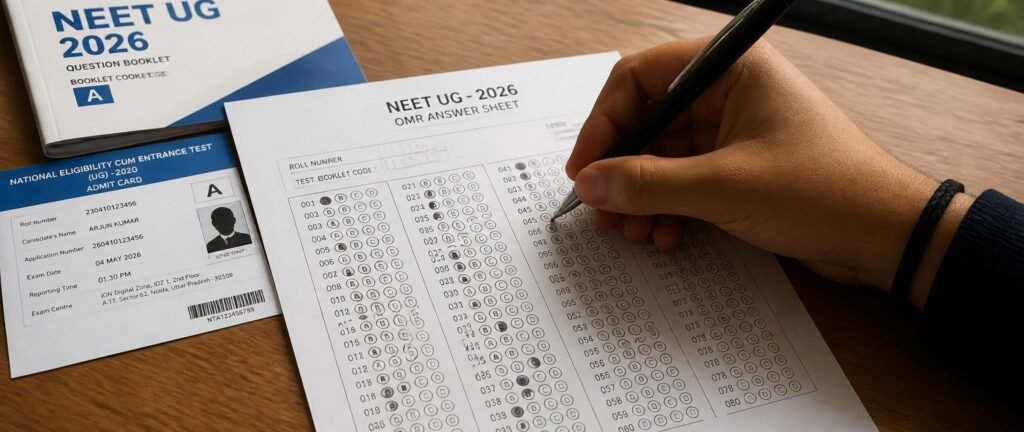
On June 21, the Re-NEET 2026 OMR sheet filling process will take less than 10 minutes of your exam time — but a single mistake here can cost you marks you genuinely earned. The NEET OMR sheet filling rules 2026 exist for one reason: the OMR scanner does not know you meant to fill option B. It only reads what is physically darkened on the sheet.
This Re-NEET 2026 OMR sheet filling guide covers every official NTA rule, the exact step-by-step filling sequence, and the specific mistakes that silently kill scores every year.
Table of Contents
What Is an OMR Sheet and Why Does Re-NEET 2026 OMR Sheet Filling Matter?
OMR stands for Optical Mark Recognition. Knowing how to fill OMR sheet in NEET is as important as knowing the answers. The NEET OMR sheet is evaluated by sensitive computer software — it accepts only properly filled bubbles. There is no human reviewing your sheet. No one will notice if your bubble was “almost” filled or if you marked two options by mistake. The machine reads what it reads, and that becomes your score. For Re-NEET 2026 OMR sheet filling, there is zero margin for carelessness — every bubble counts.
Understanding how to fill OMR sheet in NEET correctly is what separates a 700+ scorer from someone who dropped 20 marks to OMR errors. Your NEET UG 2026 score depends entirely on what the optical scanner reads from your OMR sheet. A question solved correctly in your mind but marked incorrectly on the OMR will not help your score.
This is why Re-NEET 2026 OMR sheet filling — and practising it before exam day — deserves the same attention as your subject revision.
Official NTA Rules for Re-NEET 2026 OMR Sheet Filling
The NEET OMR sheet filling rules 2026 are non-negotiable: fill the OMR sheet only with a black or blue ball-point pen. Pencil, gel pen, or felt-tip pen is not allowed.
Incorrect or incomplete filling of Roll Number, Test Booklet Code, Centre Number, or answer bubbles can result in rejection of the OMR sheet and zero marks.
Once a bubble is darkened, it cannot be changed. Whitener, eraser, correction fluid, or any other correction method is strictly prohibited on the OMR sheet.
The Test Booklet Code (A/B/C/D) printed on the question paper must be filled accurately on the OMR. A mismatch leads to incorrect evaluation.
Every candidate retains their OMR carbon copy after the exam. The original is collected by the invigilator.



Step-by-Step: Re-NEET 2026 OMR Sheet Filling Sequence
Follow this exact sequence inside the exam hall.
Step 1: Check the Sheet the Moment You Receive It
When you are given the OMR sheet, carefully check that the filling spaces and boxes are correctly printed. Ensure the OMR sheet is in good condition and not torn or misprinted. Check that the OMR sheet number is the same as printed on your question paper. If not, report to the invigilator immediately.
Do not begin writing on a damaged sheet under any circumstances.
Step 2: Fill Personal Details First — Before Touching the Questions
Fill in the Roll Number and Test Booklet Number in the provided boxes. Under each box, darken the circle that matches the number written above.
Following these Re-NEET 2026 OMR instructions carefully starts here. Your roll number is a 10-digit number found on your Re-NEET 2026 admit card. Write it carefully in the boxes first, then bubble each digit below. Double-check every digit — a wrong roll number means your score cannot be linked to your registration.
Also fill: Centre Code, Test Booklet Code (A/B/C/D), and your name in running handwriting at the designated field.
Step 3: Match the Test Booklet Code — This Step Is Critical
The Test Booklet Code (A, B, C, or D) is printed on the top of your question paper. This code must be filled accurately on the OMR. A mismatch leads to incorrect evaluation — meaning your answers will be checked against the wrong answer key. This is one of the most common silent mistakes in NEET every year.
Step 4: Mark Answers as You Solve — Not All at the End
This is the single most important habit in correct Re-NEET 2026 OMR sheet filling. Do not wait until the last 10 minutes to bubble. Fill the OMR after completing each page or section — for example, Biology first, then move to the next.
Always match the question number before marking — double-check the question number before darkening a bubble.
Filling all 180 answers in the last 10 minutes is one of the leading causes of wrong question mapping. A single shifted bubble can misalign 20+ answers below it.
Step 5: Fill Bubbles Completely and Darkly
Darken the bubbles completely. Partial or light shading may not be read by the OMR scanner, resulting in no marks for that answer.
The correct technique: press firmly with your ballpoint pen and fill the entire circle in one smooth circular motion. The bubble should be fully dark with no white space visible inside it.
Step 6: One Bubble Per Question — No Exceptions
One of the key NEET OMR sheet filling rules 2026 candidates often overlook: mark only one option per question, keep the sheet clean, and avoid any additional marks like ticks or crosses.
If two bubbles are filled for the same question, the scanner registers it as a wrong answer regardless of whether one of them was correct. You also lose 1 mark to negative marking.
Step 7: Verify Before Submission
Check your answers before submitting the OMR sheet. Students who have followed the Re-NEET 2026 last-month plan will have practised this verification step multiple times by now. In the final 5 minutes, scan through your OMR visually — check that no question has been skipped unintentionally, no double bubbles exist, and your roll number and booklet code are correctly filled.
The 7 Re-NEET 2026 OMR Mistakes That Cost Students Marks
These are the NEET OMR mistakes to avoid — exact errors that eliminate marks from correctly-answered questions:
Mistake 1 — Wrong pen type Using a pencil, gel pen, or ink pen. Only a black or blue ball-point pen is allowed. Gel pens can smear and confuse the scanner.
Mistake 2 — Incomplete bubble filling A half-filled or lightly shaded bubble is read as unanswered. Press firmly and fill the entire circle.
Mistake 3 — Test Booklet Code mismatch (Most dangerous single error in Re-NEET 2026 OMR sheet filling) Filling A when your paper says B means every answer is evaluated against the wrong key. Check this before attempting question 1.
Mistake 4 — Two bubbles for one question This happens when students change their mind mid-exam and fill a second bubble without realising correction fluid is banned. Once a bubble is filled, that option is final.
Mistake 5 — Question number shift Answering question 47 in the row for question 46 shifts every subsequent answer by one row. This single mistake can wipe out 10–15 marks — it’s the Re-NEET 2026 OMR instructions step that demands the most conscious attention during the exam. Always verify the question number before marking.
Mistake 6 — Stray marks on the sheet A random pen mark near a bubble row can confuse the scanner. Keep your sheet clean. Do not rest your pen on the OMR sheet while thinking.
Mistake 7 — Rushing the roll number Writing an incorrect digit in your roll number means your sheet cannot be matched to your registration. Your score cannot be declared. Verify all 10 digits twice before bubbling.
The OMR-Blank Scam — A Special Warning for June 21
If anyone has told you to leave your OMR sheet blank on June 21 — this is connected to the Re-NEET 2026 paper leak scam that is currently targeting students. with a promise that answers will be filled later — that is a scam. It is physically impossible. The original OMR sheet is collected by the invigilator immediately at the end of the exam under supervision. No one can access it after collection. Students who leave their OMR blank will score zero. There is no exception. If you have been approached with this offer, report it to NTA immediately at nta@nta.ac.in.
Practice This Before June 21
Many students practise questions for months but fill OMR sheets only in the last few mock tests. This is exactly the kind of mistake covered in the Re-NEET 2026 mistakes to avoid guide. This creates unnecessary risk on exam day.
The fix is simple — treat Re-NEET 2026 OMR sheet filling as a skill, not a formality. In every full mock test you take before June 21, use a printed OMR sheet. Pair this with the Re-NEET 2026 19-day sprint schedule and fill it exactly as you would on exam day. This builds the muscle memory of checking question numbers, filling bubbles firmly, and managing the sheet alongside your paper-solving rhythm.
You can download a sample NEET OMR sheet from neet.nta.nic.in for practice. Following these Re-NEET 2026 OMR instructions on every mock test is the most reliable way to eliminate preventable errors.
Quick Reference: Re-NEET 2026 OMR Sheet Filling Dos and Don’ts
| ✅ DO | ❌ DON’T |
|---|---|
| Use black or blue ballpoint pen | Use pencil, gel pen, or ink pen |
| Fill bubbles completely and darkly | Leave bubbles half-filled or lightly shaded |
| Match Test Booklet Code first | Skip the booklet code step |
| Fill answers section by section | Wait until the last 10 minutes to bubble |
| Double-check roll number digits | Rush through personal detail filling |
| Mark one bubble per question | Fill two bubbles if you change your mind |
| Report a damaged OMR immediately | Start writing on a torn or misprinted sheet |
| Keep the sheet clean of stray marks | Rest your pen on the OMR while thinking |
Final Word
If you haven’t yet reviewed the Re-NEET 2026 exam pattern, it’s worth 5 minutes — understanding the question distribution helps you plan the section-by-section OMR filling order.
Mastering Re-NEET 2026 OMR sheet filling is not a formality — it is the final translation of everything you have studied into a score. Students who lose marks on the OMR don’t lose them because they didn’t know the answer. They lose them because they rushed, skipped verification, or used the wrong pen.
The NEET OMR mistakes to avoid listed above are all preventable. Treat the OMR sheet with the same seriousness as the question paper. The scanner doesn’t know how hard you prepared — it only reads what you filled.
Make sure you’ve also reviewed the Re-NEET 2026 exam day checklist and the Re-NEET 2026 pre-exam protocol before June 21.
FAQ Section
Q: Which pen should I use to fill the Re-NEET 2026 OMR sheet? A: Only a black or blue ball-point pen is permitted. Pencil, gel pen, felt-tip pen, and ink pen are all prohibited. Ball-point pens give clean, dark, non-smearing fills that the OMR scanner reads accurately.
Q: Can I change an answer once I’ve filled a bubble on the NEET OMR sheet? A: No. Once a bubble is darkened, it cannot be changed. Whitener, correction fluid, eraser, and overwriting are all strictly banned. If you accidentally fill the wrong bubble, that answer is final. This is why filling section by section — rather than all at the end in a rush — is critical.
Q: What happens if I fill the wrong Test Booklet Code on the OMR? A: Your answers will be evaluated against the wrong answer key, leading to near-zero or incorrect marks. The Test Booklet Code (A/B/C/D) is printed on your question paper — match it exactly on the OMR before attempting any question.
Q: What if my OMR sheet is torn or misprinted when I receive it? A: Inform the invigilator immediately and ask for a replacement sheet. Do not start writing on a damaged OMR sheet. Raising this issue promptly is your right as a candidate.
Q: Should I fill all OMR answers at the end of the exam? A: No — this is one of the most dangerous habits in NEET. Filling 180 answers in the last 10 minutes causes question number misalignment, rushed bubbling, and incomplete fills. Fill your OMR section by section as you solve — Biology answers after Biology, and so on.
Q: Do I get to keep my OMR sheet after the exam? A: You retain the carbon copy of your OMR sheet. The original is collected by the invigilator at the end of the exam. The carbon copy is useful for self-evaluation using the official answer key when it is released.