
Three hours, 180 questions, 720 marks. The maths looks simple — one minute per question — until you’re sitting at a screen with a difficult Physics numerical staring back at you and the timer ticking. NEET 2027 exam time management is not about moving fast; it’s about moving smart. Students who mismanage time don’t just leave questions unanswered — they create panic that corrupts the answers they already knew. A well-paced exam is calmer, more accurate, and almost always higher-scoring than a rushed one. The good news is that time management is a trainable skill, not an exam-day instinct. Build it through deliberate practice using a structured NEET 2027 mock test strategy, and give yourself enough preparation runway with this guide on when to start NEET 2027 so you log enough timed attempts before the real thing.
Table of Contents
The Maths — and Why One Minute Per Question Is the Wrong Frame
180 questions in 180 minutes gives a 60-second average. But NEET questions are not equally weighted in time. A direct Biology factual question takes 20–30 seconds for a well-prepared student. A Physical Chemistry numerical takes 90–120 seconds. A multi-step Physics problem can take 2 minutes. Treating every question as one minute ignores this variance and leads to either rushing Biology (costing accuracy) or lingering in Physics (bleeding time).
The smarter frame is subject-level budgeting. Know the NEET 2027 syllabus weightage across subjects and allocate time accordingly.
Subject-Wise Time Allocation
Use this as your starting template — adjust based on your personal strengths across mocks:
| Subject | Questions | Suggested Time | Per Question Average |
|---|---|---|---|
| Biology | 90 | 50–55 minutes | ~35 seconds |
| Chemistry | 45 | 50–55 minutes | ~65 seconds |
| Physics | 45 | 55–65 minutes | ~75 seconds |
| Buffer / Review | — | 10–15 minutes | — |
Biology should be your fastest subject. It is largely factual and NCERT-direct — a student who has done thorough NCERT revision for NEET 2027 reads a Biology question and either knows it immediately or flags it within 20 seconds. The time saved in Biology funds the deliberate pace Physics and Chemistry need.
NEET 2027 Exam Time Management: The Two-Pass Strategy
The single most effective time management framework for NEET is the two-pass approach:
First pass — attempt the certain. Move through the paper at pace. If you know the answer immediately, mark it. If you’re unsure or need more than a minute, flag it for review and move on without guilt. The goal of the first pass is to bank every confident mark as quickly as possible and build a complete picture of the paper.
Second pass — work the uncertain. Return to flagged questions with the remaining time. Now you know exactly how many questions are left and how much time you have, which removes the panic of the unknown. Use elimination, apply the concept more carefully, and make your best decision.
This strategy integrates directly into your daily routine for NEET 2027 practice — run the two-pass approach on every timed session so it becomes habitual, not a new technique you’re trying for the first time on exam day.



Time Checkpoints to Keep You On Track
Use these checkpoints during the exam to catch pace problems before they compound:
- 60 minutes in: You should have completed Biology and made a start on Chemistry.
- 120 minutes in: Chemistry should be complete. Physics first pass should be well underway.
- 150 minutes in: First pass complete across all subjects. 30 minutes remaining for second pass and review.
If you’re behind a checkpoint, don’t panic — speed up your first-pass pace slightly and trust the second pass for anything truly uncertain. Checking your clock at these intervals takes five seconds and prevents the tail-end time collapse that costs students 30–40 marks.
How Long to Spend Per Question Type
Different question formats have different natural time ceilings:
- Direct factual MCQ (Biology / Inorganic): 20–40 seconds. You know it or you don’t. If you don’t within 30 seconds, flag and move.
- Assertion-Reason: 45–70 seconds. Read both statements independently before reading the options.
- Physical Chemistry / Physics numerical: 60–120 seconds. If you’re past 90 seconds and not converging, flag it — it’s a second-pass candidate.
- Concept-application MCQ: 40–60 seconds.
Setting mental time ceilings per question type removes the agonising “just one more second” trap. A question you’ve spent 2 minutes on and still can’t solve is almost certainly not going to resolve in the third minute. Move on. Repeaters who want to boost their NEET 2027 score often find that time management, not additional knowledge, is where the marks were lost in previous attempts.
Managing the Final 30 Minutes
More marks are lost in NEET’s final 30 minutes than any other period. Panic sets in, students rush through flagged questions, impulsive marks are made, and careful first-pass answers get changed without reason.
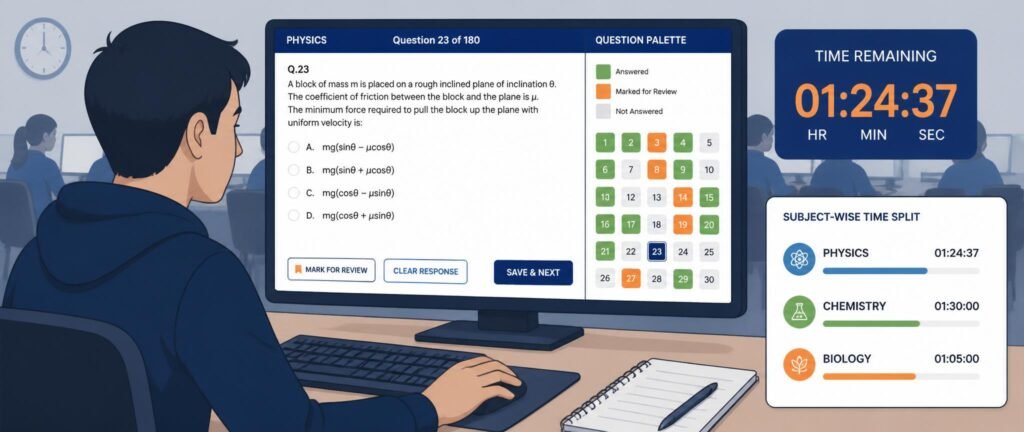
Protect the final 30 minutes with a deliberate rule: work through flagged questions in the question palette in order, give each a maximum of 90 seconds, and never change a confident first-pass answer unless you have a clear logical reason. For full-time aspirants building a complete NEET year, a structured NEET 2027 dropper study plan that includes regular full-length timed mocks builds exactly the final-stretch composure that exam day demands.
CBT Navigation Tips for NEET 2027
With NEET moving to computer-based testing, know your interface before exam day:
- The question palette shows answered, unanswered, marked-for-review, and not-visited questions at a glance — use it actively, not decoratively
- The mark for review button is your first-pass tool; it does not mean you’ve attempted the question
- You can jump directly to any question number, so moving to the next subject section takes seconds
- Practice navigating a CBT interface in your mock sessions so the platform itself costs you no time on exam day
Common Time Management Mistakes
- Spending too long on the first difficult question encountered and disrupting rhythm
- Not using the mark-for-review system and trying to solve everything in one pass
- Skipping Biology’s head start by treating it the same speed as Chemistry and Physics
- Forgetting to check time checkpoints until the final 20 minutes
- Changing confident answers in the final stretch out of anxiety rather than logic
Final Thoughts
NEET 2027 exam time management is not about being fast — it’s about being structured. Know your subject-wise time budget, run two clean passes, check your pace at the 60/120/150 minute marks, and protect the final 30 minutes from panic. Practise this framework in every mock from now until exam day. By the time you sit down at the exam terminal, it should feel less like a strategy and more like second nature.
FAQ Section
Q: How do you manage time in NEET 2027 with 180 questions? A: Use subject-wise time allocation (Biology ~50 min, Chemistry ~55 min, Physics ~60 min), the two-pass strategy, and three time checkpoints at 60, 120, and 150 minutes.
Q: Should I start with Biology in NEET 2027? A: Yes, for most students. Biology questions are fastest for well-prepared aspirants, banking marks quickly and leaving more time for Physics and Chemistry calculations.
Q: How much time should I spend per NEET question? A: Biology factuals average 30–40 seconds, Chemistry and Physics MCQs 45–70 seconds, and numericals up to 90 seconds. Set mental ceilings per type and flag anything exceeding them.
Q: What is the two-pass strategy for NEET? A: First pass: attempt all confident questions quickly and flag uncertain ones. Second pass: return to flagged questions with remaining time, using elimination and careful analysis.
Q: How do I avoid running out of time in NEET? A: Check your pace at 60, 120, and 150 minutes, set a maximum time per question type, and never linger beyond 2 minutes on any single question — flag and move.
Q: How do I practise NEET exam time management? A: Through regular full-length timed mocks where you deliberately track time per subject and per question type, running the two-pass strategy each time until it is automatic.
[…] that could have been eliminated down to much better odds with 10 extra seconds of thought. Managing exam time wisely means recognising that these 10 extra seconds are rarely wasted, since forcing a rushed guess […]
[…] connects directly to managing exam time overall, because the real problem with a linear pass usually isn’t total time — it’s when […]
[…] collisions and the kinetic energy–momentum relation. These short questions also help you solve PYQs under time pressure, since they reward quick mental […]