
2 year NEET study roadmap is the phrase that separates students who treat NEET as a distant eventuality from students who treat it as a project — one with phases, milestones, deliverables, and a non-negotiable deadline. And in the difference between those two approaches lies the difference between an MBBS seat and a missed opportunity.
Two years sounds like a long time until you map the syllabus against the calendar. 97 chapters across Biology, Physics, and Chemistry. Three full revision cycles minimum. 100+ mock tests. Error analysis, mentor sessions, milestone reviews. When the preparation is mapped honestly, two years is not generous — it is sufficient. But only if every phase of it is used correctly.
If you’re ready to stop treating NEET 2027 as something that will figure itself out and start treating it as something that requires a plan, a complete 2 year NEET study roadmap program built around your specific starting point is the most strategic investment you can make today.
Why Most NEET Roadmaps Fail Before Month 6
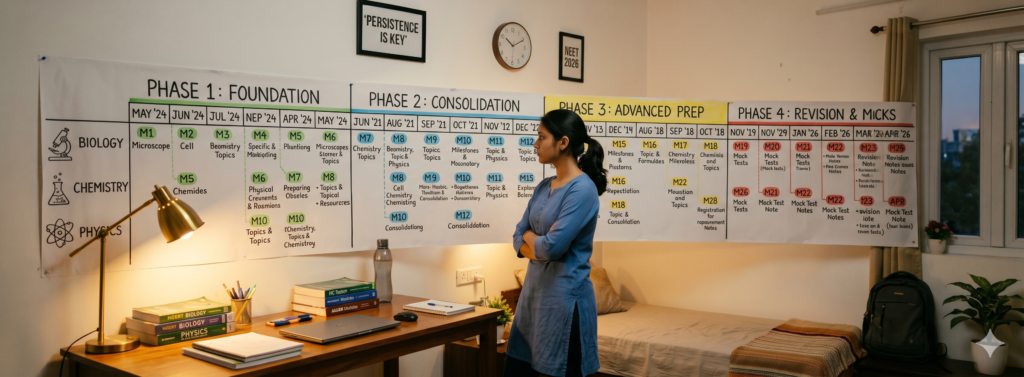
The internet is full of NEET roadmaps. Colour-coded timetables, subject-wise breakdowns, week-by-week schedules downloaded from forums and shared in WhatsApp groups. Most of them fail — not because the content is wrong, but because they are static documents applied to dynamic students.
A real 2 year NEET study roadmap is not a PDF. It is a living preparation system that evolves based on mock test data, milestone achievement, mentor feedback, and the student’s actual pace of learning. The roadmap that works is the one that knows when to accelerate, when to revisit, and when to pivot — and has a human being helping make those decisions in real time.
With that principle established, here is what a genuine two-year NEET roadmap looks like — phase by phase.
Phase 1: Foundation Building (Months 1–6)
The first six months of a 2 year NEET study roadmap are the most important and the most misused. Most students either sprint — trying to cover the entire syllabus in three months — or drift — studying loosely without a chapter completion target or testing framework.
The correct approach is methodical depth. Phase 1 is not about finishing the syllabus. It is about building the conceptual architecture that every subsequent phase will hang from.
During these six months, the goal is to complete a first-pass, concept-level study of all three subjects — Biology first at 40% time allocation, Chemistry second at 35%, Physics third at 25%. Every chapter is studied from NCERT first, supplemented with coaching material second. No chapter is marked complete until the student can answer basic MCQs from it with above 60% accuracy.
Mock testing in Phase 1 is chapter-level only — no full-length papers yet. The goal is to build the foundation correctly, not to measure readiness before it exists. By Month 6, a student on a well-executed 2 year NEET study roadmap should have covered approximately 70% of the full NEET syllabus at first-pass depth.
Phase 2: Completion and First Testing (Months 7–12)
Phase 2 of a 2 year NEET study roadmap has two parallel objectives: complete the remaining 30% of the syllabus and introduce full-length mock testing for the first time.
Months 7 through 9 focus on completing all remaining chapters — with particular urgency given to high-weightage areas that weren’t fully covered in Phase 1. By Month 9, 100% of the NEET syllabus should be covered at first-pass depth. This is a non-negotiable milestone. Any student entering Month 10 with significant syllabus gaps is carrying a structural problem into the revision phase.
From Month 10 onward, full-length mock tests begin — one per week initially, building to two by Month 12. Each mock is followed by a structured 48-hour analysis window. Error logs are built. Mentor debriefs are conducted. Subject-wise accuracy data is reviewed and fed into Phase 3 planning.
By the end of Month 12 — the midpoint of a genuine 2 year NEET study roadmap — the student should be averaging 500–540 on full-length mocks and have a clear, data-driven picture of their strongest and weakest chapters across all three subjects.
Phase 3: First Revision and Score Acceleration (Months 13–18)
Phase 3 is where the preparation shifts from building to sharpening — and where the distance between students who planned a 2 year NEET study roadmap correctly and those who didn’t becomes visible in scores.
The entire syllabus is revised systematically across these six months — not re-read passively, but actively tested. Each chapter is revisited through previous year questions, chapter-level mock tests, and NCERT line-by-line cross-referencing. The goal is not to encounter the content again — it is to identify and permanently close the gaps that first-pass study left open.
Mock frequency increases to two to three full-length papers per week. By Month 15, target scores should be reaching 560–590. By Month 18, the benchmark is 600–630. Students not hitting these benchmarks trigger an immediate mentor review — not to reassign blame, but to identify the specific chapters or question types causing the shortfall and redirect preparation accordingly.
Phase 3 of a well-designed 2 year NEET study roadmap ends with a student who knows the full syllabus, has identified their persistent weak zones, and is consistently scoring above 620 on full-length mocks. That is exam readiness at the beginning of the final phase — not the end of it.
Phase 4: Peak Preparation and Exam Optimisation (Months 19–24)
The final six months of a 2 year NEET study roadmap are not for learning. They are for perfecting. Every conceptual gap has been identified. Every error pattern has been analysed. The work of Phase 4 is converting good preparation into great exam performance.
Mock frequency reaches its peak: four to five full-length papers per week, all attempted at the same time of day as the actual NEET exam. Biology revision shifts to NCERT line mastery — the ability to identify the source chapter of any question within seconds. Chemistry Inorganic revision intensifies, given its high memorisation demand and exam-day time sensitivity. Physics strategy is refined — specifically, which question types to attempt first, which to skip and return to, and how to manage the 45-minute Physics allocation without bleeding time from Biology.
Milestone targets for Phase 4: 640 by Month 20, 660 by Month 22, 680+ average by Month 23. Students consistently hitting these benchmarks in the final phase of a 2 year NEET study roadmap enter the actual exam not with hope, but with evidence — evidence accumulated across 24 months of structured, data-driven, mentor-supported preparation.
The Milestone Map at a Glance
A complete 2 year NEET study roadmap produces specific, measurable outcomes at each phase boundary. Month 6: 70% syllabus coverage, chapter-level accuracy above 60%. Month 12: 100% syllabus coverage, full-length mock average of 500–540. Month 18: first full revision complete, mock average of 600–630. Month 24: peak readiness, mock average of 660–690+.
These are not aspirational targets. They are the operational benchmarks of a preparation system that has been engineered backward from the exam — knowing what the final score needs to be, and designing every phase of the two years to make that score the predictable output of the process.
What Makes the Difference Between a Roadmap and a Result
Every student can download a roadmap. What converts a roadmap into an MBBS seat is the system around it — the mentor who reviews the data, the mock series that generates it, the peer cohort that maintains the culture, and the institutional accountability that prevents the plan from dissolving when motivation dips.
A 2 year NEET study roadmap is the architecture. The preparation program around it is the construction crew. One without the other produces a blueprint that never becomes a building.
Conclusion
Two years. Four phases. Twenty-four months of compounding preparation, progressive testing, systematic revision, and data-driven course correction. This is what a genuine 2 year NEET study roadmap looks like — not as a motivational concept, but as an operational plan with milestones, benchmarks, and a structure that converts consistent effort into a predictable outcome.
The students who will walk into MBBS in 2027 are not waiting for the right time to start. They are already in Phase 1. The roadmap is live. The only question is whether you are on it.
FAQs
Q1. When is the best time to start a 2 year NEET study roadmap for NEET 2027? The ideal starting point is the beginning of Class 11 — typically mid-2025 for NEET 2027 aspirants. This gives students the full 24-month runway to complete all four phases without compressing any of them. Students beginning later can adapt the roadmap but should expect to accelerate Phase 1 and 2 timelines accordingly.
Q2. How does a 2 year NEET study roadmap differ from a one-year crash course? A two-year roadmap allows for slower, deeper first-pass learning, three to four complete revision cycles, 120+ full-length mocks, and progressive difficulty scaling. A one-year crash course compresses all of this into a single pass — producing surface coverage rather than the deep mastery that 95%+ scores require.
Q3. What happens if a student falls behind their 2 year NEET study roadmap milestones? Milestone misses trigger a mentor-led recalibration — not panic. The roadmap is adjusted based on the specific gap: which chapters caused the delay, whether the issue is conceptual or time-management related, and how the remaining phases need to be resequenced to recover the shortfall without sacrificing depth.
Q4. How many mock tests should be completed across a full 2 year NEET study roadmap? A complete two-year preparation journey should include 120–150 full-length mock tests, supplemented by hundreds of chapter-level and subject-level tests. The full-length mocks begin in Month 10 and peak at four to five per week in the final phase — each one followed by structured analysis and mentor review.
Q5. Should a student following a 2 year NEET study roadmap also attend school normally? Yes — and a well-designed two-year roadmap accounts for this explicitly. Class 11 and 12 school schedules are integrated into the preparation timetable, with NEET-aligned study filling the hours around school rather than competing with it. The two-year runway is what makes this integration manageable without sacrificing preparation depth.
Q6. What is the most common mistake students make when following a 2 year NEET study roadmap? Treating Phase 1 as a sprint and burning out before Phase 2. The two-year roadmap is designed for sustainable intensity — not maximum intensity from Day 1. Students who over-invest in the early months at unsustainable pace invariably see preparation quality decline in the critical Phase 3 and 4 windows when revision depth matters most.