
Question 4 stumps you. You stare at it for ninety seconds, then two minutes, then start second-guessing whether you actually know the topic at all — and now question 40, which you could have solved in fifteen seconds, is sitting unread while your confidence quietly drains away. A proper 3 pass technique NEET exam hall strategy exists specifically to prevent this exact spiral, by changing the order you attempt questions in, not how much you know. It’s one of the clearest examples of a NEET exam time management strategy that has nothing to do with knowing more content.
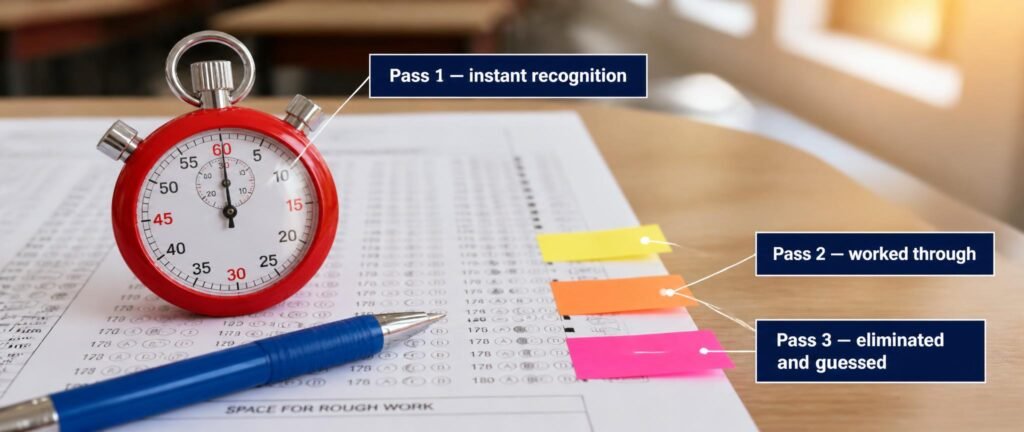
Table of Contents
Why a Single Linear Pass Causes Panic (And Why the 3 Pass Technique NEET Exam Hall Approach Fixes It)
Most students attempt NEET questions in the order they appear — question 1, then 2, then 3 — treating the paper like a straight line to walk down. The problem is that NEET doesn’t arrange questions by difficulty; an easy question and a brutal one can sit right next to each other. Getting stuck on question 4 for three minutes doesn’t just cost three minutes — it costs momentum, confidence, and often triggers a panic response that makes question 5, which might be trivially easy, harder to think through clearly too.
This connects directly to managing exam time overall, because the real problem with a linear pass usually isn’t total time — it’s when that time gets spent. Burning five minutes on one hard question in the first ten minutes of the exam is far more damaging than burning the same five minutes on a hard question with an hour still on the clock, simply because of the psychological weight early panic carries through the rest of the paper. If your mocks have been diagnosing a stuck mock score around this exact same range, a broken pass structure is often the hidden culprit.
Pass 1: The Instant-Recognition Sweep
The first of the three passes in the 3 pass technique NEET exam hall approach is the fastest and the most important for building momentum.
Go through all 180 questions once, attempting only the ones you recognise and can answer within roughly 20-30 seconds of reading them. If a question requires any real thought, calculation, or hesitation, skip it immediately — no exceptions, no “let me just quickly try.” This is the core of how to attempt 180 questions NEET actually rewards: not raw speed everywhere, but ruthless triage in the first sweep. This pass should take roughly 45-50 minutes and typically nets 90-110 confident, correct answers for a well-prepared student, banking a strong majority of your final score before the exam has even gotten difficult.
The psychological effect here matters as much as the score itself: finishing Pass 1 with over half the paper confidently answered creates real momentum, which is precisely the NEET exam hall panic management this entire strategy is built around, since momentum is what prevents the panic spiral a linear pass tends to produce.
Pass 2: The Working-Through Round
This pass covers questions that need genuine calculation or a moment of real thought, but aren’t outright unfamiliar — the kind you’d get right given 60-90 seconds instead of 20. Move through your skipped questions from Pass 1 in order, spending real time here, but capping yourself at roughly 90 seconds per question before moving on regardless of progress. This pass typically takes 50-60 minutes and should clear another 40-50 questions.
This is where a structured mock test strategy becomes genuinely useful, since Pass 2 is exactly where mock test practice teaches you to recognise your own personal “90-second questions” — the specific question types that are solvable but shouldn’t be allowed to eat unlimited time. Reviewing your mock mistakes for pass-discipline failures specifically reveals exactly where your own version of this technique needs tightening.
Pass 3: The Elimination and Decision Round
What’s left after two passes is the genuinely hard core — questions you don’t fully know, can’t solve quickly, or are simply unfamiliar. Handling assertion reason question handling fits well here too. This is where smart elimination and guessing does its heaviest lifting: for each remaining question, spend 20-30 seconds trying to eliminate at least two of the four options before deciding whether to guess, skip, or spend a genuine minute working through it. Not every remaining question deserves equal time — some are worth a real attempt, others a quick elimination-based guess, some worth skipping entirely if elimination gets you nowhere.
The Flagging System That Makes This Work
None of this works without a simple, fast way to mark which questions belong to which pass. Use a consistent physical or digital flagging system: a single dot next to questions you’re skipping in Pass 1, a circle around questions attempted but uncertain in Pass 2, and a cross next to questions you’ve decided to guess on in Pass 3. This is the practical backbone of any NEET question attempting strategy that spans multiple passes — without fast flagging, the passes blur together and lose their purpose. This system needs to take under two seconds per question to apply, or it becomes its own time sink — the goal is instant visual triage, not detailed annotation.
Time Allocation: How Many Minutes Per Pass
For a 180-minute NEET exam attempting all 180 questions, a reasonable allocation for the 3 pass technique NEET exam hall approach looks like: Pass 1 at 45-50 minutes, Pass 2 at 50-60 minutes, Pass 3 at 40-50 minutes, leaving a genuine 15-20 minute buffer for a final review pass — checking flagged answers, confirming OMR transfers, and catching any accidental skips. This buffer isn’t optional padding; it’s often where students catch the one silly transfer error that would otherwise cost four marks for no reason.
Section-wise, this technique applies independently within Biology, Chemistry, and Physics rather than across the whole paper linearly, since switching subjects resets your “instant recognition” baseline — a Biology fact you know cold and a Physics numerical you know cold feel different in your working memory, so treating each section’s three passes somewhat separately tends to work better than one continuous 180-question sweep.
Practicing the 3-Pass Technique Before Exam Day
This strategy fails if the actual exam is the first time you try it — the flagging system, the time caps, and the discipline to actually skip a stubborn question all need to become automatic well before results matter.
Consistent practice across mocks is what turns pass-discipline from a conscious effort into something that runs on autopilot when it matters most.
Final Word
NEET doesn’t just test what you know — it tests how well you can deploy what you know under a hard three-hour clock. A 3 pass technique NEET exam hall strategy turns that clock from an enemy into a structure, converting 180 unordered questions into three deliberate, manageable sweeps instead of one long, anxious walk through unpredictable difficulty. Practice the 3 pass technique NEET exam hall approach enough times before the real exam, and it stops feeling like a strategy at all — it just becomes how you take the test.
Frequently Asked Questions
Q: How many mock tests should I practice this technique on before the real exam? A: At least four to six full-length mocks, since the flagging system and time caps need to become automatic rather than something you’re consciously thinking through during the actual exam.
Q: What if I finish Pass 1 with far fewer than 90-110 questions answered? A: This usually signals a content gap rather than a strategy problem — spend more time on NCERT-level revision before refining pass timing, since the technique organises attempt order but can’t substitute for underlying preparation.
Q: Should the 3-pass technique be applied per subject or across the whole paper? A: Per subject generally works better, since switching between Biology, Chemistry, and Physics resets your sense of what counts as “instantly recognisable,” making three separate subject-level passes more effective than one continuous pass across all 180 questions.
Q: Is it normal to feel like this technique slows me down at first? A: Yes, especially during the first few practice mocks, since flagging and deliberately skipping questions feels unfamiliar initially. Most students see it start saving real time by the third or fourth full-length mock attempt.
Q: What happens if I run out of time before starting Pass 3? A: This is exactly why the time caps in Pass 1 and Pass 2 matter so much — if Pass 3 keeps getting squeezed out, it usually means Pass 2’s 90-second cap isn’t being enforced strictly enough during practice.
Q: Can this technique help with negative marking specifically? A: Indirectly, yes. By reserving Pass 3 specifically for elimination-based decisions rather than rushed first-pass guesses, the technique naturally reduces the kind of panic-guessing that tends to hurt scores through negative marking.