
Periodic trends look simple until NEET asks about the one element that breaks the pattern — and Inorganic Chemistry is built almost entirely around those exceptions. Genuine NEET inorganic chemistry exceptions trends mastery isn’t about memorising the general rule; it’s about knowing exactly where the rule fails, because that’s precisely where NTA writes its questions. These inorganic chemistry shortcuts NEET aspirants actually rely on cover the periodic trend exceptions, electronic configuration anomalies, and color tests that show up year after year.
Table of Contents
Why NEET Inorganic Chemistry Exceptions Trends Matter More Than the General Rule
Most students learn periodic trends as smooth, predictable patterns — ionisation energy increases across a period, atomic radius decreases, and so on. NEET rarely tests the smooth part of the trend, because a question asking “which trend is correct” with no exception involved is too easy to be useful. Instead, questions target the specific points where the trend breaks, which is exactly why NEET inorganic chemistry exceptions trends deserve dedicated revision time separate from general periodic table memorisation, and why treating NEET inorganic chemistry exceptions trends as a standalone revision topic pays off far more than folding them into general chapter review.
This pairs naturally with named reagents in organic chemistry, since both topics reward function-based, exception-aware understanding over blanket memorisation of a general rule — the same underlying skill that makes NEET inorganic chemistry exceptions trends manageable once you stop treating every fact as an isolated memory task.
The Periodic Trend Exceptions NEET Tests Most
- Ionisation energy: Be > B, and N > O. Both breaks happen because of stable electron configurations — a fully filled 2s² in Beryllium and a half-filled 2p³ in Nitrogen — that resist electron removal more than the smooth trend predicts.
- Electron affinity: Group 2 and Group 15 elements have unusually low or negative values. Fully filled and half-filled subshells again explain this, since adding an electron disrupts a stable configuration.
- Atomic radius: a slight increase, not decrease, occurs at certain points due to lanthanide contraction effects on period 6 elements. This specifically affects the radius similarity between period 5 and period 6 transition elements, a detail NEET tests directly.
- Electronegativity exceptions appear around the noble gases and certain transition metals, where standard electronegativity scales behave inconsistently compared to the smooth trend elsewhere in the period.
Solid chemical bonding fundamentals make all four of these exceptions far easier to actually understand rather than memorise, since each one traces back to the same underlying idea: stable electron configurations resist change more than the general trend accounts for. These periodic trends exceptions NEET tests most are also where a disciplined smart elimination technique pays off, since ruling out options that contradict a stable-configuration exception often narrows the answer quickly.
Electronic Configuration Exceptions: Chromium and Copper
Two elements break the standard (n-1)d and ns filling order, and NEET tests this specifically almost every year.
- Chromium: expected configuration is [Ar] 3d⁴ 4s², but the actual configuration is [Ar] 3d⁵ 4s¹ — a half-filled d-subshell is more stable than the “expected” pattern predicts.
- Copper: expected configuration is [Ar] 3d⁹ 4s², but the actual configuration is [Ar] 3d¹⁰ 4s¹ — a fully filled d-subshell provides the same extra stability.
These two exceptions alone account for a disproportionate share of electronic configuration questions in NEET, precisely because they contradict the pattern students learn as the “default rule” for filling orbitals. Questions on this exact contrast are also a favourite format for assertion reason exception questions, since NTA frequently pairs a correct configuration fact with an incorrect explanation of why it occurs — a classic style of NEET Chemistry exception based questions that rewards genuine understanding over memorised facts. Retaining these exceptions long-term requires spaced, tested revision specifically, since chromium and copper are exactly the kind of detail that feels familiar on a reread but disappears under exam pressure. Pairing this list with the right chemistry reference books for your level helps too, since a good reference typically flags exceptions explicitly rather than burying them inside a general trends table.
Color Tests That Show Up Every Single Year
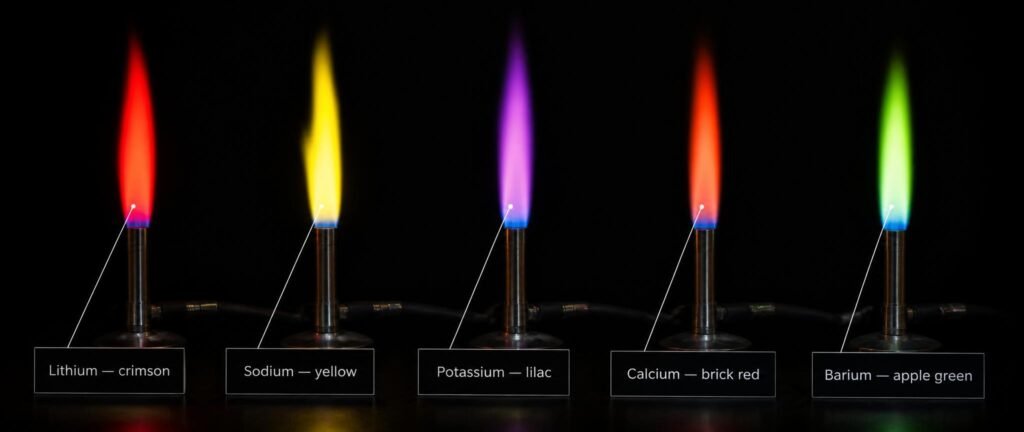
Color-based identification questions reward memorised, exact recall more than most other Inorganic Chemistry topics, making these NEET inorganic chemistry color tests some of the highest-value marks for the least conceptual effort.
- Flame tests: Lithium burns crimson red, sodium burns bright yellow, potassium burns lilac, calcium burns brick red, strontium burns crimson, barium burns apple green, and copper burns blue-green.
- Fe³⁺ with potassium thiocyanate (KSCN) gives a deep blood-red colouration, one of the most frequently tested qualitative tests in Inorganic Chemistry.
- Cu²⁺ with excess ammonia (NH₃) forms a deep blue tetraamminecopper(II) complex, [Cu(NH₃)₄]²⁺, a color change students often confuse with the pale blue of hydrated Cu²⁺ alone.
- KMnO₄ is intensely purple, while K₂Cr₂O₇ is bright orange — both frequently appear as oxidising agents in questions that also expect you to recall their characteristic color.
- Fe²⁺ solutions are pale green, while Fe³⁺ solutions are yellow-brown — a distinction NEET uses to test whether students actually track oxidation state changes through a reaction, not just the final answer.
Coordination Compound Colors: The d-d Transition Shortcut
Most transition metal complex colors come down to one underlying idea: d-d electron transitions absorb specific wavelengths of visible light, and the color you see is the complementary color of what’s absorbed. You don’t need to memorise every single complex’s color independently if you understand this one shortcut — a partially filled d-orbital is the prerequisite for color, which is also why Zn²⁺ and Sc³⁺ complexes are typically colorless, since their d-orbitals are either completely filled or completely empty.
This overlaps closely with how NEET tests exceptions elsewhere too, since NEET frequently pairs a correct color observation with an incorrect explanation of why that color occurs, testing whether students understand the d-d transition mechanism or just memorised the color itself.
Building a System to Retain These Exceptions
Don’t revise exceptions as an afterthought tacked onto general trends — build a dedicated “exceptions and colors” list separate from your main Inorganic Chemistry notes, and revise it on its own spaced schedule, using active, tested recall rather than repeated rereading. And when a color-test or exception question does show up with an unfamiliar phrasing, a disciplined elimination approach — ruling out options that contradict a color or configuration you’re confident about — often gets you to the right answer even when full recall isn’t immediate.
Final Word
Inorganic Chemistry rewards students who treat exceptions as the main event, not a footnote to the general trend. The periodic anomalies, electronic configuration surprises, and color tests covered here aren’t obscure trivia — they’re the specific, predictable places NEET consistently writes its questions, precisely because mastering NEET inorganic chemistry exceptions trends separates genuine understanding from surface-level memorisation of the smooth textbook trend.
Frequently Asked Questions
Q: Why does NEET focus so heavily on periodic trend exceptions instead of the general trends themselves? A: General trends are too straightforward to distinguish students who understand the underlying chemistry from those who’ve simply memorised a direction. Exceptions require genuine understanding of stable electron configurations, making them a more effective way to test real comprehension.
Q: Are Chromium and Copper the only electronic configuration exceptions I need to know? A: They’re by far the most frequently tested and the most important for NEET, though a few other transition elements show minor irregularities. Focusing thoroughly on chromium and copper covers the vast majority of configuration-exception questions.
Q: How many color tests should I memorise for NEET Inorganic Chemistry? A: Around 15-20 color tests cover the large majority of NEET questions, spanning flame tests, common ion identification tests, and the characteristic colors of frequently used oxidising and reducing agents.
Q: Do I need to understand d-d transitions in detail, or just memorise complex colors? A: Understanding the basic d-d transition concept is valuable because it explains why some complexes are colorless (filled or empty d-orbitals) and helps you reason through unfamiliar complexes rather than relying purely on memorisation.
Q: What’s the best way to avoid confusing similar color tests, like Fe²⁺ and Fe³⁺? A: Practice writing both colors side by side with their exact oxidation states rather than learning them in isolation, since NEET frequently tests these pairs specifically to catch students who’ve memorised only one half of the comparison.
Q: Should exceptions be revised separately from the main periodic trends chapter? A: Yes. Keeping a dedicated, separate list for exceptions and color tests prevents them from being lost inside general trend revision, and allows for the kind of focused, spaced repetition that this specific type of detail-heavy content needs.