
A government MBBS seat costs ₹2–5 lakh across the full course. A deemed university seat can cost ₹1.4 crore. For most families, that second number is only reachable through borrowing — which is why an education loan for MBBS 2026 is now part of the counselling decision itself, not an afterthought. This guide covers what banks actually offer, what collateral they demand, and what the repayment looks like once you are a junior doctor. Read it alongside our deemed university fees guide and the private MBBS fees breakdown before you commit to a seat.
Table of Contents
Work Out What You Actually Need First
Borrow against the real total, not the advertised tuition. Add:
- Annual tuition across 4.5 years
- Hostel and mess charges
- Examination and university fees
- Books, instruments, and equipment
- Internship-year expenses
Realistic totals: ₹2–5 lakh for a government seat, ₹25–60 lakh for a state private college, and ₹53 lakh to ₹1.4 crore for a deemed university. Confirm your figure from the college’s official fee structure before approaching any bank — banks issue nothing without the allotment letter you collect during the college reporting process. Also check whether a state quota seat could cut the requirement dramatically.
MBBS Education Loan Interest Rate: What Banks Charge
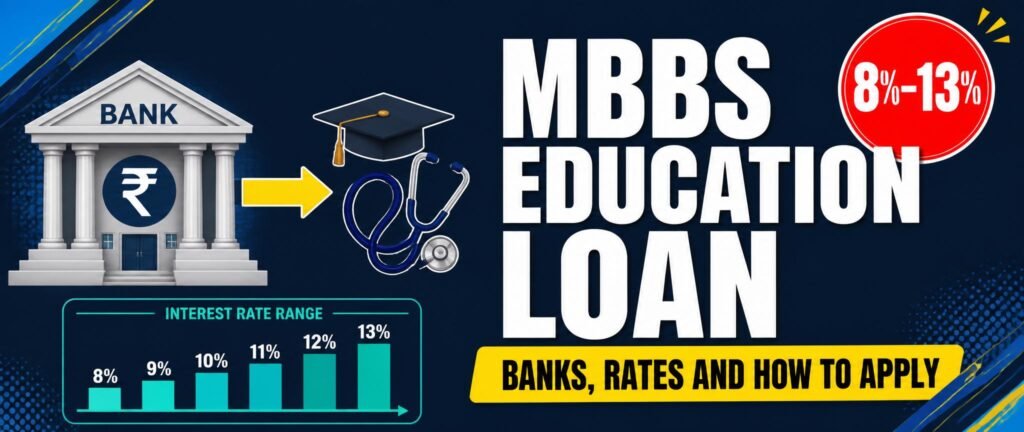
Rates in 2026 broadly sit between 8% and 13% per annum, depending on lender, loan size, collateral, and credit profile.
| Lender Type | Typical Rate Range | Notes |
|---|---|---|
| Public sector banks (SBI, BoB, PNB, Canara) | ~8.1% – 10.5% | Lowest rates, slower processing |
| Private banks (HDFC, ICICI, Axis) | ~9.5% – 12% | Faster approval, higher cost |
| NBFCs (HDFC Credila, Avanse) | ~11% – 13%+ | Most flexible, most expensive |
Two things worth knowing: most banks offer a 0.5% concession for female students, and public sector banks typically take 15–25 days to process while NBFCs move faster.
Rates change frequently. Treat every figure here as a starting point for comparison, not a quote — always confirm current rates directly with the bank.
Education Loan Collateral Rules
This is where most applications stall. The education loan collateral rules are broadly standard across Indian banks:
| Loan Amount | Security Required |
|---|---|
| Up to ₹4 lakh | No collateral, no guarantor |
| ₹4 lakh – ₹7.5 lakh | Usually third-party guarantee |
| Above ₹7.5 lakh | Tangible collateral — typically immovable property |
For amounts above ₹7.5 lakh, banks generally want property valued at 1.25 to 1.5 times the loan amount. For a ₹60 lakh deemed university loan, that means pledging property worth ₹75–90 lakh. Families without that asset base will struggle, regardless of the student’s rank.
PM Vidyalaxmi Scheme: The Collateral-Free Route
The PM Vidyalaxmi scheme is worth checking before anything else, because it removes the collateral barrier for eligible students:
- Collateral-free and guarantor-free loans for students at Quality Higher Education Institutions (QHEIs — NIRF/NAAC ranked)
- 3% interest subvention on loans up to ₹10 lakh where annual family income is ₹8 lakh or below
- 75% government credit guarantee on loans up to ₹7.5 lakh
- Open to all categories — SC, ST, OBC, and General alike
- Apply at pmvidyalaxmi.in
The catch is the QHEI requirement. Verify whether your allotted college qualifies before assuming eligibility, particularly for management quota or NRI seats at newer institutions.
How to Apply for an Education Loan for MBBS 2026
- Secure your admission confirmation. No bank processes an education loan for MBBS 2026 without it — the MCC or state allotment letter for government seats, or the college’s admission letter with fee structure on letterhead for private colleges.
- Register on the Vidya Lakshmi portal — India’s centralised education loan platform.
- Fill the Common Education Loan Application Form (CELAF) once and submit it to up to three banks simultaneously.
- Compare sanctioned offers on rate, processing fee, moratorium terms, and prepayment conditions.
- Submit documents to your chosen bank.
- Complete verification and sanction, then coordinate direct disbursement to the college.
Documents you will need
- Admission letter or allotment order with fee structure
- Class 10 and 12 mark sheets and certificates
- NEET UG 2026 scorecard
- KYC documents for student and co-applicant
- Income proof of parent or co-applicant
- Last six months’ bank statements
- Property documents, if collateral applies
The Repayment Reality
The moratorium runs for the course duration plus six months to one year. Repayment then extends up to 15 years.
Interest accrues during the moratorium. On a ₹60 lakh loan at 10%, roughly ₹30 lakh of interest builds up before your first EMI, pushing the EMI itself into the ₹75,000–₹95,000 range over 15 years. Set that against a junior resident’s typical starting salary and the strain becomes obvious.
This is not an argument against borrowing. It is an argument for treating an education loan for MBBS 2026 as a deliberate decision — and for exhausting every government and state quota option before signing.
Two practical notes: interest paid on an education loan qualifies for deduction under Section 80E for up to eight years, and most banks charge no prepayment penalty, so early repayment materially reduces total cost.
If repayment ever becomes difficult, contact your bank’s loan officer immediately about tenure extension or moratorium extension. Default damages your credit record, invites legal action, and puts pledged property at risk.
Borrow Against a Plan, Not a Hope
An education loan for MBBS 2026 is a genuine enabler for students with the rank but not the funds. It is also a fifteen-year obligation entered at eighteen. Compare at least three lenders through Vidya Lakshmi, check PM Vidyalaxmi eligibility first, and be honest about whether the EMI fits the career you are entering. This article is general information rather than financial advice — discuss your specific situation with the bank and, if possible, a qualified financial advisor before committing.
❓ FAQ
Q: Which bank offers the lowest interest rate for an MBBS education loan? A: Public sector banks typically offer the lowest MBBS education loan interest rate, generally starting around 8.1%. SBI, Bank of Baroda, Canara Bank, and Central Bank of India are commonly compared. Rates vary by loan size, collateral, and credit profile, so compare current offers rather than relying on published ranges.
Q: Can I get an education loan without collateral? A: Yes, up to ₹4 lakh with no security and typically up to ₹7.5 lakh with a third-party guarantee. Beyond that, banks generally require immovable property. The PM Vidyalaxmi scheme offers collateral-free loans for students at qualifying institutions regardless of amount tier.
Q: What is the Vidya Lakshmi portal? A: It is the Government of India’s centralised education loan platform at vidyalakshmi.co.in. You complete one Common Education Loan Application Form and submit it to multiple banks, then track status and raise grievances through the same portal.
Q: When do I start repaying the loan? A: Repayment begins after the moratorium, which covers the course duration plus six months to one year. Interest accrues during this period and is added to the principal, so the amount you repay is substantially higher than the amount you borrowed.
Q: Is there any tax benefit on an education loan? A: Yes. Under Section 80E of the Income Tax Act, the interest component of your education loan repayment is deductible for up to eight years. There is no upper limit on the interest amount claimed, though the principal is not deductible.