You can’t walk into June 21 having never seen what a Biology question actually looks like in NEET’s exact format, and reading theory alone doesn’t fix that. This Biology Re-NEET 2026 expected questions replica exists to close that gap — a sample paper built to mirror the real exam’s structure, drawn from an internal practice test series rather than any leaked or unofficial material. Treat it as a rehearsal, not a prediction guarantee. Before diving into the questions, cross-checking this against the chapter weightage breakdown shows exactly how these topics were chosen.
This replica covers a working sample of questions across both Botany and Zoology. For the complete set — all 90 attempted Biology questions plus full Physics and Chemistry papers — the Re-NEET 2026 guess paper course packages the entire predicted paper with detailed solutions, built around the same high-probability topics used here.
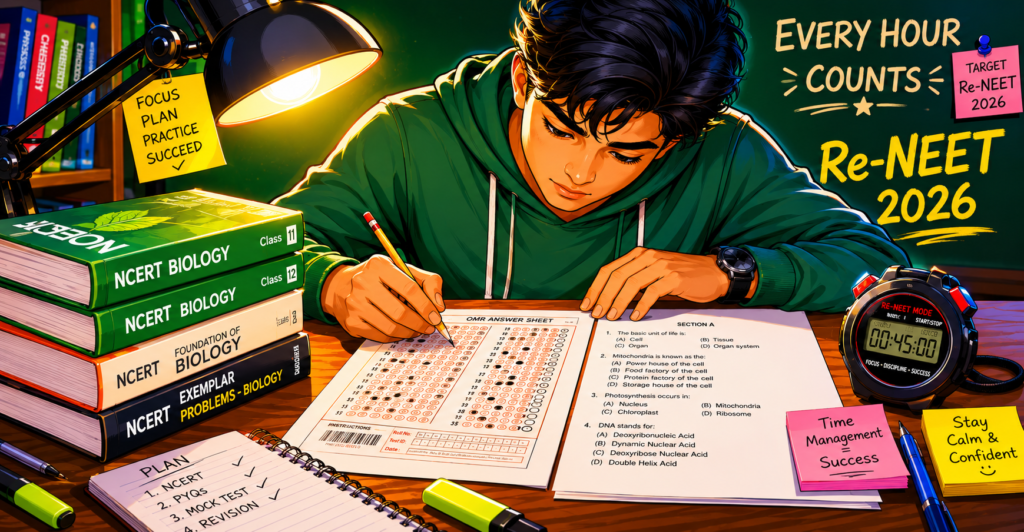
Table of Contents
The Biology Exam Pattern You’ll Actually Face
Before practicing questions, it helps to see exactly how NTA structures the Biology section, since the format itself affects strategy as much as content knowledge does. Every set of Biology Re-NEET 2026 expected questions, including this one, follows this same official structure.
| Section | Botany Questions | Zoology Questions | Questions to Attempt | Marks |
|---|---|---|---|---|
| Section A (Compulsory) | 35 | 35 | All 70 | 280 |
| Section B (Choice-based, attempt 10 of 15 each) | 15 | 15 | 20 | 80 |
| Total | 50 | 50 | 90 | 360 |
Every correct answer earns 4 marks, every incorrect answer costs 1, and Section B gives you the freedom to skip questions you’re unsure of without penalty for the ones left unattempted.
Expected Question Quota by Topic Area
Predicting individual questions is far less reliable than predicting which topics will dominate. Based on five years of chapter-wise trend analysis, here’s roughly how these NEET Biology expected questions 2026 and the 90 attempted questions overall tend to distribute across major topic areas.
| Topic Area | Expected Questions | Priority |
|---|---|---|
| Genetics & Evolution | 14 | High |
| Human Physiology | 12 | High |
| Reproduction (Plant & Human) | 12 | High |
| Ecology & Environment | 11 | Medium |
| Cell Biology & Biomolecules | 8 | Medium |
| Structural Organisation (Plant & Animal) | 8 | Medium |
| Diversity in Living World | 7 | Medium |
| Plant Physiology | 6 | Medium |
| Biotechnology & Its Applications | 6 | Medium |
| Biology in Human Welfare | 6 | Medium |
This Re-NEET 2026 Biology question bank quota is a guide for where to spend your remaining revision hours, not a guarantee of exact numbers on June 21. Genetics, Human Physiology, and Reproduction together account for nearly 40% of the section, which is precisely where these Biology Re-NEET 2026 expected questions concentrate. These high-frequency zones overlap heavily with our most repeated biology topics list, so revising both side by side reinforces the same priority chapters from two different angles.
How to Use This Replica Before You Start
Treat this Re-NEET 2026 Biology sample paper like an exam, not a worksheet, or the diagnostic value disappears. Time yourself — roughly 96 seconds per question, matching the real per-question pace — and resist checking the answer key until you’ve attempted all 14 questions in one sitting.
Once you’ve scored yourself, separate your mistakes into two categories: questions you got wrong from a genuine knowledge gap, versus questions you got wrong from careless reading or rushed elimination. Reviewing this split alongside a proper mock test analysis habit, and tightening your pacing through deliberate time management practice, turns this sample paper into a genuine diagnostic rather than just fourteen more questions you’ve answered. If a question style here feels unfamiliar rather than just hard, our Biology MCQ practice set is a good next stop before you move further into revision.
Section A Sample: Botany
These five questions are written in the same direct, NCERT-aligned style as the compulsory Section A, where speed and accuracy matter more than deep analysis. Like most NEET Biology expected questions 2026 students will encounter, the wording stays simple while the underlying concept does the real testing.
Q1. Match the cell organelles in Column I with their distinct features in Column II.
| Column I | Column II |
|---|---|
| A. Chloroplast | I. Single membrane-bound, contains hydrolytic enzymes |
| B. Mitochondria | II. Lacks a membrane, involved in protein synthesis |
| C. Lysosome | III. Double membrane, inner membrane forms cristae |
| D. Ribosome | IV. Double membrane, contains thylakoids |
a) A-IV, B-III, C-I, D-II b) A-III, B-IV, C-II, D-I c) A-IV, B-III, C-II, D-I d) A-I, B-II, C-IV, D-III
Q2. In recombinant DNA technology, which of the following enzymes acts as ‘molecular scissors’ by cleaving DNA at specific palindromic sequences? a) DNA Ligase b) Alkaline Phosphatase c) Restriction Endonuclease d) Taq Polymerase
Q3. If the Respiratory Quotient (RQ) of a respiring substrate is 0.7, the substrate is most likely: a) Carbohydrate b) Organic acid c) Protein d) Fat
Q4. In a typical Mendelian dihybrid cross (AaBb × AaBb), what is the phenotypic ratio if both gene loci exhibit complete dominance? a) 1:2:1 b) 9:3:3:1 c) 1:1:1:1 d) 9:7
Q5. In a typical angiosperm embryo sac, which of the following cells is diploid? a) Synergids b) Antipodals c) Egg cell d) Secondary nucleus (Central cell after polar nuclei fuse)
Section A Sample: Zoology
These NEET Biology expected questions for 2026 shift focus to human physiology and genetics, the two zones flagged as highest priority in the quota table above. Several of the trickier ones here hinge on a single confused term — process names, karyotype labels — which is exactly the kind of close-reading trap our assertion reason questions guide was built to address.
Q6. In human spermatogenesis, the final release of mature spermatozoa from the Sertoli cells into the lumen of the seminiferous tubule is termed: a) Spermatocytogenesis b) Spermiogenesis c) Spermiation d) Capacitation
Q7. In the human excretory system, the network of capillaries enclosed by the Bowman’s capsule is called the: a) Glomerulus b) Vasa recta c) Peritubular capillaries d) Loop of Henle
Q8. Which of the following ribs in humans are referred to as ‘floating ribs’? a) 1st to 7th pairs b) 8th, 9th, and 10th pairs c) 11th and 12th pairs d) Only the 12th pair
Q9. A human male presenting with gynecomastia, tall stature, and a sterile reproductive system is likely suffering from a genetic disorder with which karyotype? a) 45, XO b) 47, XXY c) 47, XYY d) 46, XY (with a point mutation)
Q10. Hypersecretion of thyroid hormones, accompanied by enlargement of the thyroid gland and protrusion of eyeballs, is characteristic of: a) Addison’s disease b) Hashimoto’s disease c) Exophthalmic goitre (Grave’s disease) d) Cushing’s syndrome
Section B Sample: Mixed Format
Section B questions often lean on assertion-reason and statement-based formats rather than direct recall, so this part of the Biology Re-NEET 2026 expected questions set reflects that shift.
Q11. Assertion (A): DNA is structurally and chemically more stable than RNA. Reason (R): The presence of a 2′-OH group in every nucleotide of RNA makes it easily degradable and highly reactive. a) Both A and R are true, and R is the correct explanation of A b) Both A and R are true, but R is not the correct explanation of A c) A is true, but R is false d) A is false, but R is true
Q12. Read the following statements regarding diagnostic tests. Statement I: The Widal test is utilized for the diagnosis of Typhoid fever. Statement II: ELISA is a diagnostic technique based on the principle of antigen-antibody interaction. a) Both Statement I and Statement II are correct b) Both Statement I and Statement II are incorrect c) Statement I is correct, but Statement II is incorrect d) Statement I is incorrect, but Statement II is correct
Q13. Assertion (A): ZIFT (Zygote Intra Fallopian Transfer) involves transferring a zygote or early embryo into the fallopian tube. Reason (R): In ZIFT, fertilization of the ovum by the sperm occurs strictly in vivo (inside the female’s body). a) Both A and R are true, and R is the correct explanation of A b) Both A and R are true, but R is not the correct explanation of A c) A is true, but R is false d) A is false, but R is true
Q14. Assertion (A): The breakdown of glucose in cellular respiration is strictly a catabolic pathway. Reason (R): Intermediates of the respiratory pathway are often withdrawn to synthesize other cellular compounds. a) Both A and R are true, and R is the correct explanation of A b) Both A and R are true, but R is not the correct explanation of A c) A is true, but R is false d) A is false, but R is true
Answer Key for These Biology Re-NEET 2026 Expected Questions
Use this Re-NEET 2026 Biology question bank reference to score yourself honestly before moving on, since the real value here is in the gaps it reveals, not the raw number correct. Each topic tag below maps directly back to the quota table, so a wrong answer tells you exactly which chapter needs another pass.
| Q.No | Topic | Correct Answer |
|---|---|---|
| 1 | Cell: The Unit of Life | a |
| 2 | Biotechnology: Principles and Processes | c |
| 3 | Respiration in Plants | d |
| 4 | Principles of Inheritance and Variation | b |
| 5 | Sexual Reproduction in Flowering Plants | d |
| 6 | Human Reproduction | c |
| 7 | Excretory Products and their Elimination | a |
| 8 | Locomotion and Movement | c |
| 9 | Principles of Inheritance and Variation | b |
| 10 | Chemical Coordination and Integration | c |
| 11 | Molecular Basis of Inheritance | a |
| 12 | Human Health and Disease | a |
| 13 | Reproductive Health | c |
| 14 | Respiration in Plants | d |
Want the Complete Replica Paper?
Fourteen questions give you a feel for the format, but they’re a fraction of the 90 you’ll actually face in Biology alone. The full Biology Re-NEET 2026 expected questions set inside the guess paper course extends this same approach across the entire syllabus — complete Botany and Zoology sections, detailed solutions for every question, plus matching Physics and Chemistry papers built around the same 580+ marks target strategy.
It’s designed specifically for this final stretch: subject-wise 10 sets for each subject, NCERT-direct questions, assertion-reason practice, and chapter-wise high-weightage drills you can work through without re-deriving a study plan from scratch. This Biology guess paper Re-NEET 2026 set is updated to reflect the same pattern analysis used throughout this article, and these NEET Biology expected questions 2026 trends only get sharper as more candidates work through it.
This Biology Re-NEET 2026 expected questions replica won’t predict your exact paper, but it will tell you, right now, exactly where your preparation actually stands. Working through this Re-NEET 2026 Biology sample paper honestly matters more than the score it produces, and the same applies to any Re-NEET 2026 Biology question bank you pick up afterward. Use that information honestly, and spend your remaining days closing the gaps it reveals rather than the ones you assumed were there.
FAQs
Q: Are these actual leaked questions from the Re-NEET 2026 paper? A: No. These are original questions from our own internal practice test series, written to match NCERT concepts and historical NEET patterns. No leaked or unofficial exam content was used to create this Biology guess paper Re-NEET 2026 replica.
Q: How accurate is the expected question quota by topic? A: It’s based on chapter-wise trend analysis across the last several years of NEET papers, which makes these NEET Biology expected questions 2026 a strong probability guide rather than a guaranteed breakdown of the actual exam.
Q: Should I attempt Section B questions if I’m running low on time? A: Attempt as many as you can within your remaining time, since Section B lets you choose 10 out of 15 per subject, giving you room to skip the ones you’re least confident about.
Q: Is this Re-NEET 2026 Biology sample paper enough preparation on its own? A: No single Biology Re-NEET 2026 expected questions set replaces full revision. Use it as a diagnostic check alongside your regular study plan and mock tests, not as a substitute for either.
Q: Where can I get more practice questions like these? A: The complete Biology guess paper Re-NEET 2026 course covers the full Biology section plus Physics and Chemistry, with detailed solutions for every question across all three subjects.
Q: What if I scored poorly on this sample set? A: Use it as direction, not discouragement. Identify which topics tripped you up, revisit those NCERT chapters directly, and retest yourself in a few days to track real improvement.