
Biology rewards precision more than any other section, and nowhere does that show up more clearly than in questions built around two similar-sounding concepts. Mix up mitosis and meiosis, or monocots and dicots, under exam pressure, and an easy mark turns into a careless loss. These Re-NEET 2026 biology comparison tables exist to fix exactly that problem — eight side-by-side breakdowns of the pairs that get confused most often, formatted so you can scan and recall them fast. A clear NEET biology comparison chart like this one does more for your last-minute revision than re-reading entire chapters, since it isolates exactly the Re-NEET 2026 biology differences that tend to cost marks. Pulling these against the chapter weightage data makes it obvious why these particular comparisons deserve a dedicated pass before June 21.
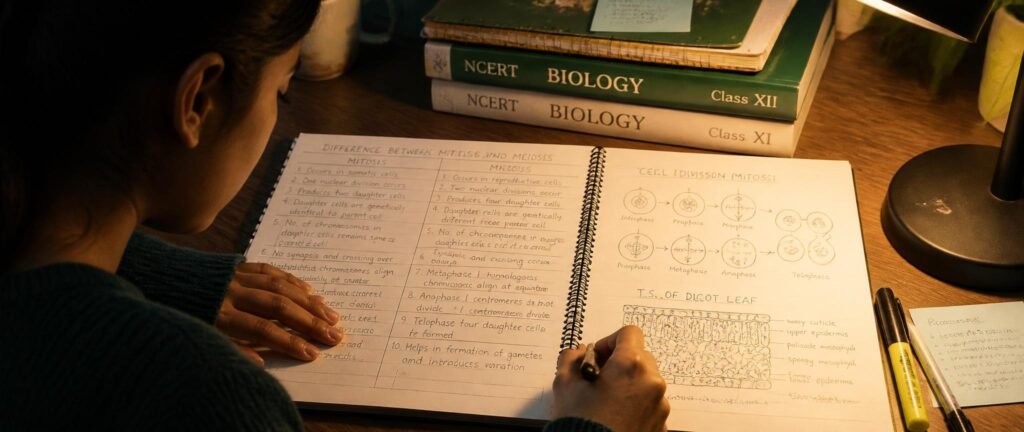
Table of Contents
Mitosis vs Meiosis
| Mitosis | Meiosis | |
|---|---|---|
| Number of divisions | One | Two (Meiosis I and II) |
| Daughter cells produced | Two | Four |
| Chromosome number | Diploid (same as parent) | Haploid (half of parent) |
| Genetic variation | None — identical to parent cell | Present, due to crossing over and independent assortment |
| Occurs in | Somatic cells | Germ cells, for gamete formation |
| Biological purpose | Growth, repair, and asexual reproduction | Sexual reproduction and genetic diversity |
This single comparison is one of the most reliable sources of easy marks in the entire syllabus, provided you don’t blur the two processes together under time pressure. Running through your Biology quick revision lines alongside this table reinforces the contrast far better than memorising it in isolation. These Re-NEET 2026 mitosis meiosis differences are also a classic trap in poorly worded statement questions, so working through a dedicated Biology MCQ set built around this exact contrast is a fast way to confirm it’s actually locked in, not just familiar-sounding.
Aerobic vs Anaerobic Respiration
| Aerobic Respiration | Anaerobic Respiration | |
|---|---|---|
| Oxygen requirement | Required | Not required |
| Location | Cytoplasm and mitochondria | Cytoplasm only |
| ATP yield per glucose molecule | Approximately 36–38 | Only 2 |
| End products | Carbon dioxide and water | Lactic acid (animals) or ethanol and CO2 (yeast) |
| Efficiency | High | Low |
Statements built around these two processes are a favourite setup for tricky question formats — the kind of contrast that Re-NEET 2026 assertion reason questions frequently lean on, since a single swapped detail flips an otherwise-true statement into a false one.
C3 vs C4 Photosynthesis
| C3 Plants | C4 Plants | |
|---|---|---|
| First stable product | 3-carbon PGA (phosphoglyceric acid) | 4-carbon OAA (oxaloacetic acid) |
| Leaf anatomy | Normal mesophyll arrangement | Kranz anatomy with bundle sheath cells |
| Photorespiration | Significant | Minimal |
| Climate suited to | Cooler, moderate conditions | Hot, dry conditions |
| Example plants | Wheat, rice | Maize, sugarcane |
Photosynthesis pathways sit inside genetics and plant physiology, chapters that consistently show up among the most repeated biology topics across recent papers, which makes this particular table worth memorising cold rather than half-remembering.
Monocot vs Dicot
If you’re following our last 4 days plan, this is exactly the kind of quick table that fits into a single Biology revision block without eating into your numericals or chemistry time.
| Monocot | Dicot | |
|---|---|---|
| Root system | Fibrous root | Tap root |
| Leaf venation | Parallel | Reticulate |
| Vascular bundles | Scattered | Arranged in a ring |
| Cotyledons | One | Two |
| Floral parts | Typically in multiples of three | Typically in multiples of four or five |
DNA vs RNA
| DNA | RNA | |
|---|---|---|
| Sugar component | Deoxyribose | Ribose |
| Strand structure | Double helix | Usually single-stranded |
| Nitrogenous bases | Adenine, Thymine, Guanine, Cytosine | Adenine, Uracil, Guanine, Cytosine |
| Primary role | Stores genetic information | Carries out protein synthesis |
| Location | Mainly nucleus | Nucleus and cytoplasm |
Genetics-heavy comparisons like this one tend to blur together fastest under stress, since DNA and RNA share enough vocabulary to make careless mixing easy even for well-prepared students.
Active Transport vs Passive Transport
| Active Transport | Passive Transport | |
|---|---|---|
| Energy requirement | Requires ATP | No energy required |
| Direction of movement | Against the concentration gradient | Along the concentration gradient |
| Examples | Sodium-potassium pump | Diffusion, facilitated diffusion, osmosis |
| Carrier proteins | Always involved | Sometimes involved (facilitated diffusion only) |
Homologous vs Analogous Organs
| Homologous Organs | Analogous Organs | |
|---|---|---|
| Origin | Same basic structure and embryonic origin | Different structure and origin |
| Function | May differ | Similar |
| Example | Forelimbs of frogs, lizards, birds, and humans | Wings of insects and wings of birds |
| Evolutionary evidence | Divergent evolution | Convergent evolution |
Innate vs Acquired Immunity
| Innate Immunity | Acquired Immunity | |
|---|---|---|
| Present from birth | Yes | No, develops after exposure |
| Specificity | Non-specific | Highly specific to the antigen |
| Response speed | Immediate | Slower on first exposure, faster afterward |
| Memory | None | Yes, immunological memory |
| Mediated by | Physical barriers, phagocytes | B and T lymphocytes |
How to Memorise These Re-NEET 2026 Biology Comparison Tables
Reading a table once rarely makes it stick. Cover one column and try to reconstruct it from memory using only the other column as a cue — this single habit reveals which rows you’ve genuinely learned versus which ones you’ve only recognised. Repeat this daily rather than rereading the whole table from scratch each time.
Grouping these comparisons by theme also helps: cell division pairs like the Re-NEET 2026 mitosis meiosis differences above, plant biology pairs, and immunology pairs each reinforce different parts of your memory rather than competing for the same mental space. If a particular table keeps slipping, it’s a sign to revisit the underlying NCERT chapter directly rather than just re-reading the comparison itself. These Re-NEET 2026 biology memorization tips work best when applied consistently across all eight Re-NEET 2026 biology comparison tables over your remaining days rather than crammed into one long session the night before.
These Re-NEET 2026 biology comparison tables aren’t meant to replace deeper conceptual study — they’re meant to lock in the Re-NEET 2026 biology differences that otherwise blur together right when you need clarity most. Spend twenty focused minutes a day on this NEET biology comparison chart, and you’ll walk into June 21 confident about exactly the kind of question that quietly costs other candidates marks.
FAQs
Q: How many comparison-based questions typically appear in NEET Biology? A: There’s no fixed number, but comparison concepts like mitosis versus meiosis or C3 versus C4 plants appear in some form almost every year, often inside assertion-reason or statement-based questions.
Q: Are Re-NEET 2026 biology comparison tables more useful than reading full chapters again? A: They’re a supplement, not a replacement. Use them to consolidate contrasts you’ve already studied rather than as your first introduction to the topic. Good Re-NEET 2026 biology memorization tips always pair tables like these with the original NCERT explanation.
Q: What’s the best way to remember mitosis and meiosis differences specifically? A: Anchor the contrast to outcome: mitosis makes two identical cells for growth and repair, meiosis makes four genetically varied cells for reproduction. Building from purpose rather than memorising lists in isolation tends to stick better.
Q: Should I create my own comparison tables for other topics? A: Yes, if you have time. The act of building the table yourself, even for concepts already covered here, reinforces the contrast more effectively than only reading someone else’s version.
Q: How close to the exam should I revise these tables? A: They work well as a same-day or next-day refresher, since they’re quick to scan and don’t require deep new learning, making them ideal for the final stretch before June 21.