
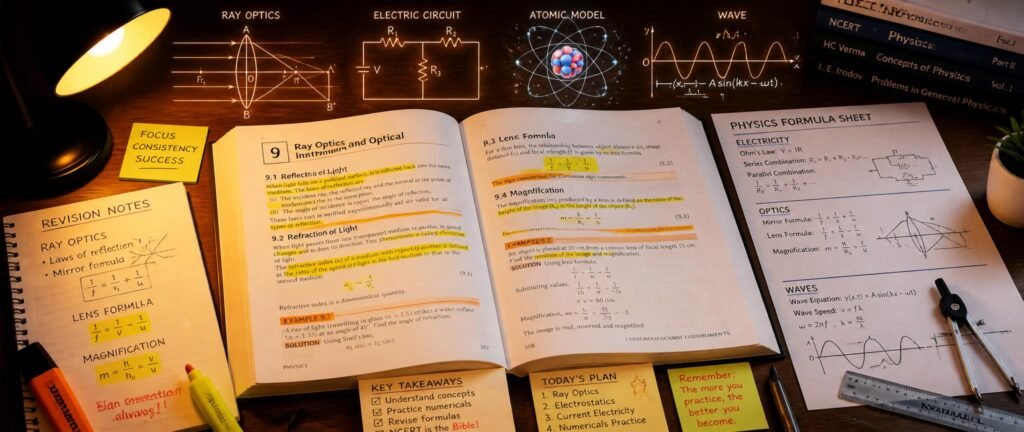
Physics is the section where most NEET students either gain a decisive edge or bleed marks unnecessarily. The difference almost always comes down to one thing: knowing the principle behind a formula. Students who know only the formula guess on conceptual questions. Students who know both the formula AND the NCERT Physics line for NEET 2026 that explains it answer with confidence. This Re-NEET 2026 Physics quick revision list gives you exactly that.
This Re-NEET 2026 Physics quick revision list is your conceptual foundation for June 21. It gives you 100 verified lines from Class 11 and Class 12 NCERT Physics — definitions, laws, principles, and statements that have appeared in NEET questions repeatedly. No outside sources, no fabrication, pure NCERT.
These are the NEET Physics NCERT important lines — the conceptual layer that makes the formula sheet complete. Keep your Re-NEET 2026 Physics formula sheet beside you as you read — these lines are the conceptual layer on top of the formulas.
Table of Contents
How to Use This Re-NEET 2026 Physics Quick Revision List
- Read 10 lines, then close the page and mentally recall them
- Mark lines you hesitate on — revise those first tomorrow
- Do NOT try to cover all 100 in one sitting — split across 3 days
- Track which lines you miss repeatedly using the Re-NEET 2026 mock test analysis error log system
- On June 20, scan only the lines you marked as weak
Class 11 NCERT Physics — 50 Re-NEET 2026 Physics Quick Revision Lines
Physical World and Units & Measurement
These lines form the foundation of your Re-NEET 2026 Physics quick revision — units and dimensions are tested every year.
- Physics is the study of the basic laws of nature and their manifestation in different natural phenomena. This first line is itself one of the NEET Physics NCERT important lines that appears as an MCQ option.
- Significant figures in a measured quantity include all certain digits plus one doubtful digit.
- Dimensional analysis is used to check the correctness of equations, derive relationships between physical quantities, and convert units.
- The SI system has seven base units: metre (length), kilogram (mass), second (time), ampere (current), kelvin (temperature), mole (amount of substance), candela (luminous intensity).
- Systematic errors are reproducible inaccuracies that are consistently in the same direction; random errors occur irregularly and have no fixed pattern.
Motion in a Straight Line & Plane
Kinematics is the entry point of Re-NEET 2026 Physics chapter revision — projectile motion and relative velocity lines appear almost every year.
- Displacement is a vector quantity — it has both magnitude and direction. Distance is a scalar quantity.
- Average velocity = total displacement / total time. Average speed = total distance / total time.
- Instantaneous velocity is the limit of average velocity as the time interval approaches zero — it equals the slope of the position-time graph at that instant.
- Acceleration is the rate of change of velocity — it is a vector quantity.
- A projectile is an object given an initial velocity and then allowed to move under gravity alone. The horizontal component of velocity remains constant; only the vertical component changes.
- For a projectile, the range is maximum at 45° to the horizontal, and the maximum height is achieved when the initial velocity is directed vertically (90°).
- Relative velocity of A with respect to B = velocity of A − velocity of B.
Laws of Motion
Laws of Motion is a chapter where Re-NEET 2026 Physics quick revision pays off immediately — Newton’s laws and friction lines appear almost every year.
- Newton’s First Law (Law of Inertia): every body continues in its state of rest or of uniform motion in a straight line unless acted upon by an external unbalanced force.
- Newton’s Second Law: the rate of change of momentum of a body is directly proportional to the applied force — F = dp/dt = ma.
- Newton’s Third Law: for every action, there is an equal and opposite reaction. Forces always act in pairs on two different bodies.
- Impulse = Force × time = change in momentum (Δp). It is a vector quantity.
- Law of Conservation of Linear Momentum: in the absence of an external force, the total momentum of a system remains constant.
- Static friction is always equal to the applied force until it reaches its maximum value (limiting friction). Kinetic friction is slightly less than limiting static friction.
- The coefficient of kinetic friction (μₖ) is always less than the coefficient of static friction (μₛ).
Work, Energy and Power
Work, Energy and Power is a chapter where NEET Physics NCERT important lines and numericals are equally represented — know both the theorem statements and the formulas.
- Work done by a constant force = F · d · cosθ. Work is a scalar quantity.
- Work done by a conservative force is path-independent — it depends only on the initial and final positions.
- Kinetic energy (KE) = ½mv². Potential energy (PE) = mgh (gravitational).
- Work-Energy Theorem: the net work done on an object equals the change in its kinetic energy — W_net = ΔKE.
- Conservation of mechanical energy: in the absence of non-conservative forces, the total mechanical energy (KE + PE) of a system remains constant.
- Power = work done per unit time = F·v. Its SI unit is the watt (W).
- Elastic collision: both momentum and kinetic energy are conserved. Inelastic collision: only momentum is conserved; kinetic energy is not.
Rotational Motion
The NEET Physics NCERT important lines from Rotational Motion are the most numerically tested in this section — know the MI values and rolling motion statements cold.
- Torque (τ) = r × F = rF sinθ. It is the rotational analogue of force.
- Angular momentum (L) = Iω = r × p. Conservation of angular momentum: L remains constant when net external torque = 0.
- Moment of inertia (I) depends on the mass of the body and the distribution of mass about the axis of rotation.
- Parallel axis theorem: I = I_cm + Md², where d is the distance between the parallel axes.
- Perpendicular axis theorem (for flat lamina): I_z = I_x + I_y.
- For rolling without slipping, the velocity at the point of contact with the ground is zero; the velocity at the top is 2v.
Gravitation
Gravitation is a high-ROI chapter in any Re-NEET 2026 Physics quick revision session — short, predictable, and mostly direct NCERT recall.
- Newton’s Law of Universal Gravitation: every particle attracts every other particle with a force F = Gm₁m₂/r². G = 6.67 × 10⁻¹¹ N m² kg⁻².
- Acceleration due to gravity (g) = GM/R² at the surface. It decreases both above and below the surface of the Earth.
- Escape velocity from Earth’s surface = √(2gR) ≈ 11.2 km/s.
- Orbital velocity of a satellite close to the Earth’s surface ≈ √(gR) ≈ 7.9 km/s.
- Geostationary satellites orbit at approximately 36,000 km above the equator, have a time period of 24 hours, and appear stationary relative to the Earth.
- Kepler’s Third Law: the square of the orbital period is proportional to the cube of the semi-major axis — T² ∝ r³.
Properties of Matter
Properties of Matter lines are part of Re-NEET 2026 Physics quick revision that students often skip — Bernoulli’s principle and Hooke’s law appear consistently.
- Stress = force per unit area (N/m²). Strain = change in dimension / original dimension (dimensionless).
- Hooke’s Law: within the elastic limit, stress is directly proportional to strain. The proportionality constant is called the modulus of elasticity.
- Young’s modulus (Y) = longitudinal stress / longitudinal strain. It is a property of the material.
- Surface tension is the property of a liquid surface by which it tends to contract to minimum area — it arises due to cohesive forces between liquid molecules.
- Bernoulli’s Principle: for a streamlined flow of an ideal fluid, the sum of pressure, kinetic energy per unit volume, and potential energy per unit volume remains constant — P + ½ρv² + ρgh = constant.
- Viscosity is the property of a fluid by which it resists relative motion between its layers. It is the fluid analogue of friction.
- Stokes’ Law: the viscous force on a sphere moving through a fluid = 6πηrv.
Thermal Properties and Thermodynamics
For Re-NEET 2026 Physics quick revision, thermodynamics lines reward students who understand the law statements — not just the formulas.
- Zeroth Law of Thermodynamics: if two systems are each in thermal equilibrium with a third system, they are in thermal equilibrium with each other — this is the basis of temperature measurement.
- First Law of Thermodynamics: ΔU = Q − W (energy is conserved — heat added to a system = increase in internal energy + work done by the system).
- Second Law of Thermodynamics: heat cannot spontaneously flow from a cold body to a hot body. Entropy of an isolated system always increases.
- Isothermal process: temperature is constant (ΔT = 0, ΔU = 0 for ideal gas). Adiabatic process: no heat exchange (Q = 0).
- Specific heat capacity is the heat required per unit mass per degree rise in temperature. Water has an unusually high specific heat capacity (4186 J kg⁻¹ K⁻¹).
Class 12 NCERT Physics — 50 More Re-NEET 2026 Physics Quick Revision Lines
Electric Charges and Fields
This chapter opens the Class 12 Re-NEET 2026 Physics chapter revision section — Coulomb’s law, Gauss’s law, and electric field lines are the three most tested topics.
- Coulomb’s Law: the electrostatic force between two point charges = kq₁q₂/r². k = 9 × 10⁹ N m² C⁻². It is an inverse square law.
- Electric field (E) = force per unit positive test charge = F/q. Its SI unit is N/C or V/m.
- Gauss’s Law: the total electric flux through any closed surface = Q_enclosed/εₒ. εₒ = 8.85 × 10⁻¹² C² N⁻¹ m⁻².
- Electric field inside a conductor at electrostatic equilibrium is zero. Any excess charge resides on the surface.
- Electric dipole moment (p) = q × 2a. Its direction is from negative to positive charge.
Electrostatic Potential and Capacitance
Capacitance lines complete the Electrostatics cluster in this Re-NEET 2026 Physics quick revision list — energy stored and capacitor combinations are standard MCQ sources.
- Electric potential at a point = work done per unit positive charge in bringing a test charge from infinity to that point. It is a scalar quantity.
- Equipotential surfaces: surfaces on which the potential is the same everywhere — no work is done moving a charge along an equipotential surface.
- Capacitance (C) = Q/V. For a parallel plate capacitor: C = εₒA/d. With dielectric: C = Kεₒ A/d.
- Energy stored in a capacitor = ½CV² = Q²/2C = QV/2.
- Capacitors in series: 1/C = 1/C₁ + 1/C₂. In parallel: C = C₁ + C₂.
Current Electricity
Current Electricity is the single highest-scoring Class 12 chapter in any Re-NEET 2026 Physics last minute revision — Kirchhoff’s laws and Wheatstone bridge are essential.
- Ohm’s Law: V = IR. It holds when temperature and other physical conditions are constant.
- Resistivity (ρ): R = ρL/A. Resistivity of a metal increases with temperature; resistivity of a semiconductor decreases with temperature.
- Kirchhoff’s Current Law (KCL): the sum of currents entering a junction = sum of currents leaving it (conservation of charge).
- Kirchhoff’s Voltage Law (KVL): the algebraic sum of all EMFs and voltage drops in any closed loop = zero (conservation of energy).
- Wheatstone bridge is balanced when P/Q = R/S — no current flows through the galvanometer at balance.
- Power dissipated in a resistor = P = VI = I²R = V²/R.
Magnetic Effects of Current and Moving Charges
For NCERT Physics lines for NEET 2026, this chapter has the most directly-quoted statements — Biot-Savart, Ampere’s law, and cyclotron lines are consistently tested.
- Biot-Savart Law: the magnetic field due to a current element dI at a point = μₒI(dl × r̂)/4πr². Direction determined by right-hand rule.
- Ampere’s Circuital Law: the line integral of B around a closed path = μₒ × (total current enclosed). μₒ = 4π × 10⁻⁷ T m A⁻¹.
- Magnetic field inside a solenoid = μₒnI, where n = number of turns per unit length. It is uniform inside and zero outside.
- Force on a moving charge in a magnetic field: F = qv × B = qvB sinθ. This force is always perpendicular to velocity — it does no work.
- Lorentz force = electric force + magnetic force = q(E + v × B).
- A cyclotron accelerates charged particles in a spiral path using alternating electric fields and a uniform magnetic field. The cyclotron frequency = qB/2πm — it is independent of speed.
Electromagnetic Induction
Electromagnetic Induction carries 2–3 questions every NEET — these lines are the core of Re-NEET 2026 Physics last minute revision for Class 12.
- Faraday’s First Law: whenever the magnetic flux through a circuit changes, an EMF is induced in the circuit.
- Faraday’s Second Law: the magnitude of induced EMF = rate of change of magnetic flux = −dΦ/dt.
- Lenz’s Law: the direction of the induced current is always such as to oppose the change that caused it — this is a consequence of conservation of energy.
- Motional EMF = BLv, where B is the magnetic field, L is the length of the conductor, and v is the velocity.
- Self-inductance (L): the property of a coil by which it opposes any change in the current through it. EMF = −L(dI/dt).
Alternating Current
AC circuits are part of Re-NEET 2026 Physics last minute revision that many students skip — don’t. RMS values, resonance condition, and power factor appear frequently.
- RMS value of AC: V_rms = V₀/√2; I_rms = I₀/√2. RMS values are equivalent to the DC values that produce the same heating effect.
- Inductive reactance: X_L = ωL = 2πfL. It increases with frequency.
- Capacitive reactance: X_C = 1/ωC = 1/2πfC. It decreases with frequency.
- Impedance (Z) in a series LCR circuit = √[R² + (X_L − X_C)²].
- Resonance in an LCR circuit occurs when X_L = X_C → ω₀ = 1/√(LC). At resonance, impedance is minimum and current is maximum.
- Power factor = cosφ = R/Z. For a pure resistor: cosφ = 1. For a pure inductor or capacitor: cosφ = 0.
Ray Optics
Ray Optics is one of the highest-scoring sections for Re-NEET 2026 Physics chapter revision — mirror formula, lens formula, and Snell’s law are tested in almost every NEET paper.
- Laws of Reflection: angle of incidence = angle of reflection; the incident ray, reflected ray, and normal are all in the same plane.
- Mirror formula: 1/f = 1/v + 1/u. Sign convention: distances measured from the pole; direction of incident ray is positive.
- Snell’s Law of Refraction: n₁ sinθ₁ = n₂ sinθ₂. The incident ray, refracted ray, and normal are coplanar.
- Total Internal Reflection occurs when light travels from a denser to a rarer medium and the angle of incidence exceeds the critical angle (sinC = 1/n).
- Lens formula: 1/f = 1/v − 1/u. Power of a lens (P) = 1/f (in metres); unit is dioptre (D).
- Lens Maker’s Formula: 1/f = (n − 1)(1/R₁ − 1/R₂).
- For two thin lenses in contact: 1/F = 1/f₁ + 1/f₂, or P = P₁ + P₂.
Wave Optics
Wave Optics has 2–3 NEET Physics NCERT important lines that appear almost every year — Huygen’s principle, YDSE fringe width, and diffraction.
- Huygen’s Principle: every point on a wavefront acts as a source of secondary wavelets; the new wavefront is the forward envelope of all secondary wavelets.
- Condition for constructive interference: path difference = nλ (n = 0, 1, 2…). Destructive interference: path difference = (2n−1)λ/2.
- Fringe width in YDSE: β = λD/d, where D = distance to screen, d = slit separation, λ = wavelength.
- Diffraction is the bending of waves around obstacles or through apertures. Diffraction effects are significant when the slit width is comparable to the wavelength.
Modern Physics
Modern Physics is the final chapter in this Re-NEET 2026 Physics quick revision list — and one of the highest-scoring. Direct NCERT recall, no complex derivations.
- Photoelectric effect: electrons are emitted from a metal surface when light of frequency above the threshold frequency falls on it. Einstein’s equation: KE_max = hν − φ.
- de Broglie wavelength: λ = h/mv = h/p. Every moving particle has an associated matter wave.
- Bohr’s model of hydrogen: the radius of nth orbit = n² × 0.529 Å; energy of nth orbit = −13.6/n² eV.
- Radioactive decay law: N = N₀e^(−λt). Half-life T½ = 0.693/λ.
- Mass-energy equivalence: E = mc². The mass defect in a nucleus is converted to binding energy. 1 u = 931.5 MeV.
- Nuclear fission: a heavy nucleus splits into two lighter nuclei with release of enormous energy. Nuclear fusion: two light nuclei combine to form a heavier nucleus — it powers the Sun and requires very high temperature.
Re-NEET 2026 Physics Quick Revision Schedule for These 100 Lines
Now–June 12: Read all 100 lines once. Mark every line you hesitate on. June 13–17: Revise only marked lines. Pay special attention to Modern Physics (lines 95–100) and Electrostatics (lines 51–60). June 18–19: Re-NEET 2026 Physics last minute revision pass — all 100 lines in under 50 minutes. June 20 (night before): Final Re-NEET 2026 Physics last minute revision — scan lines 51–100 (Class 12) only, 20 minutes maximum.
Pair this list with your Re-NEET 2026 Biology quick revision and Re-NEET 2026 Chemistry quick revision for a complete three-subject NCERT revision system before June 21.
Your Re-NEET 2026 revision schedule should dedicate one full day to these Physics lines in the final week. Also check the Re-NEET 2026 time management strategy for how to handle Physics in the exam hall — it has the specific time allocation and attempt-order guidance for Physics specifically.
FAQ Section
Q: Are these verified NCERT Physics lines for NEET 2026? A: Yes. Every line is sourced exclusively from Class 11 and Class 12 NCERT Physics textbooks. No reference books, no coaching material. Every line here is a verified NCERT Physics line for NEET 2026 — NEET conceptual questions are drawn directly from NCERT language.
Q: Which chapters have the most NCERT Physics lines for NEET 2026 that appear in MCQs? A: Electrostatics (3–4 questions), Current Electricity (3–4 questions), Ray Optics (3–4 questions), Modern Physics (3–4 questions), and Magnetism (2–3 questions) are the most consistently tested chapters. These chapters cover lines 51–100 in this list — Class 12 is the priority.
Q: How many NCERT Physics lines for NEET 2026 appear directly in the paper? A: Roughly 40–45% of NEET Physics questions are conceptual/theory-based (testing statements, laws, and definitions), and 55–60% are numerical. This list covers the conceptual half — your formula sheet covers the numerical half.
Q: Which Class should I prioritise for Re-NEET 2026 Physics chapter revision? A: Both carry approximately equal weightage (roughly 22–23 questions each). Class 12 Physics tends to have more direct NCERT statement questions, especially in Electrostatics, Magnetism, and Modern Physics. Class 11 Mechanics (lines 13–32) is heavier on numericals.
Q: What is the best Re-NEET 2026 Physics chapter revision approach for the last night? A: Only lines 51–100 (Class 12), and only as a quick 20-minute scan. Deep reading the night before disrupts sleep. Recognition, not memorisation, is the goal at that point.
Q: What should I do if I find a Physics conceptual question in the exam that I don’t know? A: Mark it, skip it immediately, and return in Round 2. Do not spend more than 90 seconds on any conceptual Physics question in Round 1. Most Physics concepts you don’t recognise immediately will not become clearer by staring — come back with fresh eyes after completing Biology and Chemistry.