
Chemistry in NEET is the section where marks are either won quickly or lost slowly. This Re-NEET 2026 Chemistry quick revision guide is designed for the former. Most Chemistry questions are direct NCERT recall — and if you’ve been through the chapter once, these lines will feel familiar the moment you read them. If you haven’t, you have 12 days.
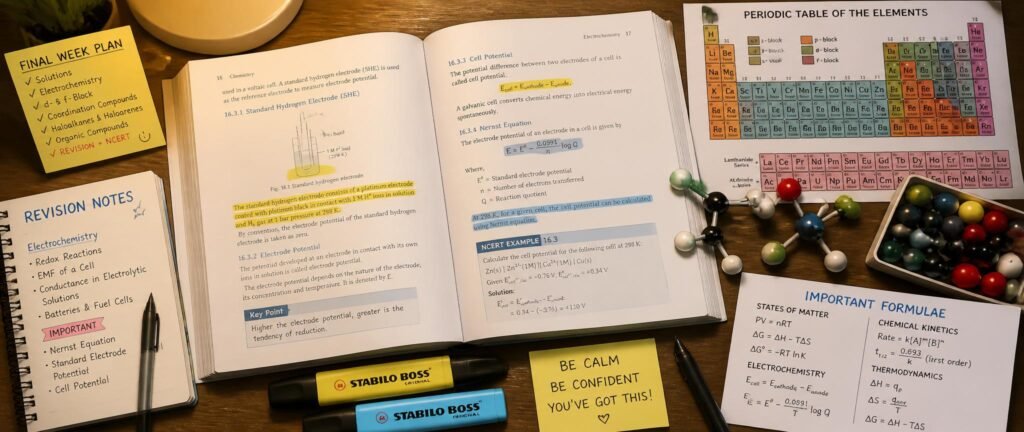
This Re-NEET 2026 Chemistry quick revision list is the fastest way to cover the most-tested Chemistry content before June 21. It covers 100 verified lines from Class 11 and Class 12 NCERT Chemistry — Physical, Organic, and Inorganic — every one of which has appeared in NEET at least once in the last five years. No outside sources. No fabrication.
Before you start, make sure your Re-NEET 2026 Chemistry formula sheet is beside you — formulas and lines together are the complete Chemistry revision toolkit for June 21.
Table of Contents
How to Use This Re-NEET 2026 Chemistry Quick Revision List
- Read one section at a time — don’t try to cover all 100 in one sitting
- Use this alongside the Re-NEET 2026 mock test analysis system to track which Chemistry lines you keep missing
- After every 10 lines, close your eyes and try to recall them
- Mark lines you hesitate on — those are your revision priorities
- Don’t make new notes — recognition, not writing, is the goal this close to the exam
Class 11 NCERT Chemistry — 50 Re-NEET 2026 Chemistry Quick Revision Lines
Some Basic Concepts of Chemistry
This section of the Re-NEET 2026 Chemistry quick revision list covers the calculation-heavy lines that appear in Physical Chemistry MCQs.
- One mole of any substance contains 6.022 × 10²³ particles — this is Avogadro’s number (Nₐ).
- Molarity (M) = moles of solute / volume of solution in litres. It changes with temperature.
- Molality (m) = moles of solute / mass of solvent in kg. It does NOT change with temperature.
- Mole fraction of a component = moles of that component / total moles of all components. Sum of all mole fractions = 1.
- Empirical formula gives the simplest whole-number ratio of atoms; molecular formula gives the actual number of atoms.
- The limiting reagent is the reactant that is completely consumed first and determines the amount of product formed.
- Percentage yield = (actual yield / theoretical yield) × 100.
Structure of Atom
Structure of Atom is compact but consistent — Re-NEET 2026 Chemistry quick revision must include Bohr’s model, uncertainty principle, and Aufbau principle.
- Bohr’s model postulates: electrons revolve in fixed circular orbits; energy is absorbed or emitted only when electrons jump between orbits.
- Heisenberg’s Uncertainty Principle: it is impossible to determine simultaneously the exact position and exact momentum of a moving electron. Δx · Δp ≥ h/4π.
- An orbital is a three-dimensional region around the nucleus where the probability of finding an electron is maximum (≥90%).
- Aufbau principle: electrons fill orbitals in order of increasing energy — 1s, 2s, 2p, 3s, 3p, 4s, 3d…
- Hund’s rule: electrons occupy orbitals of equal energy singly before pairing, and all singly occupied orbitals have the same spin.
- Pauli’s Exclusion Principle: no two electrons in an atom can have the same set of all four quantum numbers.
- The s-block elements have their last electron in an s-orbital (Groups 1 and 2); p-block in p-orbital (Groups 13–18).
Chemical Bonding and Molecular Structure
Chemical Bonding is one of the highest-weightage chapters in any Re-NEET 2026 Chemistry quick revision session — expect 3–4 direct questions.
- Ionic bond forms by complete transfer of electrons; covalent bond forms by sharing of electrons.
- Electronegativity difference > 1.7 → predominantly ionic bond; < 1.7 → predominantly covalent bond.
- VSEPR theory: the shape of a molecule depends on the number of bond pairs and lone pairs around the central atom. Lone pairs repel more than bond pairs.
- Shape of NH₃ is trigonal pyramidal (3 bond pairs + 1 lone pair); H₂O is bent/V-shaped (2 bond pairs + 2 lone pairs).
- Hybridisation of BF₃ is sp² (planar triangular); CH₄ is sp³ (tetrahedral); C₂H₂ (acetylene) is sp (linear).
- Hydrogen bond is the electrostatic attraction between the H atom covalently bonded to a highly electronegative atom (N, O, F) and the electronegative atom of another molecule.
- Resonance structures are two or more Lewis structures that collectively describe the electronic structure of a single molecule — e.g., O₃, SO₃, benzene.
States of Matter
- Boyle’s Law: at constant temperature, pressure is inversely proportional to volume — PV = constant.
- Charles’s Law: at constant pressure, volume is directly proportional to absolute temperature — V/T = constant.
- Ideal Gas Equation: PV = nRT. R = 8.314 J mol⁻¹ K⁻¹ = 0.0821 L atm mol⁻¹ K⁻¹.
- Van der Waals equation: (P + an²/V²)(V − nb) = nRT. ‘a’ corrects for intermolecular attractions; ‘b’ corrects for molecular volume.
- Critical temperature (Tₓ): the temperature above which a gas cannot be liquefied regardless of applied pressure. CO₂ has a critical temperature of 304.2 K.
Thermodynamics
Thermodynamics lines are heavily theory-based — a strong area in any Re-NEET 2026 Chemistry quick revision because they reward reading over calculation.
- First Law of Thermodynamics: energy can neither be created nor destroyed — ΔU = q + w (IUPAC convention).
- Enthalpy (H) = U + PV. At constant pressure, ΔH = qₚ (heat absorbed at constant pressure).
- Hess’s Law: the total enthalpy change for a reaction is independent of the route taken — it depends only on the initial and final states.
- Standard enthalpy of formation (ΔfH°) of any element in its most stable form is zero.
- Second Law of Thermodynamics: the entropy of an isolated system always increases for a spontaneous process.
- Gibbs free energy: ΔG = ΔH − TΔS. A reaction is spontaneous when ΔG < 0.
Equilibrium
- Law of Chemical Equilibrium: Kc = [products]^stoichiometric coefficients / [reactants]^stoichiometric coefficients.
- Le Chatelier’s Principle: if a system at equilibrium is disturbed, it shifts to minimise the disturbance.
- pH = −log[H⁺]. For a neutral solution at 25°C, pH = 7. Acidic: pH < 7; Basic: pH > 7.
- Buffer solution: resists change in pH on addition of small amounts of acid or base. Example: CH₃COOH + CH₃COONa.
- Kw (ionic product of water) = [H⁺][OH⁻] = 1 × 10⁻¹⁴ at 25°C.
- Common ion effect: suppression of ionisation of a weak acid or weak base by adding a salt with a common ion.
Redox Reactions
Redox lines are among the most direct NEET Chemistry NCERT important lines in the paper — OIL RIG and oxidation number rules appear frequently.
- Oxidation = loss of electrons = increase in oxidation number. Reduction = gain of electrons = decrease in oxidation number.
- OIL RIG: Oxidation Is Loss, Reduction Is Gain (of electrons).
- Oxidation number of oxygen is −2 in most compounds (except in peroxides where it is −1, and in OF₂ where it is +2).
- Oxidation number of hydrogen is +1 with non-metals and −1 with metals (metal hydrides).
s-Block Elements
For Re-NEET 2026 Inorganic Organic Physical revision, s-Block is a quick win — 5 lines cover everything NTA typically tests from this chapter.
- Lithium shows anomalous behaviour among alkali metals and resembles magnesium — this is called the diagonal relationship.
- Sodium hydroxide (caustic soda, NaOH) is manufactured by the Chlor-alkali process (electrolysis of brine).
- Calcium carbonate (limestone) decomposes on heating to give quicklime (CaO) and CO₂ — this is thermal decomposition.
- Plaster of Paris = CaSO₄·½H₂O. It sets on mixing with water to form gypsum (CaSO₄·2H₂O).
p-Block Elements (Class 11 portion)
- Boron is a metalloid and a non-conductor of electricity at room temperature; it forms only covalent compounds.
- Carbon shows catenation — the unique property of forming long chains, branched chains, and rings by bonding with itself.
- Allotropes of carbon: diamond (hard, poor conductor), graphite (soft, good conductor), fullerenes (C₆₀ — Buckminsterfullerene).
- Dinitrogen (N₂) is relatively inert due to the triple bond (N≡N, bond enthalpy = 941.4 kJ mol⁻¹) — one of the strongest bonds known.
Class 12 NCERT Chemistry — 50 More Re-NEET 2026 Chemistry Quick Revision Lines
Solutions
Solutions is where NEET Chemistry NCERT important lines and numerical formulas overlap — know both the theory and the formula for each colligative property.
- Henry’s Law: at constant temperature, the solubility of a gas in a liquid is directly proportional to the partial pressure of the gas above the solution. KH increases with temperature.
- Raoult’s Law: the partial vapour pressure of a volatile component = mole fraction × vapour pressure of pure component.
- Colligative properties depend only on the number of solute particles, not their nature: relative lowering of vapour pressure, elevation of boiling point, depression of freezing point, osmotic pressure.
- van’t Hoff factor (i): i > 1 for electrolytes (dissociation); i < 1 for solutes that associate in solution.
- Osmotic pressure (π) = iCRT, where C is molarity, R is gas constant, T is temperature in Kelvin.
Electrochemistry
For Re-NEET 2026 Chemistry quick revision, Electrochemistry is the single most formula-dense Class 12 chapter. These lines and your formula sheet together cover everything NTA tests.
- Kohlrausch’s Law: the limiting molar conductivity of an electrolyte equals the sum of the limiting molar conductivities of its individual ions.
- Nernst Equation: E_cell = E°_cell − (RT/nF) ln Q = E°_cell − (0.0592/n) log Q at 25°C.
- Standard Hydrogen Electrode (SHE): E° = 0.00 V by convention — the reference electrode for all standard reduction potentials.
- Faraday’s First Law of Electrolysis: the mass of substance deposited at an electrode is directly proportional to the quantity of charge passed.
- Faraday’s constant = 96,500 C mol⁻¹ — the charge on one mole of electrons.
- Electrolytic cells convert electrical energy into chemical energy; galvanic (voltaic) cells convert chemical energy into electrical energy.
Chemical Kinetics
Chemical Kinetics is a chapter where Re-NEET 2026 Chemistry last minute revision pays off quickly — the first-order formula and Arrhenius equation are tested almost every year.
- Rate of reaction = change in concentration of reactant or product per unit time.
- Order of reaction is experimentally determined; molecularity is the number of reacting species in an elementary step — it is always a positive integer.
- First-order reaction: rate = k[A]. Half-life t½ = 0.693/k — it is independent of initial concentration.
- Arrhenius equation: k = Ae^(−Ea/RT). Activation energy (Eₐ) is the minimum energy required for a reaction to occur.
- A catalyst increases the rate of reaction by providing an alternative pathway with lower activation energy. It is not consumed in the reaction.
Surface Chemistry
Surface Chemistry is one of the most Re-NEET 2026 Chemistry quick revision-friendly chapters — short, fact-heavy, and frequently tested.
- Adsorption: accumulation of molecules on the surface of a solid. Absorption involves uniform distribution throughout the bulk.
- Physisorption is weak (van der Waals forces), reversible, multi-layer, and decreases with temperature.
- Chemisorption involves formation of chemical bonds, is irreversible, mono-layer, and increases then decreases with temperature.
- Freundlich adsorption isotherm: x/m = k·P^(1/n), where 1/n is between 0 and 1.
- Colloids: particles with diameter 1–100 nm. Sols (solid in liquid), emulsions (liquid in liquid), gels (liquid in solid).
- Tyndall effect: scattering of light by colloidal particles — used to distinguish colloids from true solutions.
- Coagulation of colloids occurs by adding electrolytes, boiling, or by electrophoresis.
p-Block Elements (Class 12)
The NEET Chemistry NCERT important lines from p-Block are almost entirely factual — no numericals, pure recall. Very high return on revision time.
- Interhalogen compounds are formed between two different halogens — e.g., ClF, BrF₃, IF₅. They are more reactive than halogens.
- Ozone (O₃) is a powerful oxidising agent; it decomposes slowly to give O₂, and is used in purification of water and air.
- Sulphuric acid (H₂SO₄) is manufactured by the Contact Process (SO₂ → SO₃ using V₂O₅ catalyst → H₂SO₄).
- Nitric acid (HNO₃) is manufactured by the Ostwald Process (catalytic oxidation of NH₃ over Pt catalyst).
- Phosphorus shows allotropy — white phosphorus (P₄, poisonous, glows in dark), red phosphorus (stable, non-poisonous).
d and f-Block Elements
For Re-NEET 2026 Chemistry quick revision, d and f-block lines are high-frequency — KMnO₄ and K₂Cr₂O₇ reactions appear nearly every year.
- Transition elements (d-block) are elements whose atoms or ions have incompletely filled d-orbitals — they exhibit variable oxidation states.
- Highest oxidation state of a transition metal corresponds to its group number — e.g., Mn shows +7 in KMnO₄.
- KMnO₄ is a strong oxidising agent. It acts as a self-indicator in acidic medium (purple → colourless when reduced to Mn²⁺).
- K₂Cr₂O₇ is a strong oxidising agent in acidic medium. The orange colour is due to Cr₂O₇²⁻ → green Cr³⁺ upon reduction.
- Lanthanoid contraction: steady decrease in atomic and ionic radii across the lanthanoid series — due to poor shielding by 4f electrons.
Coordination Compounds
Coordination Compounds is a high-yield section for Re-NEET 2026 Chemistry last minute revision — compact chapter, predictable questions, 2–3 marks every year.
- In a coordination compound, the central metal atom/ion is surrounded by ligands (Lewis bases that donate electron pairs).
- Coordination number = number of ligand atoms directly bonded to the central metal atom.
- Ambidentate ligands have two possible donor atoms — e.g., SCN⁻ (can bond through S or N), NO₂⁻ (through N or O).
- Chelate complexes are formed by ligands that form rings with the central metal — e.g., EDTA is a hexadentate ligand.
- Crystal Field Theory (CFT): d-orbitals split in the presence of ligands. Strong field ligands cause large splitting (Δ) → low-spin complex; weak field ligands cause small splitting → high-spin complex.
- Werner’s theory: complexes have primary valency (oxidation state) and secondary valency (coordination number).
Organic Chemistry (Class 12)
Organic Chemistry is where NCERT Chemistry lines for NEET 2026 appear most directly as MCQ options — the exact reaction name or product is lifted from NCERT.
- Haloalkanes: nucleophilic substitution (SN1 and SN2) and elimination (E1 and E2) are the primary reactions.
- SN2 reaction: bimolecular, one step, inversion of configuration (Walden inversion), favoured by primary alkyl halides.
- SN1 reaction: unimolecular, two steps, proceeds via carbocation intermediate, favoured by tertiary alkyl halides.
- Alcohols show hydrogen bonding — they have higher boiling points than corresponding alkanes and ethers.
- Lucas test: used to distinguish primary, secondary, and tertiary alcohols. Tertiary alcohol reacts immediately with ZnCl₂/HCl (turbidity); primary does not react at room temperature.
- Aldol condensation: two molecules of an aldehyde or ketone (with α-hydrogen) condense in the presence of dilute NaOH to form a β-hydroxy carbonyl compound.
- Cannizzaro reaction: aldehydes without α-hydrogen undergo disproportionation in concentrated NaOH — one molecule is oxidised to acid, another is reduced to alcohol.
- Amines: primary amines react with nitrous acid to form diazonium salts (aromatic) or unstable diazonium compounds (aliphatic). Gabriel synthesis is used to prepare pure primary amines.
- Carbylamine test: primary amines react with chloroform and KOH to form foul-smelling isocyanides (carbylamines) — test is specific to primary amines.
- Biodegradable polymers: PHBV (polyhydroxybutyrate-co-hydroxyvalerate) and Nylon-2-nylon-6. Non-biodegradable: Nylon-6,6, Teflon, PVC, Bakelite.
- Vitamins: Vitamin A, D, E, K are fat-soluble. Vitamin B-complex and C are water-soluble. Vitamin C (ascorbic acid) deficiency → scurvy; Vitamin D deficiency → rickets.
Re-NEET 2026 Chemistry Quick Revision Schedule for These 100 Lines
June 6–10: Read all 100 NEET Chemistry NCERT important lines once. Mark anything you hesitate on. June 11–15: Revise only marked lines. Pay special attention to Organic reactions (lines 90–98) and Electrochemistry (lines 56–61). June 16–19: Re-NEET 2026 Chemistry last minute revision pass — all 100 lines in under 45 minutes. June 20 (night before): Final Re-NEET 2026 Chemistry last minute revision — scan lines 51–100 (Class 12) only, 20 minutes maximum.
This Re-NEET 2026 Chemistry last minute revision list pairs perfectly with your Re-NEET 2026 Biology quick revision list and Re-NEET 2026 Physics formula sheet for a complete three-subject revision system.
Your Re-NEET 2026 revision schedule for the final week should incorporate these lines on revision days. The Re-NEET 2026 time management strategy covers how to translate this Re-NEET 2026 Chemistry quick revision into an exam-day approach for the Chemistry section specifically.
FAQ Section
Q: Are these verified NCERT Chemistry lines for NEET 2026? A: Yes — every line is sourced exclusively from Class 11 and Class 12 NCERT Chemistry textbooks. NEET follows NCERT strictly. Every line here qualifies as a verified NCERT Chemistry line for NEET 2026 — tested at least once in the last five years.
Q: How should I split Re-NEET 2026 Inorganic Organic Physical revision in the final week? A: Roughly 35% Physical Chemistry (numericals + theory), 35% Organic (reactions + mechanisms), 30% Inorganic (facts + reactions). If you’re short on time, prioritise Organic — it has the most direct NCERT lines in MCQ options and is the most consistent section year to year.
Q: Which Chemistry chapters have the highest NEET weightage? A: Chemical Bonding (3–4 questions), Electrochemistry (2–3 questions), Coordination Compounds (2–3 questions), Organic Chemistry–II: Aldehydes, Ketones and Carboxylic Acids (2–3 questions), and p-Block Elements (2–3 questions) are consistently the highest-scoring Chemistry chapters in NEET.
Q: Is Physical Chemistry formula-based or theory-based in NEET? A: Both — but the split is roughly 60% formula application (Solutions, Electrochemistry, Chemical Kinetics) and 40% conceptual theory (Thermodynamics, Equilibrium). The formula sheet covers the numerical half; these 100 lines cover the theory half.
Q: How many NCERT Chemistry lines for NEET 2026 appear directly in MCQ options? A: Approximately 50–60% of NCERT Chemistry lines for NEET 2026 appear directly in MCQ options or as very close paraphrases. Inorganic Chemistry in particular is almost entirely direct NCERT recall — which makes these lines extremely high-value for quick marks.
Q: For Re-NEET 2026 Inorganic Organic Physical revision, which source should I trust? A: Always from NCERT for Inorganic. Inorganic Chemistry questions in NEET are designed from specific NCERT sentences — your notes may have paraphrased or missed the exact terminology NTA uses. For this section especially, NCERT is the only source you need.