
Every year, lakhs of students appear for the NEET exam with the dream of becoming a doctor. One of the most common dilemmas students face is self study vs coaching NEET preparation. Should you rely on disciplined self-learning using NCERT and online resources, or should you join a coaching institute for structured guidance?

Both methods have produced NEET toppers. Some students crack NEET through rigorous self-study, while others benefit from the mentorship and structured learning offered by coaching institutes. Understanding the strengths and limitations of each approach is essential before deciding the best strategy for your preparation.
In this article, we will compare self-study and coaching for NEET preparation, discuss their advantages and disadvantages, and help you determine which path aligns best with your learning style and goals.
Why NEET Preparation Strategy Matters

NEET is one of the most competitive entrance exams in India. According to the National Testing Agency, millions of students compete for limited medical seats every year.
You can check official exam information on the
NEET official website:
https://neet.nta.nic.in/
To succeed in such a competitive environment, students must build:
- Strong conceptual clarity
- Consistent revision habits
- Effective practice through mock tests
- A disciplined study routine
Whether you choose coaching or self-study, your strategy must support these four pillars of preparation.
What Is Self-Study for NEET?
Self-study means preparing independently using study materials, textbooks, online lectures, and practice papers without joining a formal coaching institute.
Most self-study aspirants rely heavily on NCERT textbooks, online resources, and mock tests to build their preparation.
Advantages of Self-Study
1. Flexible Study Schedule
Self-study allows students to create their own timetable. You can focus more on weak topics and revise concepts at your own pace.
2. Cost-Effective Preparation
Coaching institutes can be expensive. Self-study requires minimal investment, mainly for books and test series.
3. Better Conceptual Understanding
When you study independently, you tend to explore concepts deeply instead of memorizing shortcuts.
4. Strong Self-Discipline
Self-study naturally develops time management and discipline—skills that help students throughout their careers.
Challenges of Self-Study
Lack of Expert Guidance
Without a mentor, it can be difficult to identify mistakes or improve problem-solving techniques.
Difficulty Maintaining Consistency
Many students start strong but lose motivation over time without structured monitoring.
Limited Doubt Resolution
Solving complex physics or chemistry doubts alone can sometimes slow down progress.
What Is Coaching for NEET?
Coaching institutes provide structured classes, study material, regular tests, and mentorship to guide students through NEET preparation.
Students typically attend classroom or online lectures conducted by experienced teachers who specialize in NEET-level concepts.
Advantages of Coaching
Structured Preparation
Coaching institutes follow a well-designed syllabus schedule, ensuring that all topics are covered systematically.
Experienced Faculty Guidance
Teachers explain difficult concepts, provide shortcuts, and guide students through complex problems.
Competitive Environment
Studying alongside other aspirants creates healthy competition and motivation.
Regular Testing and Performance Analysis
Most coaching institutes conduct weekly or monthly tests to evaluate student progress.
Challenges of Coaching
Expensive Fees
Many coaching institutes charge high fees, which can be financially challenging for some families.
Fixed Study Schedule
Students must follow the institute’s timetable, which may not suit everyone’s learning pace.
Overdependence on Coaching
Some students rely too heavily on coaching material and neglect self-study, which is crucial for success.
Self Study vs Coaching NEET: Key Differences
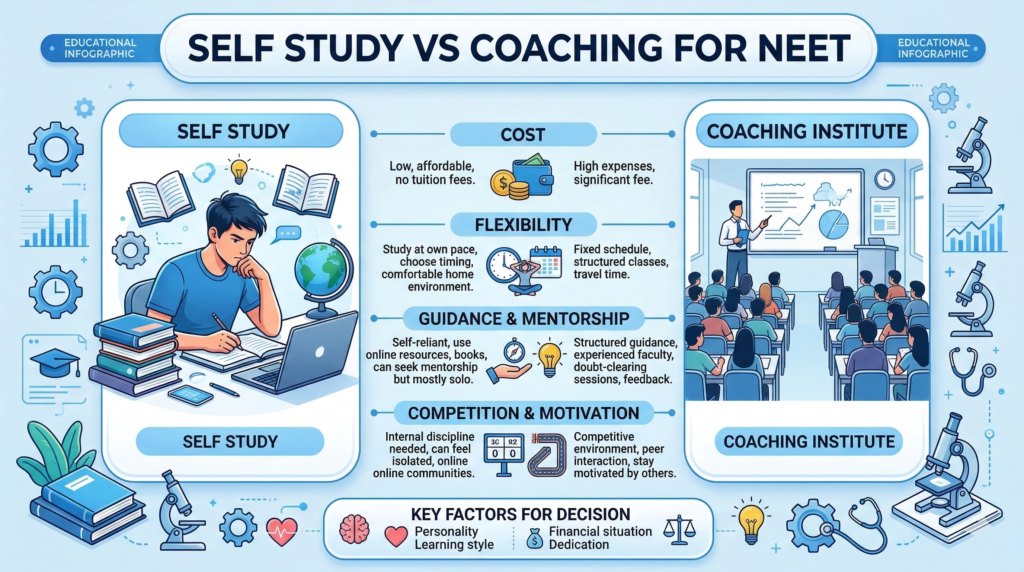
| Factor | Self Study | Coaching |
|---|---|---|
| Cost | Low | High |
| Flexibility | High | Limited |
| Guidance | Limited | Strong |
| Discipline | Self-driven | Structured |
| Doubt Solving | Harder | Easier |
| Competition | Less exposure | High competition |
The reality is simple: both methods can work if used correctly.
Self Study vs Coaching NEET: Which Method Do NEET Toppers Prefer?
Interestingly, many NEET toppers combine both methods.
They may join coaching for guidance but still dedicate several hours to self-study every day.
Most successful aspirants follow a strategy like:
- Classroom learning for concepts
- Self-study for revision
- Mock tests for performance tracking
Even students preparing independently often supplement their studies with online lectures and test series.
When Self-Study Is the Better Option
Self-study works best for students who:
- Are highly disciplined
- Understand concepts quickly
- Can maintain a consistent study schedule
- Have access to quality online resources
If you can manage your time well and stay motivated without external pressure, self-study can be extremely effective.
When Coaching Is the Better Option
Coaching is helpful for students who:
- Need structured guidance
- Struggle with complex subjects like physics
- Prefer classroom-style learning
- Benefit from competitive environments
Many students also join coaching to access organized study material and test series.
The Ideal Strategy: Hybrid Preparation
People often get confused about Self Study vs Coaching NEET, but here is The smartest approach is often a hybrid strategy combining both methods.
For example:
- Attend coaching classes or online lectures
- Revise concepts through self-study
- Solve previous year questions daily
- Take regular mock tests
This balanced approach allows students to gain expert guidance while still developing strong independent study habits.
You can also improve your preparation by focusing on important biology diagrams discussed in this guide:
Internal resource:
https://ksquareinstitute.in/blog/top-10-challenging-neet-biology-diagrams/
Final Thoughts
The debate around self study vs coaching NEET has no universal answer. The truth is that success in NEET depends more on discipline, consistency, and smart preparation than the method you choose.
Coaching can provide guidance and structure, but without consistent self-study it will not guarantee success. Similarly, self-study can be powerful, but students must stay disciplined and use the right resources.
Choose the strategy that matches your learning style, financial situation, and level of self-motivation. With dedication and the right plan, both paths can lead to success in NEET.
Remember, cracking NEET is not about where you study—it’s about how consistently you study and how deeply you understand the concepts.
FAQ Section
Is self-study enough to crack NEET?
Yes. Many students clear NEET through self-study by focusing on NCERT textbooks, practicing previous year questions, and taking mock tests regularly.
Is coaching necessary for NEET preparation?
Coaching is not mandatory but can be helpful for structured guidance, doubt resolution, and regular testing.
How many hours should a NEET aspirant study daily?
Most successful NEET aspirants study between 6 to 8 hours daily, depending on their preparation stage.
Which is better for NEET: self-study or coaching?
Both methods can work effectively. The best option depends on a student’s discipline, learning style, and access to resources.
[…] deciding which preparation style suits you best, you can also explore this detailed comparison of Self-Study vs Coaching for NEET, which explains how different learning methods impact exam […]