
NEET Physics is More Predictable Than You Think
Most aspirants treat NEET Physics like a random battlefield where anything can appear. That belief is not just wrong—it’s dangerous. Because when you assume unpredictability, you prepare blindly. And blind preparation leads to average scores.
If you step back and analyze past papers, a pattern becomes obvious. NEET Physics is not chaotic. It is structured, repetitive, and heavily dependent on a fixed set of concepts. Understanding NEET Physics chapter-wise weightage changes everything. It allows you to focus on what truly matters instead of spreading yourself thin across the entire syllabus.
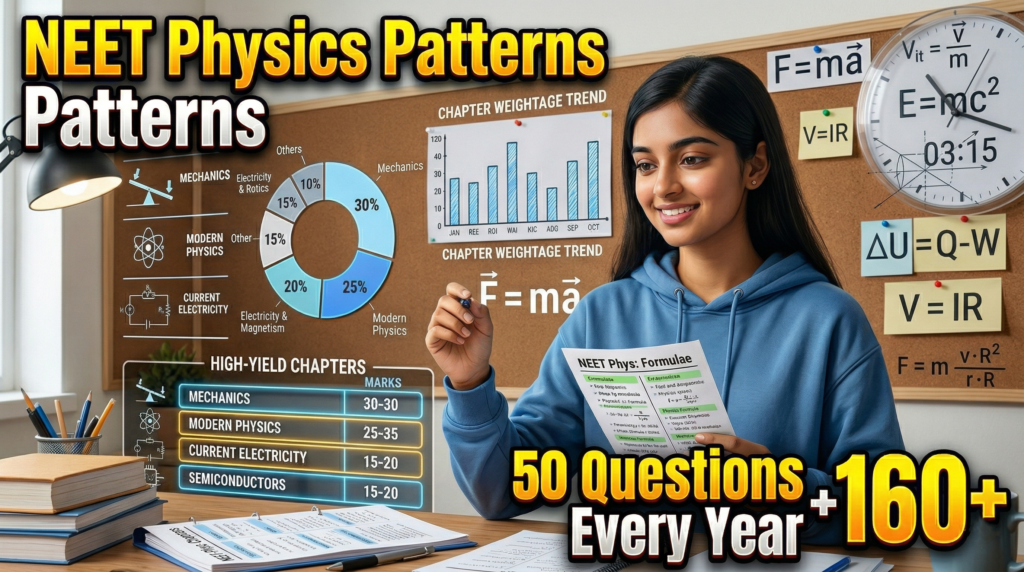
This article breaks down those patterns and shows how a core set of high-yield topics for NEET physics consistently produces nearly 50 questions every year. Aligning your preparation with the NEET 2026 physics syllabus and these patterns is what separates strategic students from the rest.
The Myth of “Unpredictable” NEET Physics
The idea that NEET Physics is unpredictable comes from surface-level observation. Students see different questions every year and assume the exam is changing. In reality, the concepts remain the same; only the presentation changes.
According to trends observed in papers conducted by the National Testing Agency, the majority of questions are built on repeated frameworks. Once you understand these frameworks, the exam stops feeling unfamiliar.
This is why analyzing NEET Physics chapter-wise weightage is not optional. It’s the foundation of smart preparation.
The Core Idea: 50 Questions That Keep Repeating
Every NEET Physics paper contains around 45–50 questions, and a large portion of them come from predictable areas. These are not exact repetitions, but variations of standard models.
When you identify these recurring models, you realize something powerful—if you master the right set of high-yield topics for NEET physics, you are essentially preparing for most of the paper in advance.
This approach aligns perfectly with the actual NEET 2026 physics syllabus, which hasn’t drastically changed in its conceptual core over the years.
Understanding Chapter-Wise Weightage
To build an effective strategy, you need clarity on where marks actually come from. Not all chapters are equal, and pretending otherwise leads to inefficient preparation.
Mechanics consistently holds a significant share of the paper. It forms the conceptual backbone and connects to multiple other topics. Electrostatics and current electricity follow closely, offering a mix of theory and numericals that appear regularly. Modern Physics remains one of the most scoring areas due to its direct and formula-based questions.
Analyzing NEET Physics chapter-wise weightage reveals that a limited number of chapters dominate the paper. Focusing on these chapters ensures that your effort produces maximum returns.
High-Yield Topics That Appear Every Year
Certain topics are almost guaranteed to appear in some form. These are the true high-yield topics for NEET physics, and ignoring them is a strategic mistake.
In Mechanics, concepts like laws of motion, work-energy theorem, and rotational dynamics frequently appear. These topics are not just important—they are unavoidable.
In Electricity and Magnetism, electric field, potential, capacitors, and circuit analysis dominate. These areas are highly structured, making them ideal for repeated practice.
Modern Physics brings questions on photoelectric effect, atomic models, and nuclear physics, which are often straightforward but require clarity.
Mastering these topics ensures that you are aligned with both NEET Physics chapter-wise weightage and the actual NEET 2026 physics syllabus.
How Patterns Translate Into Real Questions
Understanding patterns is not about memorizing questions. It’s about recognizing how concepts are applied.
For example, a question on capacitors may appear in different forms—series combination, energy stored, or dielectric insertion—but the underlying concept remains the same. Once you master the concept, all variations become manageable.
This is why focusing on high-yield topics for NEET physics is far more effective than solving random questions. You are training your brain to recognize patterns, not just answers.
Building a Strategy Around These Patterns
Once you understand the distribution of questions, your preparation becomes more focused. You begin to allocate time based on importance rather than preference.
A strong approach involves mastering high-weightage chapters first, followed by moderate ones, and finally low-weightage topics. This ensures that your preparation aligns with NEET Physics chapter-wise weightage rather than personal bias.
Resources like Concepts of Physics can help build conceptual clarity, but your practice should always revolve around high-yield topics for NEET physics.
The Role of the NEET 2026 Physics Syllabus
Many students either ignore the syllabus or treat it as a formality. That’s a mistake. The NEET 2026 physics syllabus defines the boundaries of your preparation.
By staying aligned with the official syllabus provided by the National Medical Commission, you avoid wasting time on irrelevant topics. More importantly, you ensure that your focus remains on areas that actually contribute to your score.
Common Mistakes in Pattern-Based Preparation
Even after understanding patterns, students often make errors that reduce effectiveness. One common issue is overconfidence. Identifying high-yield topics does not mean ignoring the rest of the syllabus. Balance is essential.
Another mistake is superficial learning. Knowing that a topic is important is not enough; you must master it deeply. Without conceptual clarity, even familiar questions can become difficult.
There is also the tendency to chase new resources instead of strengthening existing knowledge. A focused approach, aligned with NEET Physics chapter-wise weightage, is far more effective than constantly switching materials.
- NEET Physics Survival Kit
- Organic Chemistry Strategy
- NEET Biology Tricks for Exams
- How to Score 340+ in NEET Biology
- Top 10 Tricky NEET Biology Diagrams
Integrating Pattern Analysis With Practice
Pattern recognition must be combined with consistent practice. Solving previous year questions helps you see how concepts are framed, while revisiting them reinforces your understanding.
Internal resources like /neet-physics-survival-kit-2026 and /pen-and-paper-strategy-neet-omr-practice can further strengthen your preparation by improving accuracy and exam temperament.
When your practice aligns with high-yield topics for NEET physics, your preparation becomes sharper and more efficient.
| Course Name | Link |
|---|---|
|
Umeed NEET 2026
NEW
|
Explore |
|
SUPER 30 NEET UG
POPULAR
|
Explore |
|
Mission 180 (Physics)
NEW
|
Explore |
|
GRIP NCERT Biology
|
Explore |
|
GRIP NCERT Chemistry
|
Explore |
The Final Perspective: Predict the Paper Before It Appears
Here’s the reality—NEET Physics is not about guessing the paper. It’s about understanding it so well that nothing feels new.
When you analyze NEET Physics chapter-wise weightage, focus on high-yield topics for NEET physics, and align with the NEET 2026 physics syllabus, you are no longer reacting to the exam. You are anticipating it.
And once you reach that level, Physics stops being unpredictable. It becomes structured, manageable, and ultimately, a scoring opportunity.
Frequently Asked Questions
NEET Physics chapter-wise weightage refers to the distribution of questions from different chapters in the exam. It helps students identify which topics contribute the most marks and plan their preparation accordingly.
High-yield topics for NEET physics include Mechanics, Electrostatics, Current Electricity, and Modern Physics. These areas consistently produce a significant number of questions every year.
While exact questions are rarely repeated, around 40–50 questions follow similar concepts and patterns each year. This is why focusing on high-yield topics for NEET physics is crucial.
Yes, the NEET 2026 physics syllabus is sufficient if covered properly. Most questions are directly or indirectly based on this syllabus, making it essential for focused preparation.
You should prioritize high-weightage chapters first, then move to moderate and low-weightage topics. This ensures maximum marks coverage with efficient use of time.