
Re-NEET 2026 total students appearing is a number every serious aspirant must understand — because it directly affects your rank, your cut-off, and how many seats you can realistically target.
Here’s everything known so far about the Re-NEET 2026 total students appearing — and what the competition landscape actually means for you.
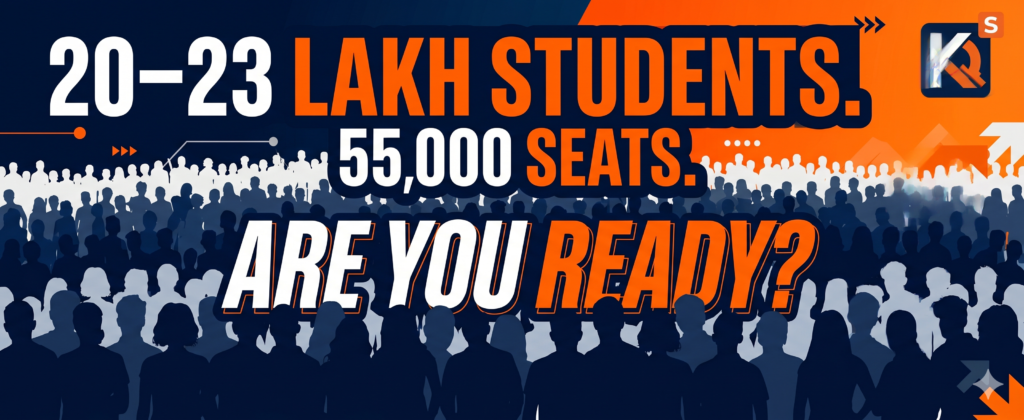
Re-NEET 2026 Total Students Appearing: What Does NTA Say?
NTA has not released the final confirmed registration count for Re-NEET 2026 as of now. However, based on the original NEET UG 2026 registration data and re-exam participation patterns from past cycles, here is what we can estimate about Re-NEET 2026 total students appearing:
| Data Point | Figure |
|---|---|
| NEET UG 2026 Original Registrations | ~24 lakh (approx.) |
| Students who appeared in original exam | ~22–23 lakh (approx.) |
| Expected Re-NEET 2026 participation | ~20–23 lakh (estimated) |
The re-exam is open to all students who had registered for NEET UG 2026 — including those who appeared in the original exam (which was cancelled due to the paper leak) and those who had registered but not yet appeared.
Important: NTA will release the official Re-NEET 2026 applicant count closer to or after the exam. Track the Re-NEET 2026 official NTA notice for confirmed figures.
Why Re-NEET 2026 Total Students Appearing Matters for Your Rank
Your NEET rank is not determined by your raw score alone. It is determined by your score relative to everyone else who appeared. This is why understanding the competition pool is critical.
Percentile vs Rank
NEET results include both a raw score and a percentile. Your percentile tells you what percentage of students scored below you. Your rank tells you your exact position among all test-takers.
If 22 lakh students appear and you score 550:
| Students Appearing | Your Score | Approx. Rank |
|---|---|---|
| 22,00,000 | 550 | ~45,000–55,000 |
| 20,00,000 | 550 | ~40,000–50,000 |
| 18,00,000 | 550 | ~36,000–45,000 |
The same score produces a better rank when fewer students appear. This is why Re-NEET 2026 — if it sees slightly lower participation than the original — could be marginally more favorable for students in the mid-score range.



How Does Re-NEET 2026 Total Students Appearing Compare to the Original NEET?
Looking at historical NEET re-exam and supplementary exam patterns, the Re-NEET 2026 total students appearing is expected to be slightly lower than the original, because some students opt out, are disqualified, or choose to wait for the next cycle. Re-exams generally also see:
- Higher average preparedness among appearing students, since re-exam students typically have had more time to prepare or are more motivated
- More competitive mid-range (450–600 score band), as students who scored poorly the first time either improve significantly or don’t appear
This means the competition at the top (600+) tends to be just as fierce — but the mid-range rank distribution can shift meaningfully. If you’re targeting government MBBS seats, every 1,000-rank improvement matters.
What the Competition Means for You: Score-Range Analysis
If You’re Targeting 650+ (Top Medical Colleges)
At this score range, competition is intense regardless of total student count. AIIMS Delhi, JIPMER, and top state government colleges require consistent top-percentile performance. The difference between 22 lakh and 20 lakh appearing students changes your rank by only a few hundred at this score — preparation quality is the only real lever.
Focus on perfecting your Re-NEET 2026 exam pattern strategy, section-wise time allocation, and error elimination.
If You’re Targeting 500–600 (Government MBBS State Quota)
This is where the student count has the most visible impact on rank. A 10–15% drop in total appearing students can improve your rank by 10,000–20,000 positions at this score band — which could be the difference between a government seat and a private one.
Students in this range should review the Re-NEET 2026 expected cut-off marks carefully and understand state-wise seat availability.
If You’re in the 350–499 Range
At this score band, rank is heavily dependent on category and state domicile. Even if fewer students appear overall, the qualifying cut-off remains fixed (50th percentile for General, lower for reserved categories). Your target here is crossing the qualifying threshold, not chasing rank.
If you scored below 350 in the original NEET and are attempting Re-NEET, read the specific guide on what Re-NEET means if you scored below 350.
Re-NEET 2026 Total Students Appearing vs Total MBBS Seats: The Real Ratio
Here’s the number that should drive your preparation intensity:
| Category | Approximate Count |
|---|---|
| Total MBBS seats in India (Govt + Private) | ~1,08,000+ |
| Government MBBS seats (All India + State) | ~55,000–60,000 |
| Students expected to appear for Re-NEET 2026 | ~20–23 lakh |
| Ratio: Students per Government MBBS seat | ~35:1 to 40:1 |
This ratio means that for every government MBBS seat, roughly 35–40 students are competing. This has been consistent across NEET cycles regardless of minor fluctuations in total student count.
The takeaway is stark: scoring above average is not enough. You need to be in the top 3–5% to reliably target government MBBS. This is why your preparation strategy — whether it’s NCERT mastery, PYQ practice, or mock test frequency — needs to be built around beating tens of thousands of other well-prepared students.
What Should You Actually Do With This Information?
Knowing the competition landscape should sharpen your preparation focus, not discourage it. Here’s how to use it practically:
1. Don’t wait for the official count before preparing seriously. Whether 20 lakh or 23 lakh students appear, the preparation required to score 600+ doesn’t change. Use your preparation time on what you can control.
2. Know your score target before the exam. Work backwards from the rank you need. If you need a rank under 15,000 for your target state’s government quota, find out what score that requires — then build your mock test benchmark around it.
3. Revise NCERT with high accuracy. The difference between rank 10,000 and rank 30,000 often comes down to 15–20 marks. Given how NCERT-heavy NEET Biology is, deep NCERT revision pays dividends at every score level. Review whether NCERT is enough for Re-NEET 2026 to understand where to focus per subject.
4. Use Biology as your rank booster. With 360 out of 720 marks in Biology, this is the single highest-leverage subject for rank improvement. Students who have practised with focused MCQ sets like the Re-NEET 2026 Biology MCQs consistently report higher confidence and accuracy on exam day.
5. Don’t let rank anxiety affect your exam day performance. More students appearing means more noise, more anxiety in the exam hall, and more pressure. Students who have built a strong Re-NEET 2026 mindset consistently outperform their mock test averages on the actual day.
Final Word: The Number to Focus On Is Your Score, Not the Headcount
24 lakh students registered. 22 lakh appeared. The Re-NEET 2026 total students appearing may be 20–23 lakh. These are background numbers — informative but not actionable.
The only number you control is your score on exam day.
A student who scores 620 in a 23-lakh-student field will rank better than a student who scores 580 in an 18-lakh-student field. Your rank is your score’s position in the distribution — and the only way to improve your position is to improve your score.
Focus there. Everything else follows.
FAQ Section:
Q: How many students are appearing for Re-NEET 2026? A: NTA has not officially confirmed the Re-NEET 2026 applicant count yet. Based on the original NEET UG 2026 registration data of approximately 24 lakh students and typical re-exam participation patterns, an estimated 20–23 lakh students are expected to appear.
Q: Does the number of students appearing affect NEET rank? A: Yes. Your NEET rank is determined by your score relative to all other appearing students. Fewer students appearing can improve your rank at the same score, particularly in the 450–600 score range. However, the total MBBS seat count remains fixed, so the overall competition ratio stays similar.
Q: How many government MBBS seats are available in India for Re-NEET 2026? A: There are approximately 55,000–60,000 government MBBS seats across All India Quota and state quotas. With an estimated 20–23 lakh students appearing, the ratio works out to roughly 35–40 students per government MBBS seat.
Q: What score do I need to get a government MBBS seat in Re-NEET 2026? A: This varies by state, category, and college. Generally, a score of 550+ gives you a strong chance at state government MBBS seats under reserved categories, while 600+ is competitive for general category state quota seats. Top All India Quota seats (AIIMS, top government colleges) typically require 650+.
Q: Will Re-NEET 2026 have fewer students than the original NEET UG 2026? A: Historically, re-exams see slightly lower participation than original exams, as some students opt out or are disqualified. However, since all originally registered candidates are eligible, the drop is typically modest — in the range of 5–15%.
What will be the rank for 492
Reply soon