
Re-NEET 2026 is officially scheduled for June 21, 2026. You have 37 days. And unlike the May 3rd attempt, you now know exactly what the paper feels like, where your time went, and which chapters let you down.
Most students who underperform in re-examinations do not fail because they studied less. They fail because they repeated the same mistakes — in preparation, in strategy, and on exam day itself. This guide covers the most important mistakes to avoid before Re-NEET 2026 so you do not waste a single one of those 37 days.
Before diving in, make sure you are updated on all official details — the complete Re-NEET 2026 official announcement covers the exam date, admit card schedule, and every confirmed rule in one place.
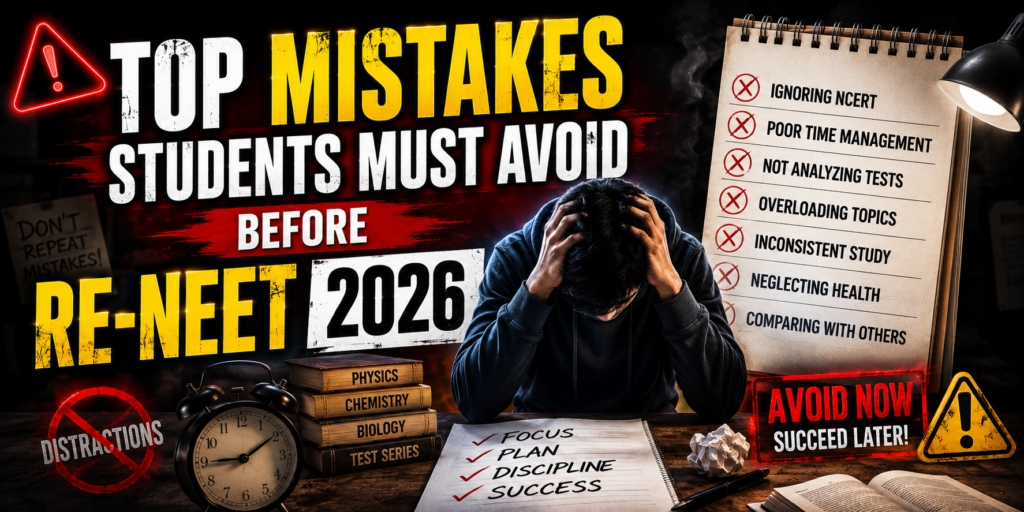
Quick Summary Table
| # | Mistake | Fix |
|---|---|---|
| 1 | Fresh start mindset | Refinement mode — fix gaps, don’t restart |
| 2 | Believing rumours | Only NEET official website for updates |
| 3 | Skipping mock test analysis | Error analysis after every mock |
| 4 | Switching study resources | NCERT + PYQs only |
| 5 | No numericals in Physics | Daily formula + numerical practice |
| 6 | Equal time to all subjects | More Biology, targeted Physics |
| 7 | No exam day time strategy | Pre-decided subject order — practise it |
| 8 | Ignoring mental health | Structured reset before intense revision |
| 9 | Panic-driven drop year | Analyse score before deciding |
| 10 | Not verifying admit card | Download on release day, verify immediately |
Mistake 1 — Treating This as a Fresh Start Instead of a Refinement
This is the most damaging mistake students make after a cancellation. You have already covered the syllabus. You sat the exam. Walking back into your books as if it is Day 1 wastes your biggest advantage — the revision edge you already hold over students who have never sat this paper.
The Re-NEET 2026 window is a refinement phase, not a learning phase. Spend the first two days doing a cold performance audit on your May 3rd paper. Categorise every wrong answer as a conceptual error, a silly mistake, or an unattempted question. That analysis tells you more about what to study than any generic plan. Our complete 40-day Re-NEET 2026 study plan is built around exactly this approach — phase-wise, targeted, and realistic.
Mistake 2 — Relying on Rumours Instead of Official Sources
Since May 12th, Telegram groups and social media have been flooded with unverified claims — syllabus changes, CBT mode for June 21, leaked content. None of these are official. All of them cost you mental energy you cannot afford to waste.
Check neet.nta.nic.in once a day. That is all. Everything else is noise.
Mistake 3 — Skipping Mock Tests or Not Analysing Them
Many students take mock tests seriously — but stop at checking the score. This defeats the purpose entirely. Mock tests are learning tools, not judgment tools. Some students avoid them out of fear of low scores — but without regular mock tests, you never build the speed, accuracy, and exam-condition stamina that NEET requires.
Start sectional tests from Day 7. Move to full-length mocks from Day 20. After every mock, spend 60 to 90 minutes on error analysis — and track your negative marking total separately. Smart time management alone can improve your score by 30 to 50 marks.
Mistake 4 — Switching Study Resources at This Stage
The re-exam period is not the time to start a new coaching module or follow a new teacher. Stick to NCERT, PYQs, and your existing notes. Switching resources mid-preparation means spending the first week getting familiar with a new style instead of revising what you already know.
For Biology, NCERT alone is sufficient for 300+. For Chemistry, NCERT plus a PYQ bank is all you need. For Physics, NCERT concepts plus focused numericals practice covers everything. Our subject-wise guides for Biology high-weightage chapters and Chemistry priority topics are built entirely on this NCERT-first framework.
Mistake 5 — Applying NCERT-Only Rule to Physics
One of the most common mistakes in NEET 2026 was treating Physics the same way as Biology — reading theory without practising numericals. While Biology is 95% direct from NCERT lines, Physics tests application through numericals, not conceptual recall.
Create a formula sheet for every chapter and review it daily. Then solve at least 10 numericals per chapter. Our Re-NEET 2026 Physics preparation guide identifies exactly which chapters need this numerical focus and which ones are safe with theory alone.
Mistake 6 — Giving Every Subject Equal Time
Biology is 360 out of 720 marks. It deserves the most preparation time — full stop. Students who divide their day equally across all three subjects consistently leave Biology marks on the table.
The smart allocation: Biology gets the most daily time, Chemistry gets the second most with clear Organic, Inorganic, and Physical splits, and Physics gets targeted chapter-specific work focused on quick-win areas like Semiconductors and Modern Physics. Check our Chemistry strategy guide for a realistic daily subject split.
Mistake 7 — No Exam Day Time Management Strategy
Time management remains the silent killer in NEET. In the 2026 paper, many students spent over 70 minutes on Physics and ran out of time during Biology — costing them easy marks in their strongest section.
Going into June 21 without a pre-decided subject order is a critical mistake to avoid before Re-NEET 2026. The recommended order for most students: Biology first (55 minutes) → Chemistry (45 minutes) → Physics (70 minutes) → buffer (10 minutes). Practise this exact order in every mock test so it is automatic on exam day.
Mistake 8 — Ignoring the Mental Side of Preparation
This one is rarely discussed but genuinely impactful. After months of pressure followed by a sudden cancellation, many students are experiencing real psychological exhaustion. Forcing intense study sessions on a brain that has not been reset produces low-quality revision and burnout in the final week.
A deliberate 48-hour rest after the cancellation is not laziness — it is necessary. If the demotivation has lasted longer than a week, our Re-NEET 2026 mindset guide has practical steps to rebuild your study routine and convert the shock of cancellation into focused preparation energy.
Mistake 9 — Making the Drop Year Decision Out of Panic
One of the most consequential mistakes students make in the first week after a cancellation is deciding to drop — not based on score analysis, but out of frustration and emotional exhaustion.
Students who scored 500+ on May 3rd and are considering a drop year out of anger at the system are often making a decision that costs them an unnecessary extra year. If you are genuinely unsure, our honest guide on Re-NEET 2026 vs drop year walks through every factor — score range, preparation gaps, and the new CBT format for NEET 2027 — to help you decide clearly.
Mistake 10 — Not Verifying Admit Card Details Immediately
A common administrative mistake: students assume their candidature is automatically fine and only check their admit card on exam day — when it is too late to correct errors.
NTA has confirmed no fresh registration is needed and your existing candidature carries forward. But details can still contain errors. Our guide on what NTA confirmed about Re-NEET 2026 candidature and exam centre rules covers exactly what to verify. The moment your admit card releases around June 14 — download it immediately, check every detail, and contact NTA the same day if anything is wrong.
Frequently Asked Questions (FAQ)
Q1. What is the biggest mistake to avoid before Re-NEET 2026? Treating the re-examination as a completely fresh start. Students who already have months of preparation should be in refinement mode — fixing specific weaknesses rather than restarting the entire syllabus. Restarting wastes the revision advantage that existing preparation provides.
Q2. How many mock tests should I attempt before Re-NEET 2026? Aim for 8 to 10 full-length mock tests starting from Day 20. Quality of post-mock error analysis matters more than the number of tests. Every wrong answer should be categorised and reviewed before the next test.
Q3. Is NCERT enough to avoid mistakes in Re-NEET 2026 Chemistry? For Inorganic Chemistry, NCERT alone is sufficient. For Organic, NCERT mechanisms plus a named reactions notebook covers everything. For Physical Chemistry, NCERT concepts plus numerical practice is the right combination.
Q4. How do I avoid negative marking in Re-NEET 2026? Practise the two-option elimination rule — attempt only when you can confidently eliminate at least two options. Track your negative marking total after every mock. If it consistently exceeds 15 to 20 marks, you are over-attempting.