
When it comes to scoring high, your knowledge alone is not enough—your NEET time allocation strategy can make or break your result. Many students lose marks not because they don’t know answers, but because they mismanage time, rush sections, or panic toward the end.
The NEET paper is designed to test not just accuracy but also speed and decision-making under pressure. If you don’t have a clear NEET time allocation strategy, you will either run out of time or make avoidable mistakes.
Understanding the NEET Exam Structure
Before deciding time allocation, you need clarity on the paper:
- Total Questions: 180
- Total Time: 3 hours (180 minutes)
- Subjects: Biology (Botany + Zoology), Chemistry, Physics
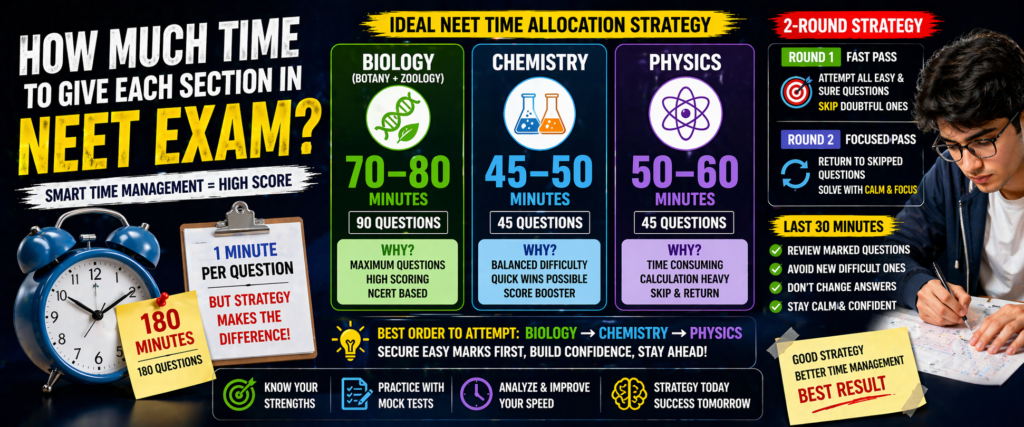
This means you roughly get 1 minute per question, but not all subjects should be treated equally.
The Ideal NEET Time Allocation Strategy
A smart NEET time allocation strategy is based on difficulty and scoring potential—not equal division.
Recommended Time Split:
| Section | Time Allocation | Reason |
|---|---|---|
| Biology | 70–80 minutes | Maximum questions, high scoring |
| Chemistry | 45–50 minutes | Balanced difficulty |
| Physics | 50–60 minutes | Time-consuming, calculation-heavy |
This distribution ensures you maximize marks while avoiding pressure in difficult sections.
Why Biology Should Get the Most Time
Biology has 90 questions and is the most scoring section. A strong NEET time allocation strategy always prioritizes Biology because:
- Questions are mostly NCERT-based
- Less calculation required
- Higher accuracy possible
If you rush Biology, you risk losing easy marks.
Chemistry: The Balance Section
Chemistry sits between Biology and Physics in terms of difficulty.
Your NEET time allocation strategy for Chemistry should focus on:
- Quick wins (Inorganic, Organic memory-based)
- Controlled solving (Physical Chemistry numericals)
Avoid spending too long on one question.
Physics: The Time Trap
Physics is where most students struggle with time. Without a proper NEET time allocation strategy, this section can consume too much time.
The key is:
- Solve easy and direct questions first
- Skip lengthy calculations initially
- Return later if time allows
Do not let Physics disturb your entire paper flow.
The Best Order to Attempt Sections
Your sequence also matters as much as time allocation.
Most effective order:
Biology → Chemistry → Physics
Why this works:
- You start with your strongest section
- Confidence builds early
- You secure maximum marks first
Some students prefer Chemistry first, but starting with Physics is usually risky unless you are very strong in it.
Time Management Inside Each Section
Your NEET time allocation strategy should not just be section-wise, but also within sections.
Follow this approach:
- First round: Attempt all easy questions quickly
- Second round: Solve moderate questions
- Final round: Try difficult ones (if time remains)
This ensures you don’t miss easy marks.
The 2-Round Strategy (Highly Effective)
Instead of solving everything in one go, use a layered approach:
Round 1 (Fast Pass):
- Attempt only sure questions
- Skip doubtful ones immediately
Round 2 (Focused Pass):
- Return to skipped questions
- Solve with calm thinking
This method improves both speed and accuracy.
Biggest Time Management Mistakes
Even with a plan, students often fail due to poor execution.
Common errors:
- Spending too long on one question
- Trying to solve everything in one go
- Not skipping tough questions
- Panicking in the last 30 minutes
A strong NEET time allocation strategy is about control, not speed alone.
Last 30 Minutes Strategy
This is where ranks are decided.
In the final 30 minutes:
- Do not start new tough questions
- Focus on revisiting marked ones
- Avoid changing answers without strong reason
- Maintain calmness
Most students lose marks here due to panic.
Final Answer: NEET Time Allocation Strategy
Here is the practical, no-confusion answer:
- Biology → 70–80 minutes
- Chemistry → 45–50 minutes
- Physics → 50–60 minutes
Follow Biology → Chemistry → Physics sequence.
Use a 2-round approach.
Skip early, return later.
Do not try to solve everything at once.
Final Thought
Your NEET time allocation strategy is not just about dividing minutes—it’s about making smart decisions under pressure.
Students who manage time well:
- Attempt more accurate questions
- Avoid panic
- Finish the paper confidently
And that’s exactly what turns a good score into a great one.
FAQ
What is the best NEET time allocation strategy?
Biology 70–80 min, Chemistry 45–50 min, Physics 50–60 min.
Which section should I attempt first?
Biology is the safest starting point for most students.
How to manage time in Physics?
Solve easy questions first and skip lengthy ones initially.
Should I attempt questions in order?
No, attempt easy ones first and come back to difficult ones.
How to avoid running out of time in NEET?
Follow a 2-round strategy and avoid getting stuck on one question.