
It’s one of the most frustrating experiences in NEET preparation. At home, questions feel manageable. You solve numericals, understand concepts, and your confidence builds. But the moment you enter a mock test or the actual exam, everything changes. Questions feel harder, mistakes increase, and your score drops. This gap is not random—it is driven by a set of predictable NEET Physics exam mistakes that most students don’t even realize they are making.
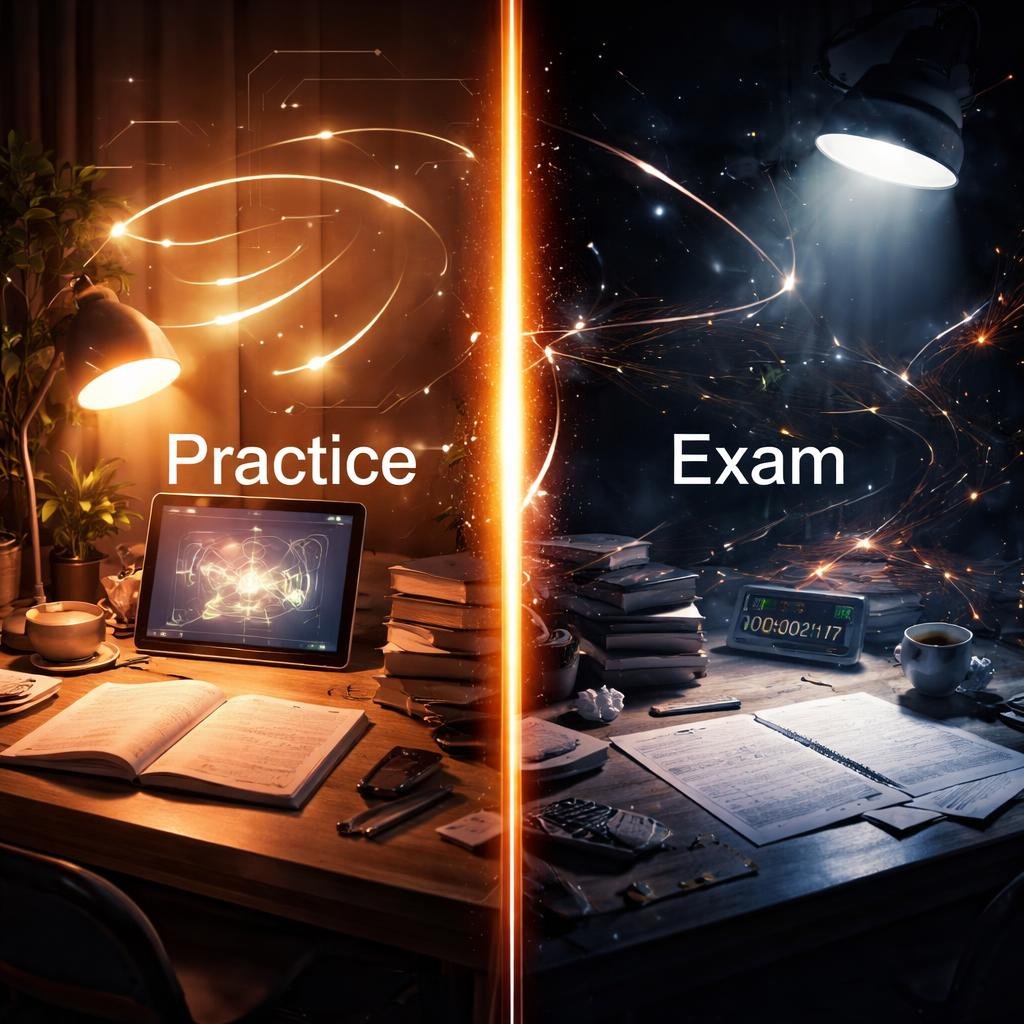
The Illusion of “Home Practice Confidence”
At home, the environment is controlled. You have:
- No strict time pressure
- Freedom to pause and think
- Access to hints, notes, or solutions
This creates a relaxed problem-solving environment. You are not just solving—you are learning while solving. That’s why accuracy appears high.
But NEET is not a learning environment. It is a performance environment. And many NEET Physics exam mistakes happen because students fail to transition from learning mode to performance mode.
The Real Difference: Learning Mode vs Exam Mode
When you solve at home, your brain operates in exploration mode. You try, adjust, re-check, and eventually arrive at the answer. In the exam, your brain must operate in decision mode. You have limited time, no external help, and no room for trial-and-error.
This shift exposes hidden weaknesses:
- Slow concept identification
- Weak time management
- Over-reliance on step-by-step solving
These are not visible during home practice, but they become critical in the exam. This is why many NEET Physics exam mistakes are not about knowledge—they are about execution.
Why You Make More Mistakes in Exams
The increase in errors during exams is not accidental. It is driven by specific factors.
Time Pressure
When time is limited, students rush. This leads to:
- Skipping steps
- Calculation errors
- Misreading questions
Cognitive Load
In exams, your brain processes multiple things simultaneously—time, accuracy, selection of questions. This overload reduces clarity.
Stress and Anxiety
Even mild stress reduces recall efficiency and increases impulsive decisions, leading to avoidable NEET Physics exam mistakes.
Lack of Decision Strategy
Many students attempt questions randomly without a clear plan, wasting time on difficult questions and rushing easy ones.
The “Overthinking” Trap
Another major reason students fail in exams despite solving well at home is overthinking.
At home, you trust your approach. In the exam, you start doubting:
- “Is this too easy?”
- “Am I missing something?”
This leads to:
- Changing correct answers
- Adding unnecessary steps
- Wasting time
Overthinking is one of the most subtle yet damaging NEET Physics exam mistakes, because it turns correct thinking into incorrect results.
The Accuracy Illusion
Students often believe they are accurate because they solve correctly at home. But this accuracy is misleading because:
- They take more time
- They cross-check multiple times
- They correct mistakes during solving
In the exam, none of these are possible.
So what feels like high accuracy is actually slow, assisted accuracy, not exam-ready accuracy. This gap is rarely noticed until performance drops.
The Missing Skill: Fast Concept Recognition
One of the biggest differences between average and high scorers is how quickly they identify the concept behind a question.
At home, you can take time to figure it out. In the exam, you must recognize it instantly.
If this skill is weak:
- You waste time understanding the question
- You apply wrong approaches
- You get stuck mid-solution
Improving this alone can reduce a large number of NEET Physics exam mistakes.
Why Mock Tests Don’t Always Fix This
Many students assume that giving more mocks will solve the problem. But mocks only help if used correctly.
If you:
- Focus only on marks
- Don’t analyze mistakes
- Don’t change your approach
then the same NEET Physics exam mistakes repeat.
Mock tests are not a solution by themselves—they are a tool for correction.
The Role of Decision-Making
NEET Physics is not just about solving—it is about choosing what to solve and when.
Poor decisions lead to:
- Attempting difficult questions first
- Ignoring easy scoring opportunities
- Losing time balance
Strong decision-making reduces pressure and improves accuracy.
This is a key part of avoiding NEET Physics exam mistakes.
How to Bridge the Gap Between Home and Exam
To fix this issue, your preparation must simulate exam conditions.
You need to:
- Practice with strict time limits
- Avoid using hints during solving
- Train quick concept recognition
- Analyze every mistake deeply
This builds exam-ready thinking, not just conceptual understanding.
The Confidence Shift
When you start preparing in exam mode, your confidence changes. You no longer rely on comfort—you rely on performance.
This reduces:
- Panic
- Overthinking
- Unnecessary mistakes
And your accuracy becomes stable, not situational.
Final Insight
The difference between solving at home and performing in NEET is not about knowledge—it is about execution under pressure.
If you keep practicing in a relaxed environment, you will keep facing the same problem in exams.
You don’t fail in the exam because you don’t know Physics.
You fail because of avoidable NEET Physics exam mistakes in execution.
And once you start preparing for performance instead of comfort, this gap disappears.
FAQs
Why do I solve Physics questions correctly at home but not in exams?
Because home practice lacks time pressure and decision-making constraints, which are critical in exams.
What are common NEET Physics exam mistakes?
Misreading questions, calculation errors, poor time management, and overthinking.
How can I reduce mistakes in NEET Physics exam?
Practice under timed conditions, analyze errors, and improve concept recognition speed.
Are mock tests enough to fix this issue?
Only if you analyze them properly and adjust your strategy based on mistakes.